
|
Forex Forums | ForexLasers.com |
|
|||||||
 |
|
|
LinkBack | Thread Tools | Search this Thread |
|
#481
 30-10-2025, 19:59
|
||||
|
||||
 Re: HFMarkets (hfm.com): Market analysis services.
Date: 30th October 2025.
Alphabet Leads Tech Gains as US–China Deal Lifts Market Sentiment. Trading Leveraged products is Risky Investors have plenty to digest this week, with volatile earnings results, interest rate cuts, and hawkish comments from central banks. The Federal Reserve and Bank of Japan have announced their interest rate decisions and held press conferences. In addition, tech giants including Alphabet, Microsoft and Meta have released their quarterly earnings reports. Some aspects of the latest developments have been positive, while others have been negative. As a result, most asset classes have experienced mixed price movements. However, the main factor driving optimism is the trade agreement between the US and China. US-China Trade Agreement US President Donald Trump’s tour of Asia which is drawing to a close. Before returning to the US, President Trump met with Chinese President Xi Jinping at Busan Airport amid heightened tensions over tariffs, TikTok, and rare earth minerals. Political analysts have expressed optimism about the outcome of the meeting and comments made from both sides. President Xi stated that the two countries had reached an agreement to resolve ‘major trade issues.’ China has agreed to pause new rare-earth export restrictions for one year, with annual reviews planned. Trump said the issue is ‘settled’ for now, while China has also resumed purchases of US soybean, signaling a renewal in agricultural trade. Maintaining stability is now the main priority, as past periods of trade optimism have often been followed by renewed tariffs and tensions. This development is having a positive impact on the market’s risk appetite. This is reflected in the VIX index, which is trading 1.50% lower, and the Put/Call Ratio, which has again declined towards the 0.60 level. However, technical analysts warn that if the Put/Call Ratio falls below 0.60, the stock market may experience profit-taking and resistance. Earnings Reports Investors had been eagerly awaiting for the earnings reports from major technology companies. In the first half of the year, the NASDAQ experienced a market decline of 26% and within six months recovered only 6-7%. The index was lagging behind Asian and European stocks with most investors suggesting that the US market required stronger bullish catalysts-potentially from earnings results. On Wednesday, after market close, Microsoft, Alphabet and Meta released their third-quarter earnings reports. The main takeaways are as follows: Microsoft stocks Fall 3.95% After Earnings Release-the company’s revenue and earnings per share were slightly above expectations but not enough to significantly boost demand. Microsoft’s record $35 billion AI spending raised concerns over margins, while its forecast of persistently high costs unsettled investors. Alphabet stocks rise 6.70% After Earnings Report-the company's revenue was higher than predictions set by analysts. The Earnings per share came in 7% higher than previous forecasts. Meta stocks fall 7.40% After Earnings Report-the company was unable to beat earnings and revenue expectations. However, the main concern for investors was that tax-related charges reduced earnings and the company warned that expenses would increase in 2026. The standout performer was Alphabet which not only impressed with beating earnings expectations but also through user growth. Alphabet reported record quarterly revenue of $102.3 billion, up 16% year on year and above expectations, driven by growth in its Cloud and YouTube divisions. The company’s record $91–93 billion in capital spending highlights its aggressive investment in AI infrastructure. NASDAQ (US100)-Technical Analysis 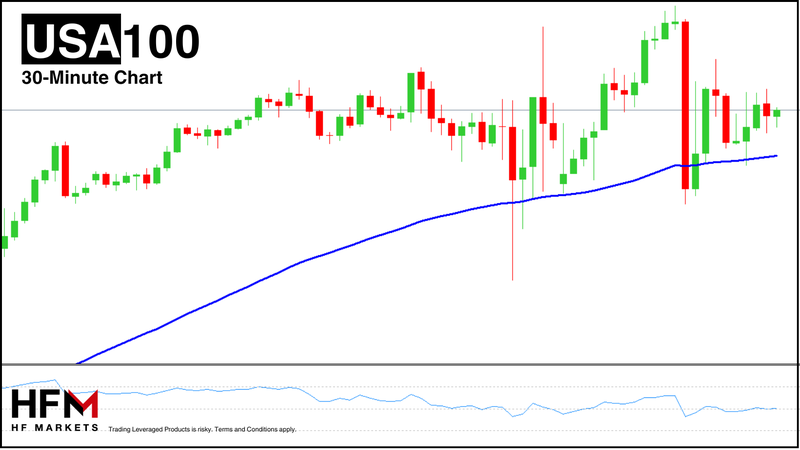 NASDAQ (USA100) 30-Minute Chart During the US trading session the NASDAQ experienced three major price waves on the shorter timeframes. The first when the Federal Reserve confirmed its decision to cut rates by 0.25% which triggered a brief decline. The price quickly recovered but then fell again as Jerome Powell’s press conference was more hawkish than markets had anticipated. The index later rebounded following the announcement of Alphabet’s earnings report, which drove the price to a new all-time high. The key support level can be seen at $25,929.30 and the resistance level at $26,287.65. Although the index was unable to maintain its bullish impulse wave momentum, it has remained above key technical levels and the VWAP. Key Takeaways: * Markets remain volatile as investors react to earnings results, rate cuts, and hawkish central bank commentary. * The new US-China trade agreement boosts global risk appetite, easing tensions over tariffs and rare-earth exports. * Alphabet leads technology gains with strong earnings and record AI investment, while Microsoft and Meta stocks decline. * The NASDAQ reaches a new all-time high after Alphabet’s results, supported by optimism despite mixed market sentiment. Always trade with strict risk management. Your capital is the single most important aspect of your trading business. Please note that times displayed based on local time zone and are from time of writing this report. Click HERE to access the full HFM Economic calendar. Want to learn to trade and analyse the markets? Join our webinars and get analysis and trading ideas combined with better understanding of how markets work. Click HERE to register for FREE! Click HERE to READ more Market news. Michalis Efthymiou HFMarkets Disclaimer: This material is provided as a general marketing communication for information purposes only and does not constitute an independent investment research. Nothing in this communication contains, or should be considered as containing, an investment advice or an investment recommendation or a solicitation for the purpose of buying or selling of any financial instrument. All information provided is gathered from reputable sources and any information containing an indication of past performance is not a guarantee or reliable indicator of future performance. Users acknowledge that any investment in Leveraged Products is characterized by a certain degree of uncertainty and that any investment of this nature involves a high level of risk for which the users are solely responsible and liable. We assume no liability for any loss arising from any investment made based on the information provided in this communication. This communication must not be reproduced or further distributed without our prior written permission. 
|
|
#482
31-10-2025, 13:23
|
||||
|
||||
|
Re: HFMarkets (hfm.com): Market analysis services.
Date: 31st October 2025.
Meta Sell-Off Drags S&P 500 Lower, Could Friday Bring a Rebound? Trading Leveraged products is Risky The US Dollar Index rose to a three-month high, while the S&P 500 struggles as investors digest the latest earnings reports. Apple and Amazon's earnings per share exceeded expectations, but will Meta’s stocks halt demand? The S&P 500 has fallen for two consecutive days despite earnings while the NASDAQ continues to show bullish trends. Earnings data supported growth on Thursday, aided by Netflix’s latest announcement. S&P 500-Earnings Reports, AI Ventures, and Stock Splits 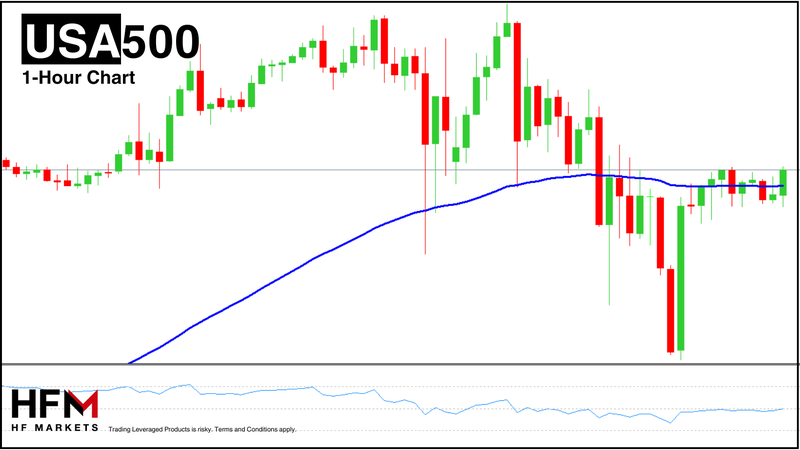 S&P500 1-Hour Chart Meta and Alphabet stocks were one of the key reasons why the S&P 500 fell on Thursday. During the Asian session, Alphabet’s stocks rose almost 8% providing early support for the S&P 500. However, during the European and US session the stock lost momentum and ended the day only 2.45% higher. For this reason, the alphabet’s strong earnings report had limited impact on demand even though it significantly improved sentiment. Furthermore, Meta stocks, which fell more than 11% were the main contributors to the S&P 500 ending the day 0.35% lower. Regarding Meta, the market is struggling to absorb the level of expenses that the company is facing, particularly in relation to AI, taxes, and penalties. According to Meta’s CEO, the company is looking to significantly invest in AI and expenses in the next 2 years are likely to rise. Overnight, Meta also announced that the company will issue $30 billion in corporate bonds to fund its expansion into AI. The stock is trading 1.20% higher during this morning’s Asian session, however, Meta’s performance will depend on whether the company can convince investors that the ‘venture’ can be successfully monetised. Amazon is this morning’s best-performing stock after the company beat its earnings expectations. Amazon stocks, which are the 5th most influential within the S&P 500, are trading 13% higher this morning. In addition to this, Apple is also trading slightly higher (2.35%) after beating both earnings and revenue expectations. Apple’s earnings per share came in at $1.85, $0.21 higher than the same period last year. Lastly, Netflix stocks, which have fallen more than 9% in the past month following its earnings report, are regaining momentum this morning. The stock has risen more than 3% as the company is announcing a 1-for-10 stock split to lower the stock price from $1,089 to $108. The company has stated that the move aims to make the stock more attractive to employees and retail investors. Reports also suggest that Netflix is considering acquiring Warner Bros Discovery, though this has not yet been confirmed. US Dollar Strength-Are The Fed Bluffing? The US Dollar Index has risen for three consecutive days as the Federal Reserve adopted a more hawkish tone. Investors should note that the Federal Reserve was not necessarily ‘hawkish’, the central bank remains ‘dovish’. However, the comments made were simply not as ‘dovish’ as the markets had hoped. As a result, the US Dollar Index rose higher, particularly as one of its main competitors, the Japanese Yen, fell due to monetary policy weakness. 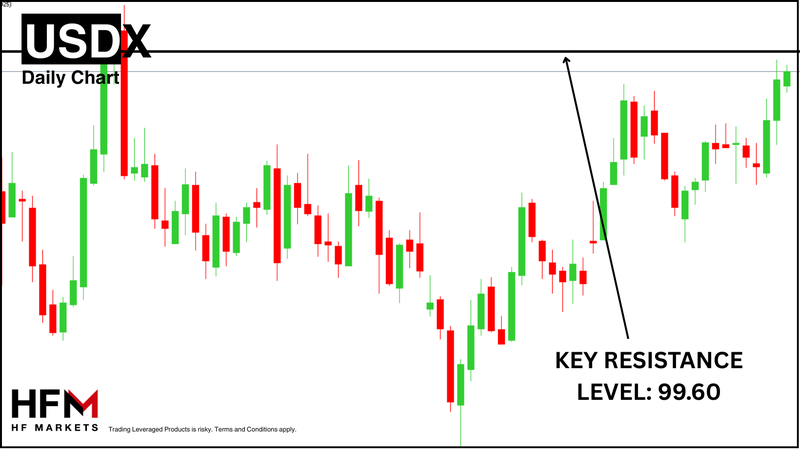 US Dollar Index Daily Chart Ten members of the Federal Open Market Committee (FOMC) voted to ease monetary policy, while two opposed the move. Board member Stephen Miran supported a larger 50-basis-point cut, whereas Kansas City Fed President Jeffrey R. Schmid preferred to keep rates unchanged amid persistent inflation concerns. Following the meeting, Federal Reserve Chair Jerome Powell suggested the Fed may pause further policy changes in December, despite investor expectations for another rate cut before year-end. Powell noted that many FOMC members believe it is important to pause and assess economic conditions before easing further. His comments disappointed markets, and the CME FedWatch Tool now shows that the probability of a December rate cut has fallen from 90% to 67%. Therefore, a cut is still likely, but is not guaranteed as previous thought. The US Dollar has been this week’s best-performing currency followed by the Australian Dollar. The worst performers so far are the British Pound and Japanese Yen. Key Takeaways: * The US Dollar Index hit a three-month high as the Federal Reserve hinted at a possible policy pause in December. * The S&P 500 fell for a second day, pressured by Meta’s 11% decline despite strong results from Apple and Amazon. * Meta plans to issue $30 billion in bonds issuance to fund AI expansion, though investors remain sceptical about its profitability. * Amazon surged 13% and Apple rose 2.35% after both companies beat earnings expectations. * Netflix gained 3% after announcing a 1-for-10 stock split aimed at attracting retail investors and employees. Always trade with strict risk management. Your capital is the single most important aspect of your trading business. Please note that times displayed based on local time zone and are from time of writing this report. Click HERE to access the full HFM Economic calendar. Want to learn to trade and analyse the markets? Join our webinars and get analysis and trading ideas combined with better understanding of how markets work. Click HERE to register for FREE! Click HERE to READ more Market news. Michalis Efthymiou HFMarkets Disclaimer: This material is provided as a general marketing communication for information purposes only and does not constitute an independent investment research. Nothing in this communication contains, or should be considered as containing, an investment advice or an investment recommendation or a solicitation for the purpose of buying or selling of any financial instrument. All information provided is gathered from reputable sources and any information containing an indication of past performance is not a guarantee or reliable indicator of future performance. Users acknowledge that any investment in Leveraged Products is characterized by a certain degree of uncertainty and that any investment of this nature involves a high level of risk for which the users are solely responsible and liable. We assume no liability for any loss arising from any investment made based on the information provided in this communication. This communication must not be reproduced or further distributed without our prior written permission.
|
|
#483
03-11-2025, 10:34
|
||||
|
||||
|
Re: HFMarkets (hfm.com): Market analysis services.
Date: 3rd November 2025.
Global Markets Open November with Optimism Amid Key Central Bank Decisions and Data Releases. Trading Leveraged products is Risky Global markets began the week on a positive note, with investors aiming to extend October’s rally into November. As fresh central bank decisions, key employment data, and PMI data line up across major economies, traders are watching for clues on how monetary policy and global growth will shape the final stretch of 2025. Wall Street Extends October’s Momentum US stock futures climbed early Monday, signalling a continuation of October’s rally. S&P 500 futures gained 0.2%, Nasdaq 100 futures rose 0.3%, and Dow Jones futures added 0.1%. October was a strong month for equities, with the S&P 500 up 2.3%, the Dow rising 2.5%, and the Nasdaq Composite advancing 4.7%. Investors continued to favourgrowth and AI-linked stocks, with Big Tech and the ‘Magnificent Seven’ driving gains. Optimism also improved on signs of easing US-China trade tensions, supporting risk appetite. Washington in Focus as Shutdown Drags On Despite the upbeat start, focus remains fixed on Washington’s political deadlock. The US government shutdown, now entering its fifth week, continues to delay key economic data-including the highly anticipated US jobs report. Meanwhile, the US Supreme Court is preparing to hear arguments on the legality of former President Trump’s tariffs, a case that could shape future trade policy. Earnings season also remains in full swing, with nearly 300 S&P 500 companies having reported Q3 results and over 100 more-including Palantir (PLTR), Super Micro (SMCI), and AMD (AMD)-set to announce this week. 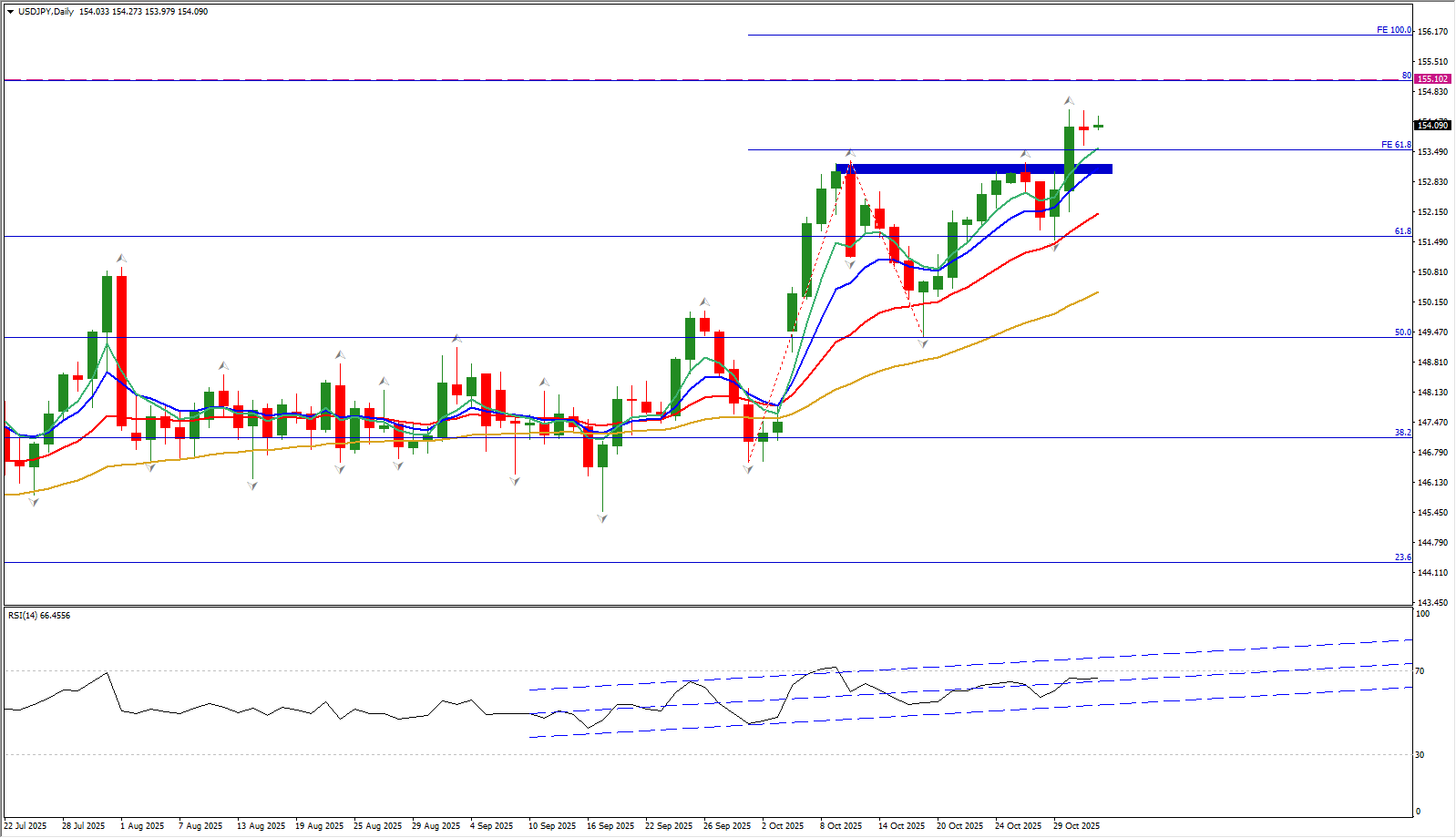 Data-Focused Week Ahead With limited official data available due to the ongoing government shutdown, investors are turning to private-sector surveys for guidance. This week’s highlights include: * Monday: Manufacturing PMI data for the US, Eurozone, UK, and Canada. * Tuesday: Reserve Bank of Australia (RBA) policy decision and New Zealand employment report. * Thursday: Bank of England (BoE) interest rate announcement. * Friday: Canada’s employment figures and US consumer sentiment from the University of Michigan. Meanwhile, several Federal Reserve (FOMC) officials are set to speak, although the lack of fresh data complicates the Fed’s assessment ahead of its December meeting. Several FOMC members are also scheduled to speak, though the ongoing shutdown complicates the Fed’s preparation ahead of its December policy meeting. The upcoming ISM Manufacturing PMI is expected at 49.4, up slightly from 49.1 in September, while the prices index is forecast at 62.4. Although the sector remains in contractionary territory, the modest rise suggests firms are adapting to trade pressures and clearing backlogs. Analysts at Wells Fargo note that while input costs and tariffs continue to weigh on output, the pace of decline is easing, hinting at early signs of stabilisation in US manufacturing. Australia: RBA Expected to Hold Rates as Inflation Still Running Hot The RBA is expected to keep its cash rate steady this week, as policymakers weigh sticky inflation against early signs of a softer labour market. Analysts suggest another rate cut could come as early as February, though this would depend on a further cooling in employment conditions. While inflation remains above the target range, policy is already restrictive, and the central bank is seen continue its easing cycle into next year. Westpac forecasts a 25 bp rate cut in May 2026, followed by additional reductions later in the year, potentially bringing the cash rate down to around 3.10%. Unemployment is projected to rise toward 4.6% by late 2026, with consumer spending expected to weaken if monetary conditions remain tight. New Zealand: Labour Market Loosens Further In New Zealand, employment is expected to grow 0.1% quarter-on-quarter, with the unemployment rate rising modestly from 5.2% to 5.3%. Analysts at Westpac note that while monthly hiring has stabilized, job creation continues to lag behind population growth, creating a slack in the labour market. As a result, wage growth has cooled, aligning more closely with inflation near 2%-a sign that pressures in the job market are gradually easing. United Kingdom: BoE to Keep Cautious Tone The Bank of England is expected to leave rates unchanged at 4.00%, maintaining a careful balance between persistent inflation and signs of resilience in the broader economy. Services inflation remains elevated, even as wage growth cools and the labour market softens. Recent GDP data exceeded expectations, although looming fiscal tightening in the upcoming Autumn Budget (26 November) could weigh on growth and reinforce the disinflationary trend. Markets will closely watch the BoE’s updated forecasts and tone for any hints of a rate cut at the December meeting, though officials are likely to signal patience. 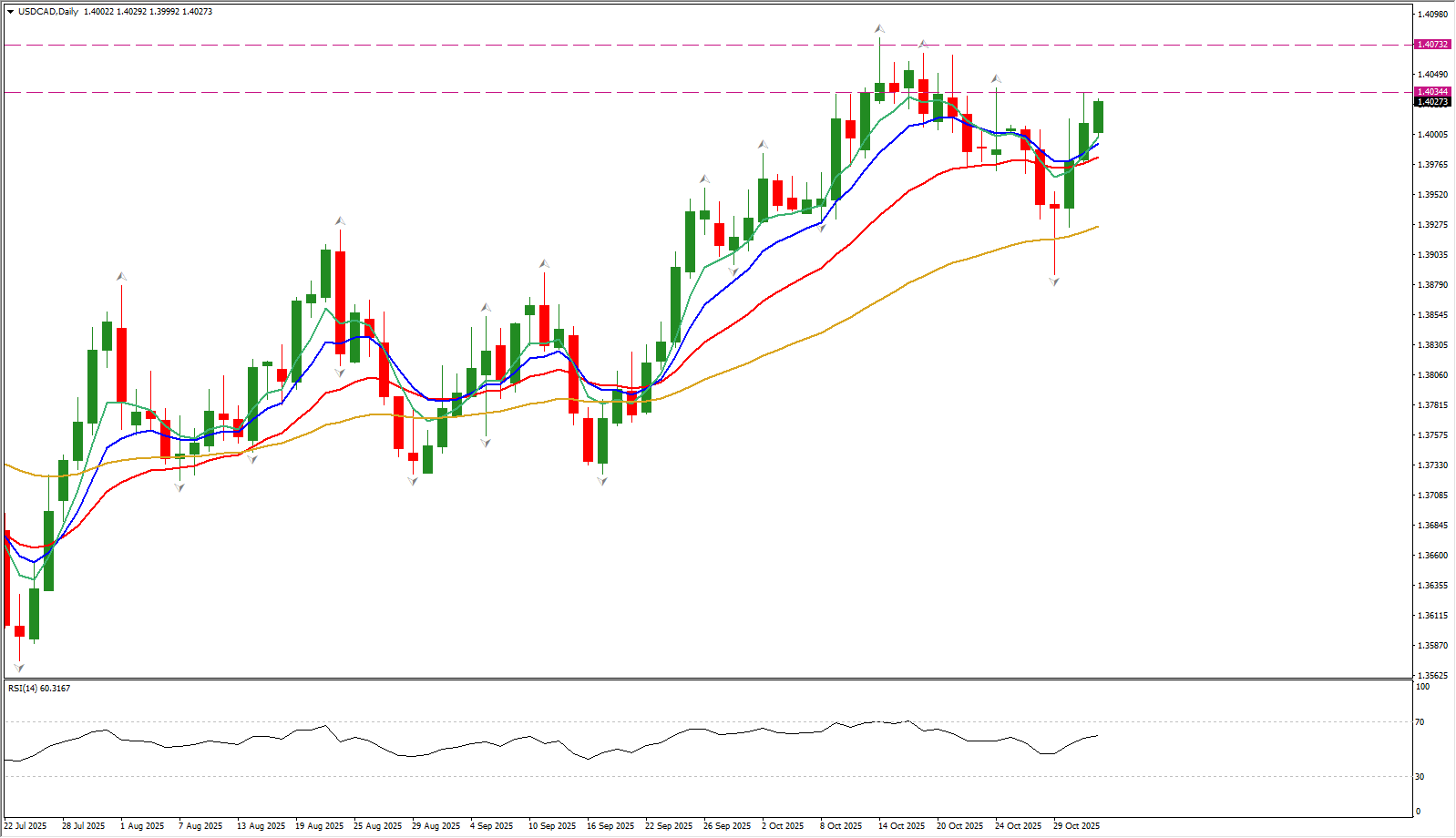 Canada: Job Market Steady Despite Recent Swings Canada’s upcoming jobs report is expected to show a 4,000 decline in employment, following a 60,400 surge in September, with the jobless rate seen ticking up to 7.2%. However, RBC expects a modest gain of around 10,000 jobs, citing stable online job postings and limited layoffs. Job losses have been concentrated in manufacturing and transport, while broader employment remains firm. Despite a surprise GDP dip in August, revisions to prior months suggest the economy remains on track for 0.5% quarterly growth in Q4. Attention will also turn to Tuesday’s federal budget, where potential fiscal measures could provide additional support for growth into 2025. Gold Retreats Below $4,000 After China’s Tax Shift Gold prices slipped below $4,000 per ounce on Monday after China removed a key tax incentive for local retailers. Beijing’s decision, announced Saturday, ends the ability for retailers to offset value-added tax (VAT) on gold purchased from the Shanghai Gold Exchange or Shanghai Futures Exchange. The move triggered a 1% decline in Asian trading, extending gold’s retreat from record highs earlier in October. Despite the correction, gold remains over 50% higher year-to-date, supported by central bank demand and safe-haven flows. ‘China’s tax changes may dent sentiment temporarily,’ said Adrian Ash, Director of Research at BullionVault, ‘but this could offer traders a welcome opportunity for a deeper correction after last month’s spike.’ Outlook The week ahead promises a dense mix of economic releases and central bank decisions that could set the tone for November. With the US government shutdown limiting official data and global policymakers signalling a cautious stance, traders will look to private surveys and corporate earnings for direction. As 2025 enters its final stretch, the market’s ability to sustain October’s optimism may hinge on whether growth remains resilient in the face of policy uncertainty and fading stimulus. Always trade with strict risk management. Your capital is the single most important aspect of your trading business. Please note that times displayed based on local time zone and are from time of writing this report. Click HERE to access the full HFM Economic calendar. Want to learn to trade and analyse the markets? Join our webinars and get analysis and trading ideas combined with better understanding of how markets work. Click HERE to register for FREE! Click HERE to READ more Market news. Andria Pichidi HFMarkets Disclaimer: This material is provided as a general marketing communication for information purposes only and does not constitute an independent investment research. Nothing in this communication contains, or should be considered as containing, an investment advice or an investment recommendation or a solicitation for the purpose of buying or selling of any financial instrument. All information provided is gathered from reputable sources and any information containing an indication of past performance is not a guarantee or reliable indicator of future performance. Users acknowledge that any investment in Leveraged Products is characterized by a certain degree of uncertainty and that any investment of this nature involves a high level of risk for which the users are solely responsible and liable. We assume no liability for any loss arising from any investment made based on the information provided in this communication. This communication must not be reproduced or further distributed without our prior written permission.
|
|
#484
04-11-2025, 08:55
|
||||
|
||||
|
Re: HFMarkets (hfm.com): Market analysis services.
Date: 4th November 2025.
Asian Markets Retreat as Traders Lock in Profits Despite AI Optimism. Trading Leveraged products is Risky Asian shares retreated on Tuesday, tracking losses in US futures, as investors across the region took profits after a strong rally driven by AI-related optimism in global markets. Japan’s Nikkei 225 fell 1.7% to 51,497.20, slipping back after a national holiday and following recent record highs. South Korea’s Kospi dropped 2.4% to 4,121.74, reversing from its own recent rally, while Australia’s S&P/ASX 200 shed 0.9% to 8,813.70. In Greater China, Hong Kong’s Hang Seng Index erased early gains to end 0.6% lower at 25,983.29, and the Shanghai Composite declined 0.4% to 3,960.19, as investors booked profits amid caution over the sustainability of the AI-driven tech surge. Wall Street Mixed as AI Heavyweights Power Gains Overnight, US markets posted mixed results as AI enthusiasm once again lifted major indices. The S&P 500 rose 0.2%, edging closer to last week’s all-time high, while the Nasdaq Composite climbed 0.5%. The Dow Jones Industrial Average, however, slipped 0.5%, or 226 points, reflecting pressure from non-tech sectors. Nvidia remained a dominant force, rising 2.2% to extend its year-to-date gain to 54%. Amazon surged 4% after announcing a $38 billion partnership with OpenAI, under which the AI firm will use Amazon’s cloud infrastructure for its workloads. AI-related momentum also lifted IREN, which jumped 11.5% after securing a $9.7 billion contract with Microsoft that grants access to Nvidia’s chips. Palantir Technologies, up 165% year-to-date prior to earnings, added another 3.3% ahead of its results. Concerns Over Valuations and Earnings Sustainability Despite the ongoing tech rally, analysts are voicing concerns that the AI sector’s valuations may be overheating, drawing comparisons to the dot-com bubble of 2000. Still, corporate results have largely supported the gains-80% of S&P 500 companies have exceeded analysts’ profit forecasts so far, according to FactSet. With two-thirds of quarterly results in, companies in the S&P 500 are on pace for nearly 11% year-on-year earnings growth, keeping investors cautiously optimistic. However, some deals raised eyebrows on Wall Street. Kimberly-Clark plunged 14.6% after announcing the $48.7 billion acquisition of Kenvue, which rallied 12.3% on the news. The transaction has sparked debate about the cost and strategic value of large-cap consumer deals in a tightening economic environment. Economic Headwinds: Manufacturing and Tariff Pressures Economic sentiment was dented by a disappointing US manufacturing report, which showed activity contracting more sharply than expected in October. Several manufacturers cited tariff-related pressures under President Donald Trump’s administration, highlighting the impact of trade policies on input costs. Investors are also growing concerned about delays in key US economic data releases, including the non-farm payrolls report, due to the ongoing government shutdown in Washington. 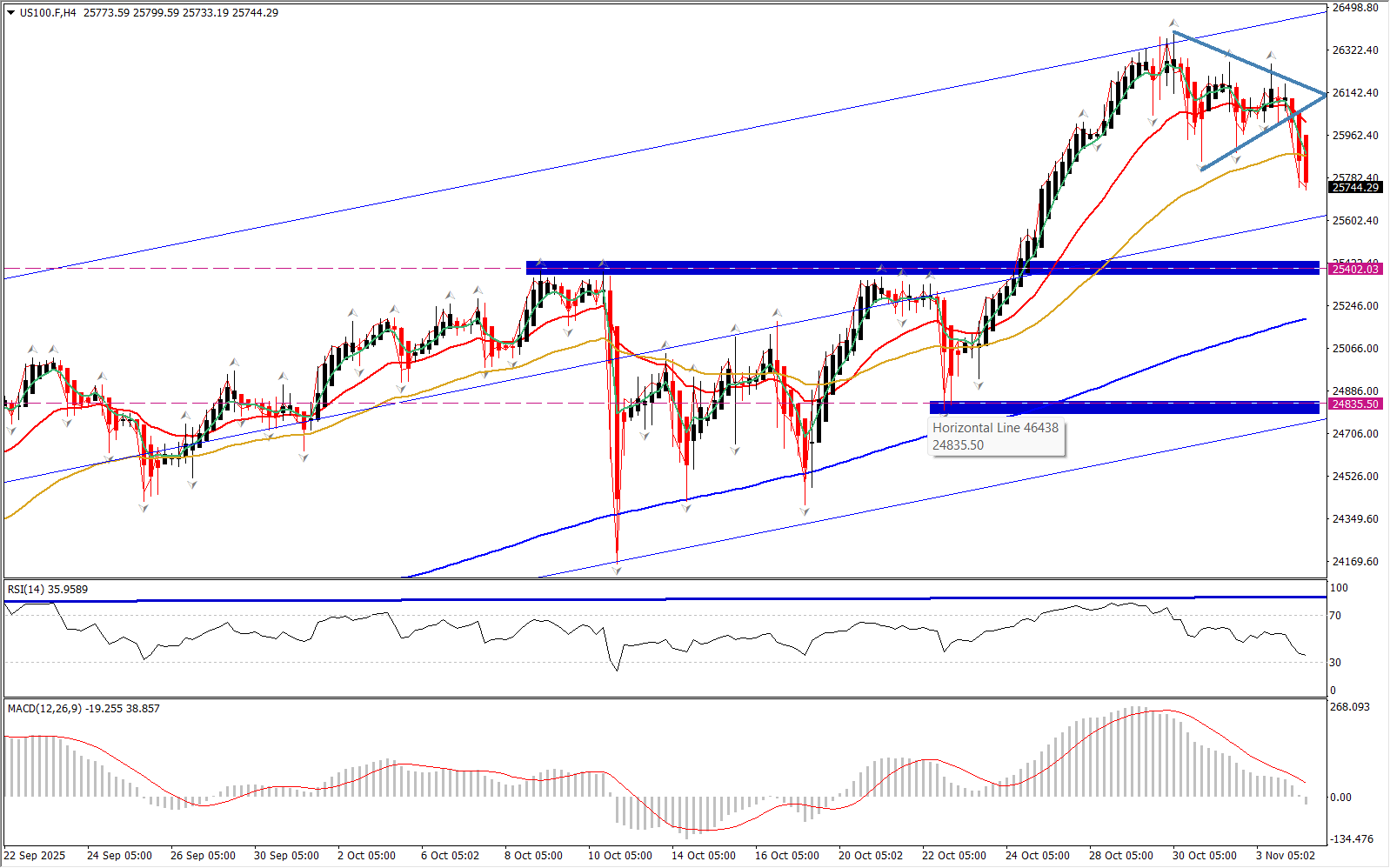 Futures Point to a Lower US Open In early Tuesday trading, US benchmark crude slipped $0.21 to $60.84 a barrel, while Brent crude fell $0.22 to $64.67. The US dollar weakened slightly, trading at 153.64 against the Japanese yen from 154.21 earlier. The euro was marginally softer at 1.1524. Ahead of the New York session, US stock futures signaled weakness, suggesting a cautious open. Dow futures dropped 0.5%, S&P 500 futures fell 0.8%, and Nasdaq 100 futures were down 1.1%, reflecting potential profit-taking after tech’s strong start to the week. As investors digest fresh earnings from AMD, Uber, Spotify, and Supermicro later today, the focus remains squarely on whether AI and cloud-related spending can continue to justify elevated market valuations amid persistent macroeconomic uncertainties. Key Takeaway While the AI revolution continues to drive enthusiasm and lift major US benchmarks, signs of profit-taking in Asia, valuation anxiety, and economic headwinds suggest markets could be entering a period of consolidation. Traders are now watching whether the next wave of corporate earnings, and Washington’s ability to resolve the shutdown, will sustain investor confidence or trigger a broader pullback. Always trade with strict risk management. Your capital is the single most important aspect of your trading business. Please note that times displayed based on local time zone and are from time of writing this report. Click HERE to access the full HFM Economic calendar. Want to learn to trade and analyse the markets? Join our webinars and get analysis and trading ideas combined with better understanding of how markets work. Click HERE to register for FREE! Click HERE to READ more Market news. Andria Pichidi HFMarkets Disclaimer: This material is provided as a general marketing communication for information purposes only and does not constitute an independent investment research. Nothing in this communication contains, or should be considered as containing, an investment advice or an investment recommendation or a solicitation for the purpose of buying or selling of any financial instrument. All information provided is gathered from reputable sources and any information containing an indication of past performance is not a guarantee or reliable indicator of future performance. Users acknowledge that any investment in Leveraged Products is characterized by a certain degree of uncertainty and that any investment of this nature involves a high level of risk for which the users are solely responsible and liable. We assume no liability for any loss arising from any investment made based on the information provided in this communication. This communication must not be reproduced or further distributed without our prior written permission.
|
|
#485
05-11-2025, 10:14
|
||||
|
||||
|
Re: HFMarkets (hfm.com): Market analysis services.
Date: 5th November 2025.
Tech Sell-off and Bitcoin Crash: Is Market Euphoria Finally Cooling? Trading Leveraged products is Risky The global rally in stocks and cryptocurrencies is facing its first serious test in months. Sharp declines in major technology shares and a wave of Bitcoin liquidations have shaken investor confidence, prompting questions over whether markets are simply taking a breather, or signalling something deeper. Tech Stocks Lead the Market Pullback Asian and US markets turned lower this week as technology-heavy indices erased part of their 2025 gains. Seoul and Tokyo exchanges fell nearly 5% from Tuesday’s peaks, while the Nasdaq dropped 2%, with futures pointing to further weakness. The hardest-hit names were those that had led the artificial intelligence boom. Nvidia, once crowned the world’s most valuable company, slid 4%, extending its decline to 7% below last month’s record. Meanwhile, Palantir Technologies dropped 8% despite strong earnings, highlighting just how stretched valuations have become. Fund managers suggest the downturn reflects profit-taking rather than panic, a typical pattern as investors lock in gains ahead of year-end. As Angus McGeoch from Barrenjoey noted, ‘Managers don’t want to give up too much, but if the market rebounds, they’ll be quick to re-enter.’ Even after the decline, the Nasdaq remains over 50% higher since April, suggesting that the broader uptrend is still intact. AI Stocks: Reset or Reality Check? The correction has reignited the debate over whether the AI-driven stock rally has overheated. Wall Street executives, including those from Goldman Sachs and Morgan Stanley, have warned of potential pullbacks after a year of rapid gains. Adding to the caution, South Korea’s regulator issued a standard warning on SK Hynix, which has tripled in a year but has now lost 6% in two days. Saxo Bank’s Charu Chanana called the move ‘healthy,’ adding that a short-term reset is preferable to a larger market unwind later. 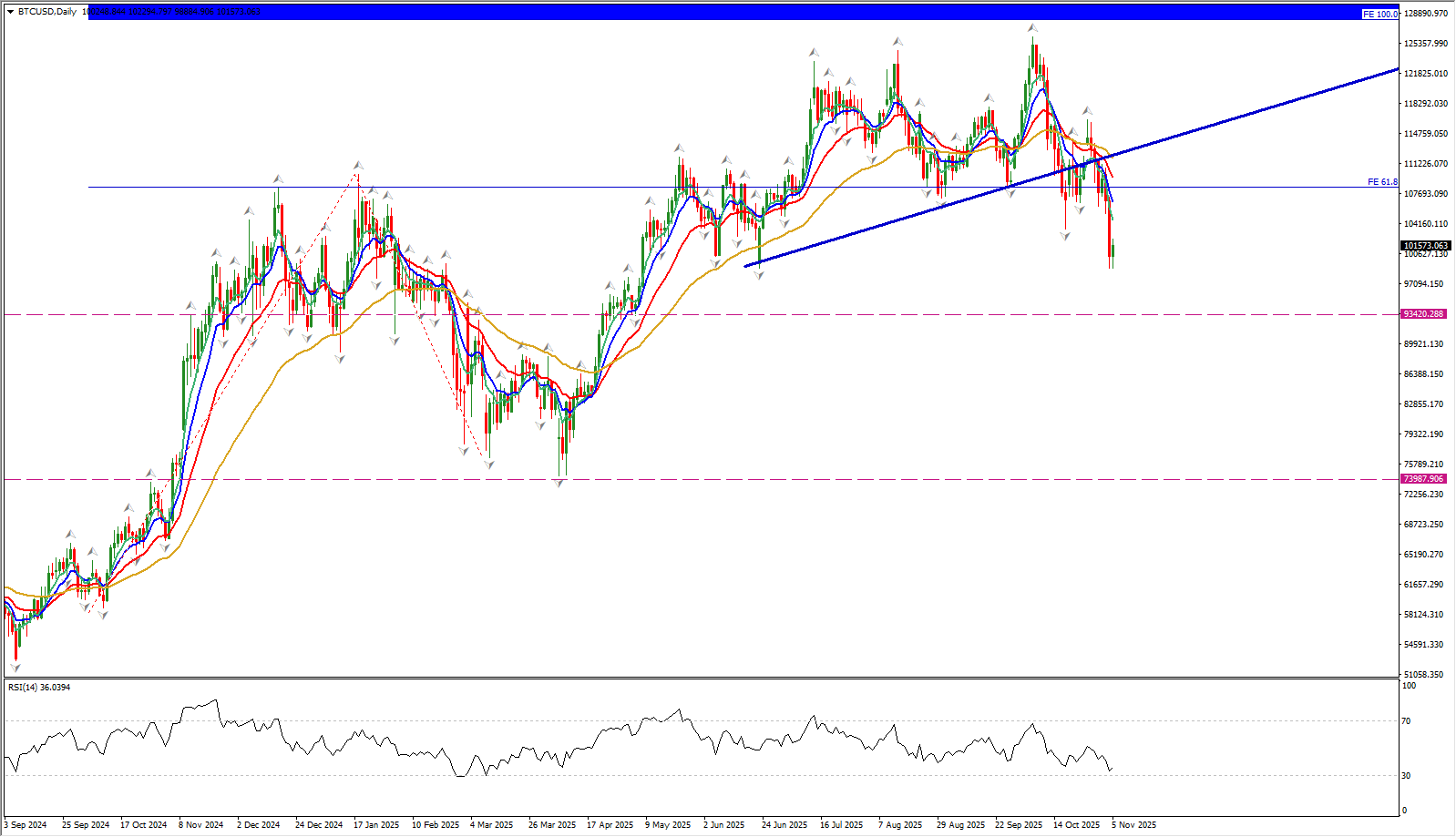 Bitcoin Mirrors the Market’s Mood The cryptocurrency market has followed a similar pattern. Bitcoin (BTC) dropped over 20% from its October record above $126,000, briefly dipping below the $100,000 mark for the first time since June. Long-term holders have liquidated an estimated $41.6 billion in BTC, marking one of the largest sell-offs in recent memory. This wave of selling has been accompanied by mounting pressure on miners, whose profitability has hit its lowest point in months due to rising energy costs and falling rewards. Over $1.3 billion in crypto positions were liquidated in just 24 hours, underscoring the severity of the correction. However, some contrarian investors have stepped in to buy the dip, showing that long-term confidence in Bitcoin remains resilient. Macro Developments: Trade Relief Meets Policy Uncertainty Interestingly, the Bitcoin sell-off coincides with a positive geopolitical development. China’s decision to suspend additional tariffs on US goods for one year has eased trade tensions, removing a major source of market anxiety. However, optimism is tempered by domestic political instability in the US, including a prolonged government shutdown and ongoing uncertainty around future digital asset regulations. These factors have combined to create a highly volatile environment for both equities and cryptocurrencies. Bitcoin and Stock Market Technical Outlook On the charts, Bitcoin’s 50-week simple moving average (SMA) around $102,900 remains a key support level. Historically, this line has acted as a springboard for previous recoveries. A decisive break below $100,000 could open the door towards $94,000 or even $85,000, according to InvestingHaven and Sevens Report analysts. For equities, investors are watching whether the tech sector can stabilise and reassert leadership. If so, the pullback could quickly prove to be a buying opportunity rather than the start of a bear trend. The Bottom Line: A Healthy Pause in an Overheated Market Both the stock and crypto markets are experiencing their first meaningful correction after months of relentless gains. For now, analysts view this as a healthy reset, not a crisis. While uncertainty around regulation, earnings, and policy remains, easing trade tensions and robust long-term trends in AI and blockchain continue to support the broader bullish narrative. In other words, this may not be the end of the rally, just the market catching its breath. Always trade with strict risk management. Your capital is the single most important aspect of your trading business. Please note that times displayed based on local time zone and are from time of writing this report. Click HERE to access the full HFM Economic calendar. Want to learn to trade and analyse the markets? Join our webinars and get analysis and trading ideas combined with better understanding of how markets work. Click HERE to register for FREE! Click HERE to READ more Market news. Andria Pichidi HFMarkets Disclaimer: This material is provided as a general marketing communication for information purposes only and does not constitute an independent investment research. Nothing in this communication contains, or should be considered as containing, an investment advice or an investment recommendation or a solicitation for the purpose of buying or selling of any financial instrument. All information provided is gathered from reputable sources and any information containing an indication of past performance is not a guarantee or reliable indicator of future performance. Users acknowledge that any investment in Leveraged Products is characterized by a certain degree of uncertainty and that any investment of this nature involves a high level of risk for which the users are solely responsible and liable. We assume no liability for any loss arising from any investment made based on the information provided in this communication. This communication must not be reproduced or further distributed without our prior written permission.
|
|
#486
06-11-2025, 18:21
|
||||
|
||||
|
Re: HFMarkets (hfm.com): Market analysis services.
Date: 6th November 2025.
BoE’s Dovish Hold Sets Stage for December Cut as GBPUSD Forms Bearish ‘M’ Pattern. Trading Leveraged products is Risky The Bank of England kept its benchmark rate unchanged at 4.00%, but the decision came through an unusually close 5-4 split vote, with four members already favouring a rate cut. The narrow margin underlines a growing shift within the Monetary Policy Committee (MPC) towards easing policy sooner rather than later, likely as early as December. A Dovish Hold with a Divided Committee The BoE’s policy statement revealed a notably softer tone, acknowledging that inflation risks have become less pressing and that domestic price pressures are easing faster than expected. Governor Andrew Bailey said the outlook is now ‘more balanced,’ though he remains cautious, insisting the Bank needs ‘further evidence’ before moving on rates. Among the nine MPC members, Breeden, Ramsden, Dhingra and Taylor voted for a 25 bps cut, arguing that monetary conditions have become too restrictive amid weakening demand and signs of fading inflation momentum. In contrast, Mann and Pill warned that premature easing could risk inflation persistence, preferring to maintain the current stance. The BoE’s revised guidance, now saying rates are ‘likely to continue on a gradual downward path,’ omitting the previous ‘careful’ qualifier, reinforces expectations for a rate cut in December, especially once the autumn budget passes. GBPUSD Reaction: Up but Off Highs Despite the dovish tilt, GBPUSD initially climbed to 1.31, buoyed by broad USD weakness and expectations that the BoE’s gradual easing path might still offer near-term support to sterling. However, the pair later retreated towards 1.3065, reflecting profit-taking and a shift in risk sentiment following a sharp rise in US job-cut data. US Challenger announced job cuts spiked 153.1k in October following the 54k increase in September. It is the largest gain for an October since 2003. Technology and warehousing led the jump. For the year-to-date, announced layoffs total 1.09k. The y/y pace surged to a 175.3% clip from -25.8% previously. Challenger noted some companies are downsizing after the pandemic boom. But AI, weaker consumer and business spending, and rising costs are factors too. Announced hirings increased 165.8k following September's 115.8k gain. Technology led the way with 250k, followed by retail at 16k. This was the largest October increase since 2003, a stark reminder that AI-driven restructuring and post-pandemic corrections are cooling the job market. The US dollar index (DXY) fell back below 100 following the data. 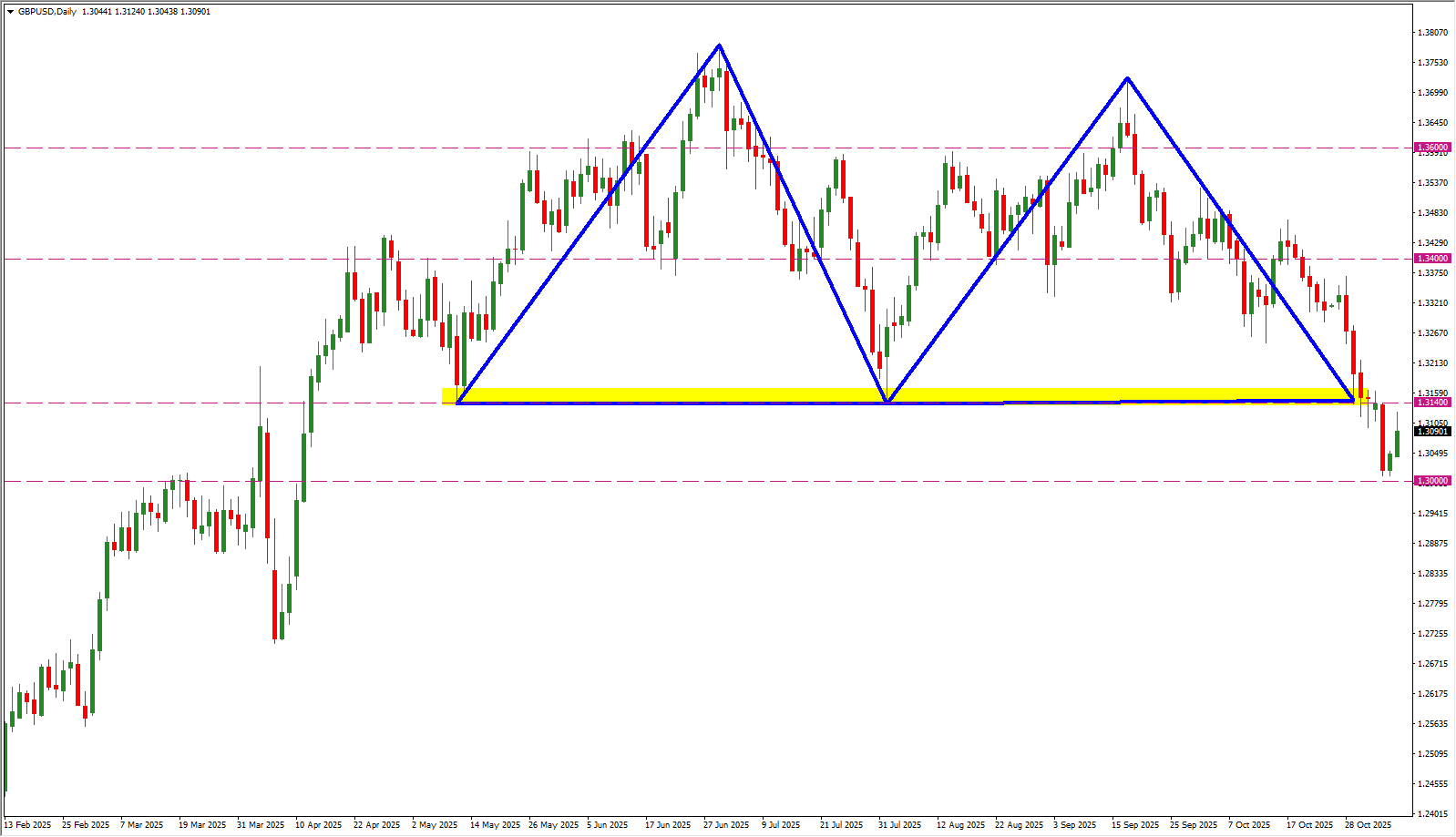 Technical Picture: ‘M’ Formation Points to Potential Downside On the daily chart, GBPUSD has formed a clear ‘M’ formation, a classic double-top pattern signalling the long-term trend exhaustion. The neckline currently sits near 1.3150, and a confirmed continuation below this level could open the door toward the 1.27-1.28 area, especially if market sentiment turns risk-off or if US data support a dollar rebound. For now, the USD seems to have run out of steam. From a risk management perspective, sellers currently hold a better risk-to-reward setup near the 1.3150 resistance and the major downward trendline, aiming to target new lows if the bearish momentum extends below 1.3000. Buyers, on the other hand, will look for a decisive breakout above 1.3140 to gain conviction and potentially extend the pullback toward new highs. GBPUSD Technical Analysis – 4-Hour Timeframe On the 4-hour chart, the price action remains more constrained. The two key resistance zones are still clustered around 1.3140 and 1.3250, where the major descending trendline comes into play. Until a breakout occurs on either side, short-term traders are likely to see choppy consolidation, with intraday momentum dictated by incoming US labour and inflation data. Outlook The BoE’s dovish split marks a turning point for UK monetary policy, signalling that the next move is down, not up. With inflation decelerating and growth subdued, the Bank seems ready to prioritise supporting demand over tightening further. Still, the pound’s direction in the coming weeks will hinge on two key drivers: * The December BoE meeting, confirmation of a cut could accelerate sterling weakness. * US data trajectory, further signs of labour market stress or Fed dovishness could offset sterling downside through a softer dollar. For now, traders will be watching the 1.3050 neckline and 1.3140 resistance closely. A sustained break below the former could validate the M-formation and accelerate bearish momentum, while a rebound above the latter might signal the start of a corrective rally before December’s pivotal BoE decision. Always trade with strict risk management. Your capital is the single most important aspect of your trading business. Please note that times displayed based on local time zone and are from time of writing this report. Click HERE to access the full HFM Economic calendar. Want to learn to trade and analyse the markets? Join our webinars and get analysis and trading ideas combined with better understanding of how markets work. Click HERE to register for FREE! Click HERE to READ more Market news. Andria Pichidi HFMarkets Disclaimer: This material is provided as a general marketing communication for information purposes only and does not constitute an independent investment research. Nothing in this communication contains, or should be considered as containing, an investment advice or an investment recommendation or a solicitation for the purpose of buying or selling of any financial instrument. All information provided is gathered from reputable sources and any information containing an indication of past performance is not a guarantee or reliable indicator of future performance. Users acknowledge that any investment in Leveraged Products is characterized by a certain degree of uncertainty and that any investment of this nature involves a high level of risk for which the users are solely responsible and liable. We assume no liability for any loss arising from any investment made based on the information provided in this communication. This communication must not be reproduced or further distributed without our prior written permission.
|
|
#487
07-11-2025, 19:26
|
||||
|
||||
|
Re: HFMarkets (hfm.com): Market analysis services.
Date: 7th November 2025.
Stocks Struggle Due to US Shutdown and AI fears. Trading Leveraged products is Risky The NASDAQ drops to a 2-week low as investors grow uneasy about high tech valuations during the ongoing US government shutdown. The lack of employment data is also concerning investors, as neither the market nor the Fed are able to appropriately price the market. The US ADP Employment Change is the only employment figure still being made public. The figure rose above expectations and read higher than the previous month. NASDAQ-US Shutdown Creating a Low Risk Appetite The NASDAQ fell by 1.75% on Thursday and is the worst-performing index of the week along with the Nikkei 225. When analysing the individual stocks within the NASDAQ, the downward price movement is not necessarily being caused by large losses. The real damage lies in the limited number of stocks showing gains or even maintaining their value. From the most influential stocks, only 11% rose in value on Thursday. For this reason, analysts can see the price is not being pulled down by a limited number of stocks experiencing high losses but the overall market sentiment. The main concern for the market is the ongoing US shutdown (38 days) which is now the longest in history. In addition to this, investors are concerned that the price is trading very close to all-time highs while significant risks within the market remain. Senate Republicans plan a key vote this afternoon on a funding bill to extend operations beyond November 21st. However, talks remain stalled as Democrats push for renewed health-care subsidies, which Republicans oppose. In addition to the US shutdown, AI is also another concern, particularly after the NVIDIA CEO said in a recent interview that China may win the ‘AI race’ due to lower energy costs and access to materials. AI Doubts & Expenses Pressuring the NASDAQ Rising fears of an AI valuation bubble have sparked sell-offs across major tech stocks. Even strong earnings from companies like Palantir failed to reassure investors, who now question the sustainability of AI-driven growth. Meanwhile, Meta’s soaring AI infrastructure costs have fuelled concerns over low returns and increasing risk. On Thursday, Palantir Technologies fell by 6.85% and AMD fell by 7.25%. The stock which saw the strongest gains was Datadog, which rose by 23% due to strong earnings. However, Datadog stocks only hold a weight of 0.21%. US Supreme Court Hearing on Tariffs Investors are watching the US Supreme Court review of the Republican administration’s trade tariffs. Justices questioned Trump’s authority, noting that the tariffs act as a new tax on businesses and consumers and expand executive power over Congress. The announcement and final decision are likely to create high volatility amongst US stocks and the US Dollar. No ruling has been issued, but Treasury Secretary Scott Bessent said the White House will seek alternative protectionist measures if the decision is negative. NASDAQ (USA100) - Technical Analysis The price of the NASDAQ is now trading at the resistance level which has been flipped into a support. This is a well-known support level. However, if the price does not find support here, the next support level can be found at $24,009, which is almost 5% lower than the current price.  NASDAQ (USA100) 2-Hour Chart On the 2-hour timeframe, the price is trading below the main moving averages and in line with the VWAP. The price is also forming clear lower lows and lower highs. For this reason, technical analysis is pointing towards continued price weakness. However, if the NASDAQ rises above $25,512, the bearish bias starts to fade. Key Takeaways: * NASDAQ falls 1.75% to a 2-week low, driven by weak market sentiment amid the 38-day US government shutdown. * Limited stock gains, not large losses, are causing the downturn; only 11% of the most influential NASDAQ stocks rose on Thursday. * AI concerns and rising infrastructure costs at companies like Meta fuel fears of an AI valuation bubble. * Investors monitor the US Supreme Court tariff review, which could trigger volatility in US stocks and the Dollar. Always trade with strict risk management. Your capital is the single most important aspect of your trading business. Please note that times displayed based on local time zone and are from time of writing this report. Click HERE to access the full HFM Economic calendar. Want to learn to trade and analyse the markets? Join our webinars and get analysis and trading ideas combined with better understanding of how markets work. Click HERE to register for FREE! Click HERE to READ more Market news. Michalis Efthymiou HFMarkets Disclaimer: This material is provided as a general marketing communication for information purposes only and does not constitute an independent investment research. Nothing in this communication contains, or should be considered as containing, an investment advice or an investment recommendation or a solicitation for the purpose of buying or selling of any financial instrument. All information provided is gathered from reputable sources and any information containing an indication of past performance is not a guarantee or reliable indicator of future performance. Users acknowledge that any investment in Leveraged Products is characterized by a certain degree of uncertainty and that any investment of this nature involves a high level of risk for which the users are solely responsible and liable. We assume no liability for any loss arising from any investment made based on the information provided in this communication. This communication must not be reproduced or further distributed without our prior written permission.
|
|
#488
12-11-2025, 18:23
|
||||
|
||||
|
Re: HFMarkets (hfm.com): Market analysis services.
Date: 12th November 2025.
Bitcoin Holds the Line at $100,000: Support or Stall? Trading Leveraged products is Risky After several weeks under selling pressure, Bitcoin seems to be finding its footing. The world’s largest cryptocurrency has paused its decline around the $100,000 level, an area reinforced by the 50-week simple moving average (SMA) and the lower Bollinger Band, two key indicators that often act as major long-term supports. This confluence suggests that BTC’s current range may represent a short-term floor, though momentum remains fragile. On the weekly chart, the Relative Strength Index (RSI) and Stochastic oscillator continue to trend lower, with the latter nearing oversold territory. The MACD also remains deep in negative territory, underlining persistent bearish sentiment. 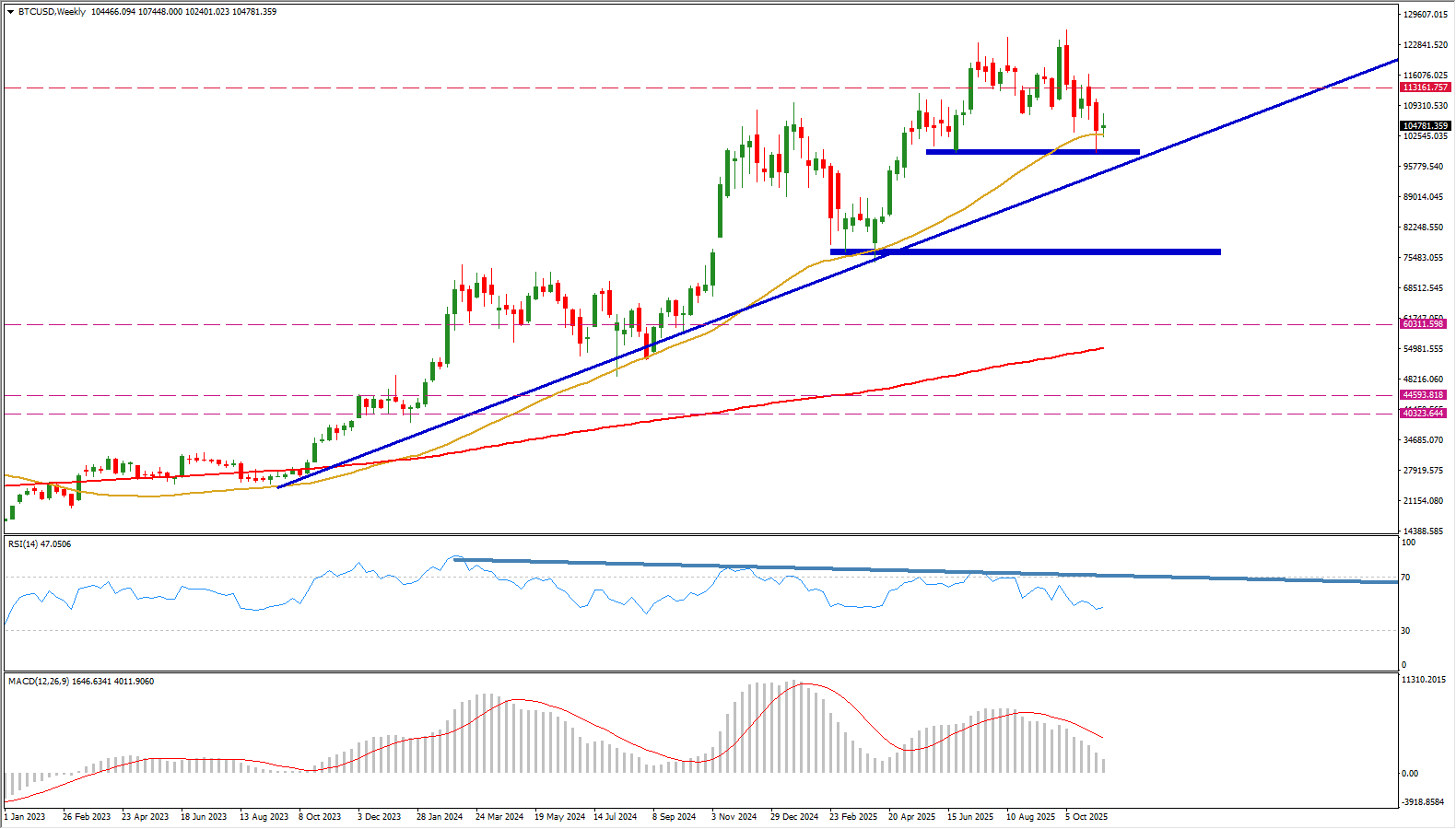 NASDAQ (USA100) 2-Hour Chart Yet, the daily chart shows tentative improvement. The Stochastic has begun recovering from oversold levels, while the RSI edges towards neutral ground. Meanwhile, the MACD lines are nearing a potential bullish crossover, a setup that, if confirmed, could open the door for renewed upside momentum. Key levels to watch: * Support: $104,000 and $100,000 (50-week SMA and lower Bollinger Band) * Resistance: $106,500 and $109,000 Bitcoin appears to be stabilising, but a convincing recovery will require sustained strength above the $109,000-$112,000 area. The Bigger Picture: Can the Bulls Reclaim Control? Bitcoin’s recent pause coincides with a modest recovery in risk appetite, a mix of technical consolidation and cautious macro optimism. Renewed hopes for a US government shutdown lifted crypto alongside equities. Still, this isn’t a story of quick rebounds, it’s about whether the right combination of technical signals, liquidity, and investor sentiment can realign to invite bulls back before year-end. 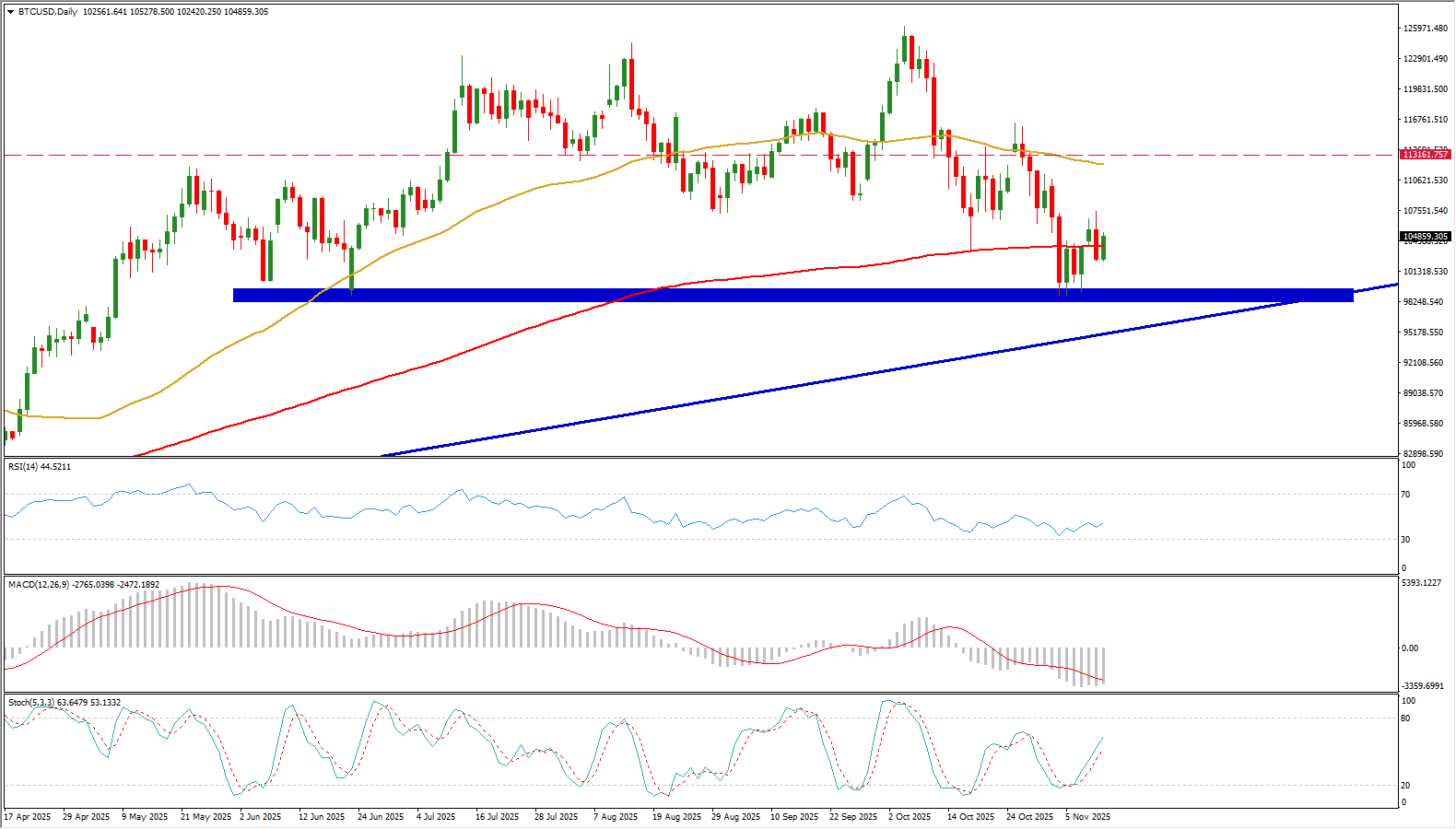 Fundamentals: A Market Catching Its Breath Hovering around the $100,000 psychological level, Bitcoin sits at a crucial point between consolidation and recovery. The short-term holder cost basis near $112,500 marks a key boundary, breaking above it could confirm renewed accumulation. Roughly 71% of BTC supply remains in profit, which historically signals a mid-cycle cooldown rather than a full bear market. Yet momentum has cooled: long-term holders have offloaded more than 300,000 BTC since July, a rare occurrence hinting at fatigue rather than panic. Despite the slowdown, the broader picture remains stable. The Relative Unrealised Loss ratio sits near 3%, suggesting traders remain defensive but not distressed. In essence, traders seem to be hedging exposure rather than exiting positions, a sign of consolidation, not collapse. BTC Market Structure: The Hidden Drivers of Volatility Beyond headlines and price swings, deeper market mechanics are shaping Bitcoin’s recent behaviour. Shifts in funding rates, collateral settings, and ETF hedging activity have become key drivers of short-term volatility. October’s shakeout, which wiped out nearly $19 billion in leveraged positions, underscored how changes in derivatives spreads can move Bitcoin as sharply as any macro event. When basis spreads widen, arbitrage traders tend to buy spot and short futures, reducing exchange supply and lifting prices. When those spreads compress, the unwind has the opposite effect, adding supply and pressure. ETF Flows: Demand Slowly Returns After six consecutive sessions of outflows totalling $660 million, US-listed Bitcoin ETFs have finally flipped back to net inflows, with around $240 million entering the market. While one day of green doesn’t erase a week of red, it signals a possible turning point, the largest institutional buyers may be shifting back to accumulation. ETF flows are now one of the clearest barometers of real demand. A sustained streak of five to ten days of inflows could ease mechanical sell pressure and re-establish a structural bid capable of pushing BTC back above key resistance levels around $112,000-$113,000. Until then, investors remain cautiously optimistic. Liquidity: The Hidden Bullish Catalyst The global liquidity backdrop is quietly becoming more supportive. The world’s broad money supply has climbed to a record $142 trillion, up nearly 7% year-on-year, while signals from the New York Fed suggest that quantitative tightening may soon pause, or even reverse. If central banks maintain looser liquidity conditions, Bitcoin could again act as a magnet for both speculative and institutional capital, mirroring earlier reflation phases when ample cash searched for higher returns in crypto and equities. Holder Activity: Conviction, Not Capitulation Recent headlines about ‘OG whale dumping’ only tell part of the story. On-chain data reveals that much of this movement stems from address upgrades, custody migrations, or collateral use, not mass liquidation. Meanwhile, ETF investors have shown remarkable resilience, holding through a 20% correction without significant withdrawals. The takeaway? Conviction hasn’t disappeared, it’s simply shifting hands, from long-time holders to more structured, institutional participants. As liquidity builds and ETF demand stabilises, Bitcoin’s foundation appears solid, even if sentiment is still recovering. Bitcoin Price Forecast: What’s Next for BTC? The $100,000 level remains a pivotal line in the sand. A decisive bounce from this zone could reinforce confidence among both short-and long-term participants. A confirmed move above $112,000 could open the path toward a broader recovery, possibly testing $120,000–$125,000 by year-end if ETF inflows persist and liquidity expands globally. Conversely, failure to defend the $100,000 level could trigger another retest toward $95,000, where strong historical support lies. For now, Bitcoin’s outlook remains cautiously bullish, supported by solid structural underpinnings but constrained by weak momentum. Traders and investors should continue to watch ETF flows, liquidity indicators, and key resistance levels to gauge whether this is simply a mid-cycle pause or the start of the next Bitcoin uptrend. Always trade with strict risk management. Your capital is the single most important aspect of your trading business. Please note that times displayed based on local time zone and are from time of writing this report. Click HERE to access the full HFM Economic calendar. Want to learn to trade and analyse the markets? Join our webinars and get analysis and trading ideas combined with better understanding of how markets work. Click HERE to register for FREE! Click HERE to READ more Market news. Andria Pichidi HFMarkets Disclaimer: This material is provided as a general marketing communication for information purposes only and does not constitute an independent investment research. Nothing in this communication contains, or should be considered as containing, an investment advice or an investment recommendation or a solicitation for the purpose of buying or selling of any financial instrument. All information provided is gathered from reputable sources and any information containing an indication of past performance is not a guarantee or reliable indicator of future performance. Users acknowledge that any investment in Leveraged Products is characterized by a certain degree of uncertainty and that any investment of this nature involves a high level of risk for which the users are solely responsible and liable. We assume no liability for any loss arising from any investment made based on the information provided in this communication. This communication must not be reproduced or further distributed without our prior written permission.
|
|
#489
13-11-2025, 09:57
|
||||
|
||||
|
Re: HFMarkets (hfm.com): Market analysis services.
Date: 13th November 2025.
US Shutdown Ends, Fed Split on Rate Cuts, and UK Data Weighs on the Pound Trading Leveraged products is Risky The longest government shutdown in the history of the US has officially come to an end. However, even with the shutdown over, today’s inflation report may still be postponed. According to Goldman Sachs, the Bureau of Labor statistics will likely schedule the NFP Employment Change for early next week. Economists and analysts continue to expect the inflation rate to remain at 3%, with employment continuing to weaken. As a result, the stock market continues to rise, while the US Dollar remains unchanged. The price movement is largely due to its impact on interest rates. However, two members of the Federal Reserve officially came out opposing a rate cut in December. As a result, the possibilities of a rate cut fell from 66% to 52% according to the Chicago Exchange. Although many economists continue to advise that the Federal Reserve is still likely to cut rates in December. GBPUSD - Poor Economic Data Continues For the UK The British Pound continues to decline for a third consecutive day, with downward momentum gaining due to further poor data. The UK’s employment data was originally triggering the downward price movement of the week. This includes the UK’s Unemployment Rate rising to 5% and salary earnings falling 0.2% below expectations. However, today’s UK Gross Domestic Product further increases the downward momentum. The UK’s Gross Domestic Product fell from 0.0% to -0.1% and below previous expectations. The GDP expectations, which are also made public by the Office For National Statistics, also fell from 0.3% to 0.1%. Since the announcement at 07:00 (GMT), the price of the Pound fell 0.17%, but has since seen up-and-down volatility. A positive factor for the Pound is Health Minister Wes Streeting de-escalating the latest political tensions. Sources within the Labour Party also reported a possible leadership change, with Health Minister Wes Streeting emerging as a potential candidate. However, Mr Streeting has since advised he has no desire to oust the current UK Prime Minister. The British Pound is the worst performing currency of the week along with the Japanese Yen. The best performing currency remains the Swiss Franc and Australian Dollar. NASDAQ - Cisco Beat Earnings Expectations, But Fed Members Oppose a December Cut The NASDAQ and S&P 500 saw a day marked by contrasting performances between the first and second halves of the day. The NASDAQ rose in value during the Asian and US Sessions but fell during the US session. The decline was largely due to the comments made by two members of the Federal Reserve. Two Federal Reserve officials voiced opposition to another interest rate cut at the December meeting, adding uncertainty to the Fed’s policy outlook. Previously, members had taken a neutral stance or advised that a cut was not certain. However, in recent weeks this is the first time members have outright opposed a rate cut. Comments from Susan Collins, President of the Boston Fed, and Raphael Bostic, President of the Atlanta Fed, indicate the rate-setting committee may be shifting away from what was previously expected to be a third consecutive rate reduction next month. If the Federal Reserve does not cut in December, the NASDAQ could decline between 4-7% according to JP Morgan’s Strategists. 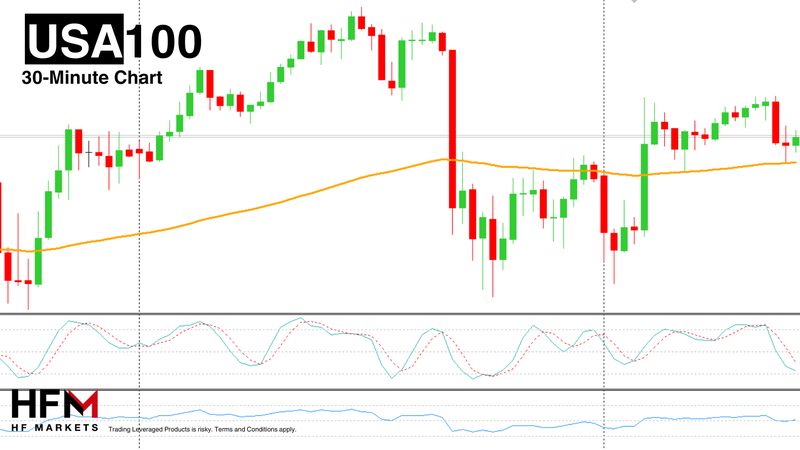 NASDAQ (USA100) 30-Minute Chart A positive factor for the NASDAQ is the end of the US shutdown officially coming to an end as well as the latest positive earnings reports. Last night, Cisco Systems made public their earnings for the 3rd quarter. The company’s revenue beat expectations by $11 million and earnings beat expectations by $0.02. In addition to this, an important factor for shareholders is the company’s forward-guidance figures were significantly higher than previous data. Cisco stocks rose 3.14% on Wednesday and a further 7% after the announcement of the company’s earnings. On Wednesday, 58% of the most influential stocks (weight above 0.50%) rose in value with AMD stocks witnessing the strongest gains (+9.00%). NASDAQ Component Performance - 12th Nov NASDAQ - Technical Analysis Even with the decline during yesterday’s Asian session the price of the NASDAQ remains above most Moving Averages. The price is also trading slightly above the RSI’s neutral level on the 30-minute timeframe. The NASDAQ continues to form higher highs and lows, but has not broken above the resistance level at $25,793.00. The price is almost forming a ‘head and shoulders’ price pattern, which would indicate a downward trend. This is something investors will continue to monitor, and if the price falls below $25,570.00, the ‘head and shoulders’ pattern will become more visible. However, if the price rises above $25,662.20, the pattern and bearish signal will fade, and buy signals will strengthen. Key Takeaway Points: * US government shutdown ends, but key economic reports such as inflation and employment data may still face delays. * Rate-cut expectations fell from 66% to 52% after two Fed officials publicly opposed a December reduction. * Economists and analysts continue to expect the inflation rate to remain at 3%, with employment continuing to weaken. * UK economic data disappoints, with GDP contracting by 0.1% and unemployment rising, pressuring the British Pound further. * Cisco released its Q3 earnings, beating revenue estimates by $11 million and EPS by $0.02, with stronger forward guidance. Cisco’s stocks rose 7.00%. Always trade with strict risk management. Your capital is the single most important aspect of your trading business. Please note that times displayed based on local time zone and are from time of writing this report. Click HERE to access the full HFM Economic calendar. Want to learn to trade and analyse the markets? Join our webinars and get analysis and trading ideas combined with better understanding of how markets work. Click HERE to register for FREE! Click HERE to READ more Market news. Michalis Efthymiou HFMarkets Disclaimer: This material is provided as a general marketing communication for information purposes only and does not constitute an independent investment research. Nothing in this communication contains, or should be considered as containing, an investment advice or an investment recommendation or a solicitation for the purpose of buying or selling of any financial instrument. All information provided is gathered from reputable sources and any information containing an indication of past performance is not a guarantee or reliable indicator of future performance. Users acknowledge that any investment in Leveraged Products is characterized by a certain degree of uncertainty and that any investment of this nature involves a high level of risk for which the users are solely responsible and liable. We assume no liability for any loss arising from any investment made based on the information provided in this communication. This communication must not be reproduced or further distributed without our prior written permission.
|
|
#490
14-11-2025, 10:27
|
||||
|
||||
|
Re: HFMarkets (hfm.com): Market analysis services.
Date: 14th November 2025.
Fed Comments Have Traders Fearing a December Pause! Trading Leveraged products is Risky Doubts continue to grow over the Federal Reserve’s December rate decision impacting both Gold and the stock market. The US shutdown has come to an end, but agencies have not yet released economic data to help investors determine the state of the US economy and employment sector. Economists are now advising that certain data such as the NFP figures for October, may not be released at all. This would make it even more difficult for the Federal Reserve to determine if a rate cut is necessary. Particularly if no extreme figures are seen for November. According to the Chicago exchange, the possibility of a rate cut in December is at 50%, the lowest in over a month. NASDAQ (USA100) - Stock Market Declines The stock market saw its strongest decline of the week yesterday, with the NASDAQ falling by 2.20% and the Dow Jones by 1.65%. The decline is largely being attributed to fears the Federal Reserve will hold interest rates unchanged in December. 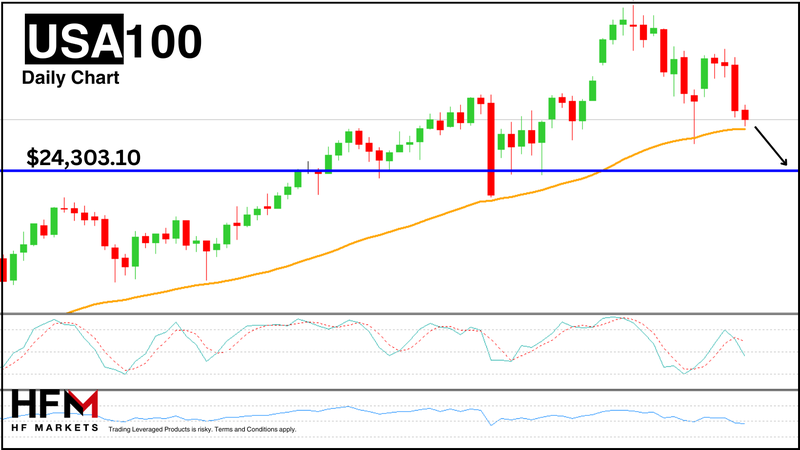 NASDAQ (USA100) - Daily Chart Tech heavyweights also contributed to the decline as investors worried about fewer expected Federal Reserve rate cuts. NVIDIA illustrates this effect clearly. Overall, 84% of the NASDAQ’s most influential stocks fell on Thursday, signalling strong downward momentum. NVIDIA was one of the main drivers as the stock fell 3.58% and is the most influential stock holding the largest weight. NVIDIA also continued to decline on Friday, with the stock trading 0.50% lower during the Asian session. A key factor for NVIDIA and the technology market will be NVIDIA’s earnings report on November 19th. Analysts’ expectations vary, with estimates ranging from $1.17 to $1.23. Some forecast stronger results, while others remain cautious. They also note the figure must exceed expectations by at least 5–6% to boost demand. As per yesterday’s article, a lack of Fed rate cuts may distort the market’s pricing of US indices. In that case, the NASDAQ may continue falling toward $24,303.10. This decline could continue as long as the Fed issues dovish guidance for 2026. If the Federal Reserve takes a more hawkish approach, the decline could potentially be even stronger. However, this is not something which economists are currently indicating. Most economists advise the Federal Reserve will continue to cut, but the frequency is not known. US Dollar Index - Hawkish Fed Comments Unable to Support The Dollar The US Dollar continued to decline on Thursday despite the more hawkish tone from the Federal Open Market Committee. However, there is still some concern over the potential for the Dollar to maintain its value while the Fed lowers rates. Reports from the last 24 hours confirm that European officials are exploring the option of pooling Dollars among non-US central banks. This is being done in order to reduce reliance on US funding mechanisms and the US financial system. 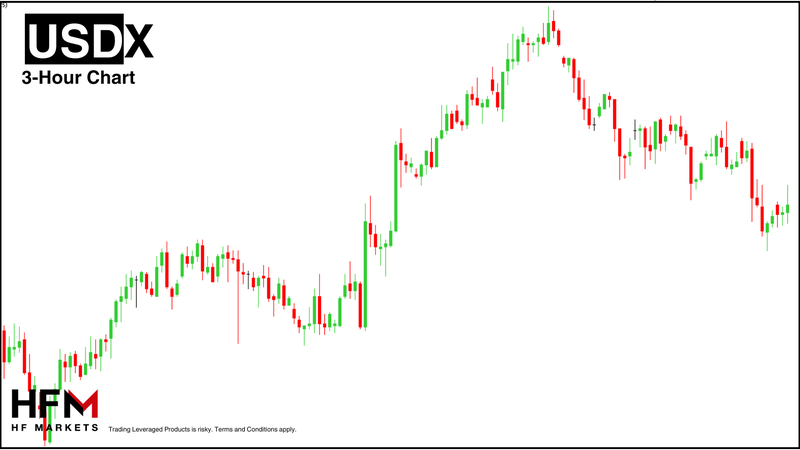 US Dollar Index 3-Hour Chart The hawkish tone from the Federal Reserve does not yet support the US Dollar Index. However, investors will continue to monitor this. Atlanta Fed President Raphael Bostic said he supports holding rates steady until inflation shows clear progress. Boston Fed President Susan Collins agreed that rates should remain unchanged while the labour market stays stable. Collins’ stance is especially notable because she previously voted twice in favour of easing monetary policy, yet now appears more cautious. With these shifting views, a pause in the Fed’s “dovish” cycle in December seems increasingly likely. However, upcoming economic data, set to flow again as the government restarts operations, will play a critical role in shaping officials’ final decisions. Even a modest uptick in inflation, from 3.0% to 3.1%, could prompt the Federal Reserve to adopt a more hawkish position on rate cuts. In such a scenario, the US Dollar may strengthen, while gold and equity markets could face renewed downward pressure. Key Takeaway Points: * Market chances for a December rate cut fell to 50%, the lowest in over a month. Stocks and Gold reacted negatively. If the Fed does not cut in December, the NASDAQ may potentially keep falling toward $24,303.10 * US stocks fell sharply, with NASDAQ down 2.20%, driven by tech heavyweights like NVIDIA. * NVIDIA remains a key market driver, with 19 November earnings needing 5-6% above expectations to boost demand. * US Dollar Index weakened despite hawkish Fed signals; European officials are considering pooling dollars to reduce reliance on the US. Always trade with strict risk management. Your capital is the single most important aspect of your trading business. Please note that times displayed based on local time zone and are from time of writing this report. Click HERE to access the full HFM Economic calendar. Want to learn to trade and analyse the markets? Join our webinars and get analysis and trading ideas combined with better understanding of how markets work. Click HERE to register for FREE! Click HERE to READ more Market news. Michalis Efthymiou HFMarkets Disclaimer: This material is provided as a general marketing communication for information purposes only and does not constitute an independent investment research. Nothing in this communication contains, or should be considered as containing, an investment advice or an investment recommendation or a solicitation for the purpose of buying or selling of any financial instrument. All information provided is gathered from reputable sources and any information containing an indication of past performance is not a guarantee or reliable indicator of future performance. Users acknowledge that any investment in Leveraged Products is characterized by a certain degree of uncertainty and that any investment of this nature involves a high level of risk for which the users are solely responsible and liable. We assume no liability for any loss arising from any investment made based on the information provided in this communication. This communication must not be reproduced or further distributed without our prior written permission.
|
|
#491
17-11-2025, 19:11
|
||||
|
||||
|
Re: HFMarkets (hfm.com): Market analysis services.
Date: 17th November 2025.
The US Reopens. Central Banks Pause. What Happens Next? Trading Leveraged products is Risky Global Markets Outlook: Uncertainty Persists as the US Reopens and Central Banks Hold Steady The US government is officially back in operation, but the shutdown has left a mark. Beyond the drag on fourth-quarter growth, the bigger issue now is the integrity of the economic data. Several key surveys were simply not conducted, meaning policymakers may be navigating with only partial visibility for weeks, possibly until 2026. This uncertainty could cloud the Federal Reserve’s view heading into the 9-10 December FOMC meeting. In the meantime, Fed hawks are taking the lead, arguing for a cautious, wait-and-see stance until the labour market and inflation picture becomes clearer. Elsewhere, central banks are signalling stability, not action. The ECB looks firmly on hold. The BoE’s flexibility is constrained by budget pressures. And in Japan, fiscal and political developments continue to shape the BoJ’s next steps. United States This week will finally bring a wave of US economic data back to the markets, with the delayed September nonfarm payrolls report on November 20 expected to attract the most attention. Yet how insightful these releases will be is another question entirely. The information is now outdated, and the October household employment survey may never be recovered. As a result, markets will be relying on older indicators to piece together the state of the economy. Construction spending, industrial production, factory orders, trade price data, and consumer sentiment will all come through, but the labour market will remain at the center of the debate. Policymakers want to see whether the slowdown in employment is significant enough to justify a rate cut. Hawkish commentary in recent weeks has already pushed expectations lower, with markets now assigning roughly even odds for a cut next month. Our expectation is for nonfarm payrolls to rise by around 40k, following modest gains in previous months. The unemployment rate is likely to hold steady at 4.3%, while wage growth should maintain a monthly pace of 0.3%, keeping the annual rate at 3.7%. Alternative indicators, from jobless claims to ISM employment components, suggest cooling rather than collapsing labour conditions. If data land in line with these expectations, it would strengthen the argument for holding rates steady. This week will also be dominated by a packed Fedspeak calendar. Key policymakers, including Jefferson, Waller, Williams, Kashkari, Barr, Barkin, Logan, and Goolsbee, will be delivering remarks across the week. Their commentary following the jobs report will be particularly important, especially for understanding the direction of the December meeting. The release of the FOMC minutes on Wednesday adds another layer to an already heavy calendar. Canada Canada will release October CPI and retail sales, both of which will be central to shaping expectations for the December 10 Bank of Canada meeting. The economy continues to soften under the weight of global trade pressures, tariffs, and a weakening job market. Inflation has eased, with headline CPI expected to remain slightly above 2% year-over-year, although core inflation is still hovering near 3%. This makes it difficult for the Bank to justify an additional cut without stronger evidence of cooling. Retail sales, which showed a solid increase in August before slipping in September’s advance estimate, will provide further clarity. For now, the odds of either a hold or a cut remain evenly balanced. Eurozone ECB officials continue to stress that current interest rates are appropriate, and upcoming data is unlikely to shift that stance. Markets will focus on the flash HCOB PMI reports, where manufacturing activity is expected to inch slightly above the 50 expansion threshold, while services remain comfortably in growth territory. This combination supports the ECB’s narrative of an economy that is not strong, but still resilient. Inflation should confirm the preliminary reading of 2.1% year-over-year, a figure that aligns closely with the ECB’s target. However, core inflation, and especially services inflation, remains elevated, reinforcing the view that rate cuts are not on the agenda anytime soon. Additional data from Germany, the Eurozone confidence surveys, and French business indicators will offer more insight but are unlikely to alter the overall picture. United Kingdom In the UK, fiscal concerns have re-emerged following reports that Chancellor Reeves abandoned plans to raise income taxes. The decision came after more optimistic debt projections from the OBR, but it has reignited concerns about how the government intends to address a remaining fiscal gap estimated at around GBP 20 billion. Markets reacted nervously, particularly on fears that this uncertainty could limit the Bank of England’s ability to cut rates in December. The November 26 budget will overshadow most other developments this week. Even so, the BoE will be watching the inflation report closely. CPI is expected to ease to 3.6% year-over-year, while core inflation should also decline slightly. Despite remaining above target, the downward trend gives the central bank some room to consider a cut, assuming the budget does not disrupt confidence further. PMI figures are expected to soften, with services activity dipping but still above 50, while manufacturing may slide deeper into contraction. Retail sales will likely reflect the same cautious spending behaviour seen in recent months, with households saving more and spending less. Japan Japan enters an important week with a flood of major economic reports, including GDP, CPI, trade data, production numbers, and machinery orders, arriving ahead of the December 18-19 BoJ meeting. While inflation is expected to remain near the 3% mark, GDP likely contracted sharply by around -2.0%, which supports the argument for keeping policy unchanged. Ongoing uncertainty around fiscal plans under the new Takaichi government adds another reason for a cautious approach. Apart from a few hawkish voices, most policymakers seem in no rush to tighten policy again in the near term. China China’s loan prime rate announcements are also due, although no changes are expected. The PBoC has resisted easing, keeping the one-year and five-year LPRs at 3.00% and 3.50% respectively, levels last trimmed in May. Always trade with strict risk management. Your capital is the single most important aspect of your trading business. Please note that times displayed based on local time zone and are from time of writing this report. Click HERE to access the full HFM Economic calendar. Want to learn to trade and analyse the markets? Join our webinars and get analysis and trading ideas combined with better understanding of how markets work. Click HERE to register for FREE! Click HERE to READ more Market news. Andria Pichidi HFMarkets Disclaimer: This material is provided as a general marketing communication for information purposes only and does not constitute an independent investment research. Nothing in this communication contains, or should be considered as containing, an investment advice or an investment recommendation or a solicitation for the purpose of buying or selling of any financial instrument. All information provided is gathered from reputable sources and any information containing an indication of past performance is not a guarantee or reliable indicator of future performance. Users acknowledge that any investment in Leveraged Products is characterized by a certain degree of uncertainty and that any investment of this nature involves a high level of risk for which the users are solely responsible and liable. We assume no liability for any loss arising from any investment made based on the information provided in this communication. This communication must not be reproduced or further distributed without our prior written permission.
|
|
#492
18-11-2025, 08:27
|
||||
|
||||
|
Re: HFMarkets (hfm.com): Market analysis services.
Date: 18th November 2025.
Stocks Slide: Nvidia, NFP and Asia Shake Up the Week. Trading Leveraged products is Risky Global financial markets started the week under heavy pressure, with a sharp sell-off in US equities rippling across Asia-Pacific trading. Concerns over overextended tech valuations, a deeper risk-off shift, and two major US events, Nvidia’s earnings and the long-delayed September US jobs report, drove volatility higher across asset classes. This broad downturn exposed deeper structural anxieties around inflation, interest rates, and the sustainability of the AI-driven rally that has powered equity markets throughout 2024 and 2025. Wall Street Falls as Volatility Surges and Fear Index Hits Extreme Levels US markets started the week on the back foot after an aggressive wave of selling hit major indices on Monday. * Dow Jones Industrial Average sank 557 points (-1.18%) * S&P 500 shed 0.92% * Nasdaq Composite fell 0.84% The downturn was accompanied by a spike in volatility indicators: * The VIX surged about 13% * CNN’s Fear & Greed Index plunged into ‘extreme fear’ territory,the lowest reading since early April Investors were particularly cautious given concerns that the Federal Reserve may alter its rate-cut expectations in light of stubborn inflation and stretched tech valuations. US futures extended losses early Tuesday: * S&P 500 futures: -0.6% * Dow futures: -0.4% This indicates risk aversion extending into the next trading session. Nvidia Earnings Take Centre Stage as AI Trade Faces its Biggest Test Markets worldwide are focused on Nvidia, which is set to release its earnings on Wednesday. As the flagship of global AI optimism,and a major contributor to the S&P 500’s gains ,Nvidia’s performance could set the tone not only for US equities but for global semiconductor markets. * Analysts expect quarterly revenue around $54 billion to $55 billion for Q3 FY2026. * One commentary described the report as a ‘crucial test for the entire AI market.’ * Some analysts warn the stock could swing 6-8% upon release. 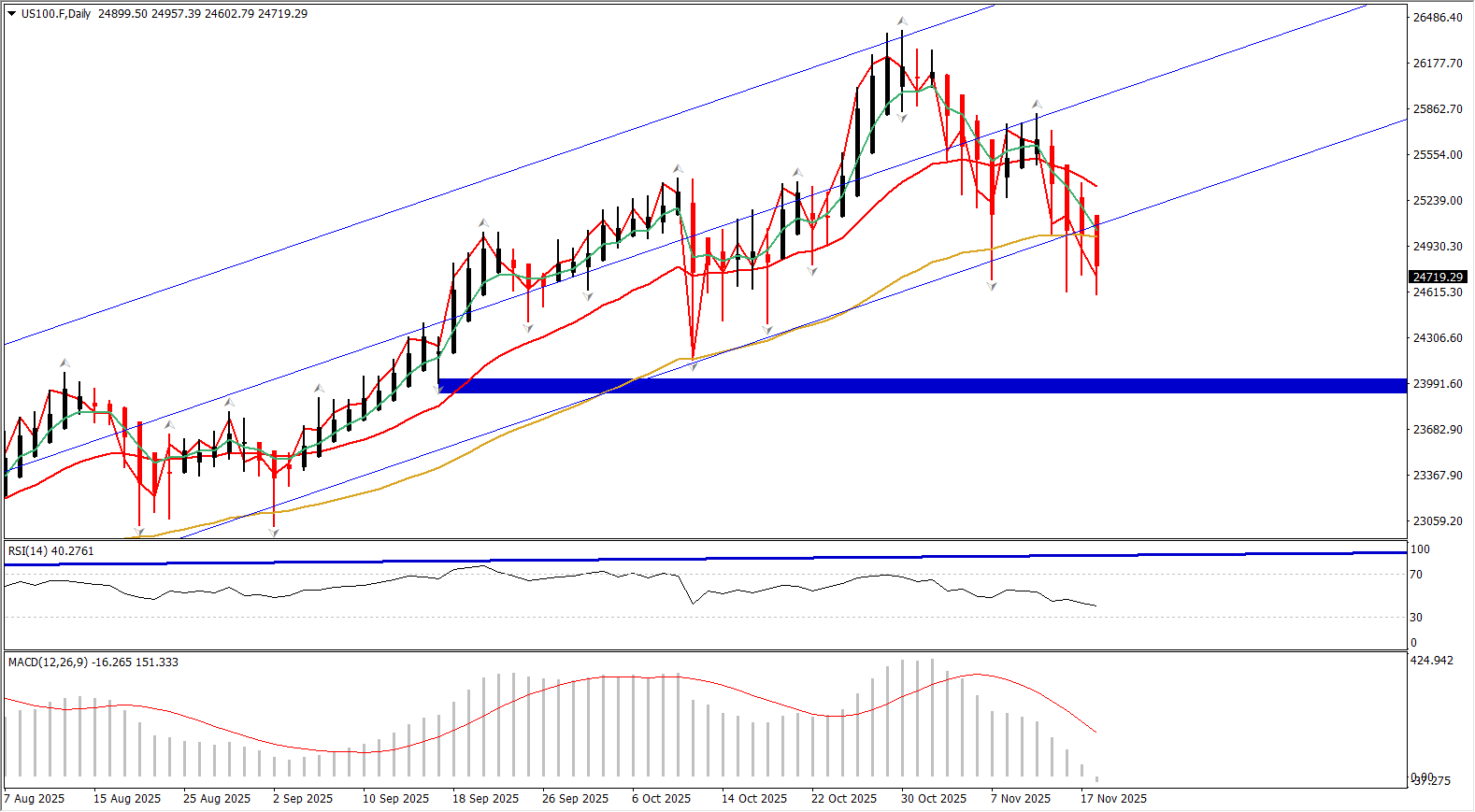 Nvidia shares were down about 1.8% Monday, though still up nearly 40% year-to-date. Other AI-linked stocks suffered steeper declines, including Super Micro Computer (-6.4%). Investors are increasingly questioning whether the AI trade has legs, particularly as the tech-heavy Nasdaq is already down about 5.5% since its late-October record high. Bitcoin Drops Below $90,000, Extending Six-Week Sell-off Crypto markets mirrored the negative tone: * Bitcoin slid below $90,000 for the first time in seven months, losing more than 28% in just six weeks. * Crypto-exposed equities also fell sharply: Coinbase (COIN) -7.1%, Robinhood Markets (HOOD) -5.3%. The decline reflects not only speculative unwinding, but a broader reduction in risk appetite across asset classes. 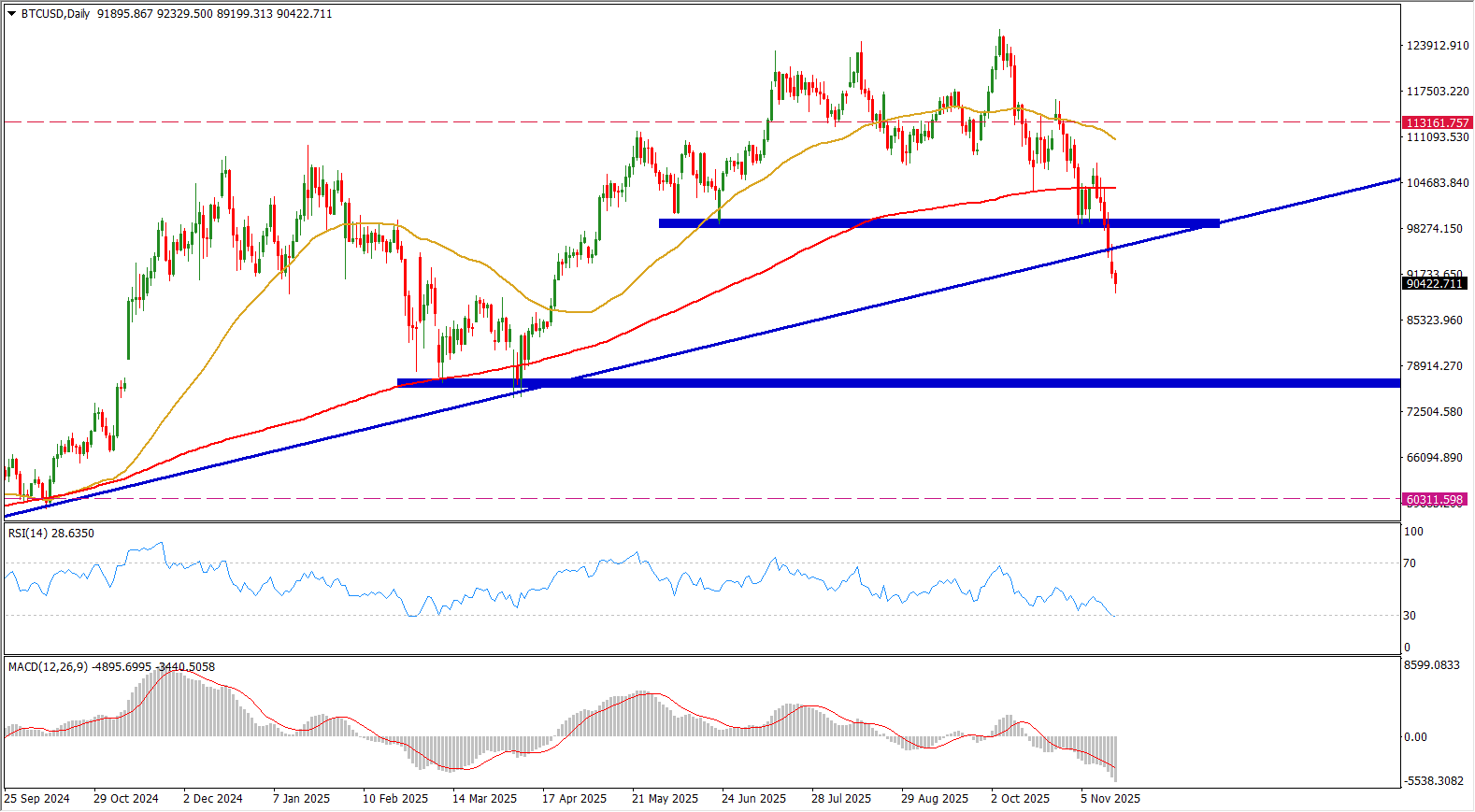 Asian Markets Tumble as US Tech Weakness Spreads Globally The US tech-led sell-off spilled into Asian trading on Tuesday. Benchmarks in Japan, South Korea, and Taiwan, all heavyweights in global semiconductor supply chains, suffered sharp declines as investors reassessed chip demand and valuations. Japan: Nikkei Declines as Bond Yields Spike * Nikkei 225 fell ~3% by midday * Tokyo Electron -5.4% * Advantest -4.6% A key driver was the surge in long-term Japanese government bond yields: 30-year JGB yields hit ~3.31%, the highest in years. The yen hovered above ¥155 per dollar, near its weakest level since February, and reached its lowest level against the euro since 1999. Asia: Chip Giants Lead Declines * Kospi dropped ~3.1% * Samsung Electronics -2.9% * SK Hynix -5.7% South Korea’s economy, heavily reliant on semiconductors, was especially vulnerable to global tech turmoil. * Taiex fell ~2.3% * TSMC -2.4%: The global chip demand fears weighed heavily in Taiwan’s market. * Hang Seng Index: -1.5% * Shanghai Composite: -0.6% * ASX 200 (Australia): -2.1% These markets, though less tech-concentrated, were not immune to the global sell-off. Fed Expectations Shift as Traders Reassess December Rate-Cut Odds One of the dominant narratives this week is the reshaping of interest-rate expectations. Just a month ago, markets priced in about a 94% probability of a December rate cut from the Fed. Today, that probability has sharply fallen to around 45%. Traders and investors are reacting to: * Persistent inflation above the Fed’s ~2% target * The US government shutdown, which delayed key economic releases * Mixed labour-market signals * Uncertainty around rate-cut timing Fed officials have recently suggested that more clarity is needed before proceeding with another cut,in light of weaker data and the end of the shutdown. Thursday’s US Jobs Report Could Shift the Entire Market Narrative The delayed September Non-Farm Payrolls (NFP) report, now due on Thursday, carries outsized importance this week. Key points: * A strong number would reduce the chance of a December rate cut. * A weak number would raise recession concerns and could push the Fed to accelerate easing. * A mixed print may leave markets in limbo. Oil, Forex & Global Macro Moves Reflect Risk-Off Mood Commodity and currency markets also shifted into defensive mode: * WTI Crude: ~$59.49 (-$0.42) * Brent Crude: ~$63.77 (-$0.43) FX and bond markets responded to the risk-off environment: * USDJPY ~ 155.08 * EURUSD ~ 1.1600 With rising yields in Japan and USD weakness, global macro flows tilted toward safe-haven dynamics. 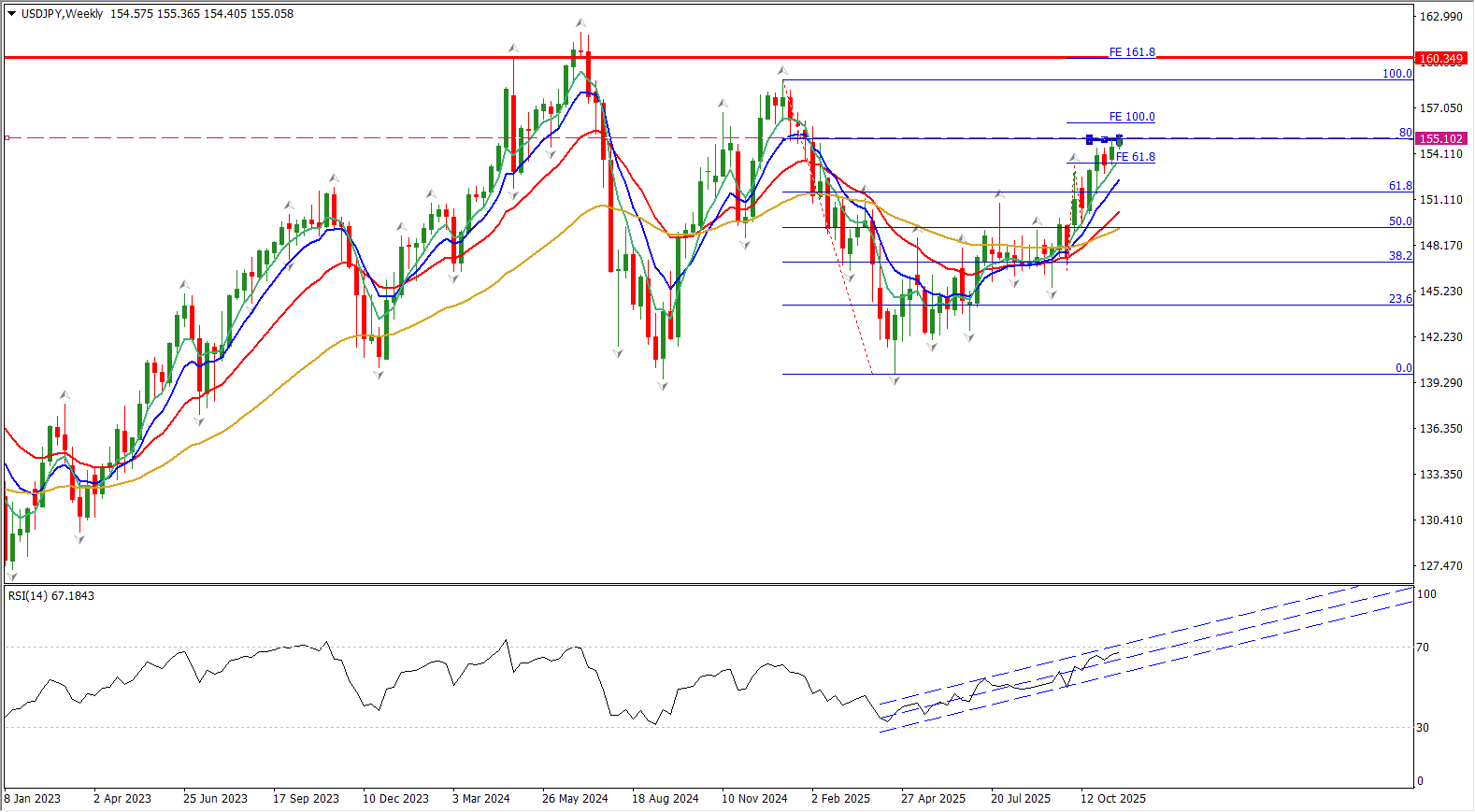 Alphabet Buckets the Trend as Berkshire Takes Major Stake One rare bright spot in Monday’s US session was Alphabet Inc. (GOOGL), which gained ~3.1% after Berkshire Hathaway disclosed a new ~$4.34 billion stake. Warren Buffett’s investment is seen as a value-oriented vote of confidence, providing a counterbalance to the broader technology sell-off. What Traders Should Watch Next Markets enter mid-week with a high-stakes setup: Wednesday: * Nvidia earnings: the major test of the AI trade * Semiconductor sector reaction and global chip supply chain sentiment Thursday: * US September Non-Farm Payrolls: pivotal for Fed policy and the dollar * Potential strong volatility in indices, FX, and crypto Friday and beyond (Aftermath): * Market digestion of earnings and jobs data * Fed commentary and updated rate expectations * Continued focus on Asian bond yields and semiconductor earnings With valuations stretched, volatility elevated, and major catalysts lined up, this week may prove decisive for the direction of global markets. Always trade with strict risk management. Your capital is the single most important aspect of your trading business. Please note that times displayed based on local time zone and are from time of writing this report. Click HERE to access the full HFM Economic calendar. Want to learn to trade and analyse the markets? Join our webinars and get analysis and trading ideas combined with better understanding of how markets work. Click HERE to register for FREE! Click HERE to READ more Market news. Andria Pichidi HFMarkets Disclaimer: This material is provided as a general marketing communication for information purposes only and does not constitute an independent investment research. Nothing in this communication contains, or should be considered as containing, an investment advice or an investment recommendation or a solicitation for the purpose of buying or selling of any financial instrument. All information provided is gathered from reputable sources and any information containing an indication of past performance is not a guarantee or reliable indicator of future performance. Users acknowledge that any investment in Leveraged Products is characterized by a certain degree of uncertainty and that any investment of this nature involves a high level of risk for which the users are solely responsible and liable. We assume no liability for any loss arising from any investment made based on the information provided in this communication. This communication must not be reproduced or further distributed without our prior written permission.
|
|
#493
19-11-2025, 08:19
|
||||
|
||||
|
Re: HFMarkets (hfm.com): Market analysis services.
Date: 19th November 2025.
Wall Street Extends Declines as AI Jitters Intensify Ahead of Nvidia Earnings. Trading Leveraged products is Risky Global markets shifted decisively into risk-off mode this week as Wall Street extended its decline for a fourth consecutive session. The sell-off reflects growing concerns over AI-driven valuations, a softening macro backdrop, and uncertainty ahead of Nvidia’s highly anticipated earnings report. Investor sentiment has deteriorated sharply since early November, with many questioning whether the extraordinary run in AI-linked equities can be sustained. The S&P 500 is now experiencing its worst losing streak since the early stages of this year’s AI bubble fears, as traders reposition cautiously ahead of Wednesday’s key event: Nvidia’s Q3 earnings. Wall Street Ends Lower but Off Intra-Day Lows All three major US indices finished Tuesday in the red, though losses were trimmed in afternoon trading: * NASDAQ: –1.21% * S&P 500: –0.82% * Dow Jones: –1.07% The worst performance came from consumer discretionary and information technology, two sectors particularly sensitive to shifts in growth expectations. Adding pressure, Home Depot shares sank more than 6% after disappointing results, amplifying concerns over US consumer resilience heading into the holiday season. Bonds and Commodities React to Risk Aversion The drop in equities triggered a flight to safety, with Treasuries drawing renewed demand: * 2-yr Treasury yield: 3.575% (–3.6 bps) * 10-yr Treasury yield: 4.117% (–2.1 bps) Safe-haven flows also pushed gold up 0.62% to $4,070 per ounce, while oil rebounded 1.35% to $60.70 after briefly touching a multi-month low at $59.31. Dovish Waller Comments Revive Fed Rate Cut Bets Market expectations for a December Fed rate cut strengthened meaningfully following comments by Federal Reserve Governor Christopher Waller, who noted he ‘cannot envisage not cutting by 25 bps’ in December. Rate futures reacted immediately: * December implied cut: –12.6 bps (up from –9.8 bps before Waller’s remarks) * January implied cut: –23.1 bps Soft data from US jobless claims and the ADP employment report further bolstered rate-cut optimism, especially as signs of cooling in the labour market begin to align with the Fed’s objectives. Still, traders remain cautious, December’s outcome is far from guaranteed, and the market currently views the decision as a close call. Nvidia Earnings: A Pivot Point for the AI Trade The spotlight now shifts to Nvidia (NVDA), whose earnings report on Wednesday could set the tone for the entire AI complex. Nvidia’s results are often viewed as a barometer for AI demand, given the company’s dominant role in powering cloud-based artificial intelligence workloads. Market Nervousness Is Rising Nvidia shares closed 2.81% lower at $181.36 on Tuesday, extending a decline of roughly 12% from its record highs. According to analytics firm ORATS, this earnings event could trigger a market-cap swing of up to $320 billion, the largest potential post-earnings move in the company’s history. Investors are torn between two competing narratives: * A beat-and-raise scenario may reinforce concerns about over-investment and inflated expectations. * A modest beat might suggest AI demand is stabilising sooner than hoped, raising fears of slowing growth. Recent sales of Nvidia shares by major players, including Peter Thiel’s hedge fund and SoftBank, have also fuelled caution. What Wall Street Expects Q3 consensus forecasts (Bloomberg): * EPS: $1.26 (vs. $0.81 a year ago) * Revenue: $55.2B (vs. $35.1B a year ago) * Data Center: $49.3B * Gaming: $4.4B * Gross Margin: 73.62% (vs. 75% last year) Nvidia continues to model zero revenue from China, with no progress reported on US-China AI chip export negotiations. Given the company’s influence, any surprise, positive or negative, could ripple across semiconductor stocks, cloud providers, and the broader market. Bitcoin Struggles as ‘Digital Gold’ Narrative Weakens Bitcoin’s performance continues to disappoint, with the world’s largest cryptocurrency falling nearly 30% from its 2025 peak. The decline has left Bitcoin lagging behind gold, long-term Treasuries, emerging market equities, and even traditionally low-growth sectors like utilities. On Tuesday, BTC briefly dipped below $90,000, near the average entry price of ETF inflows since launch, before recovering to trade around $93,241. Why BTC Is Underperforming Analysts point to several contributors: * Lingering fallout from October’s crash, which liquidated ~$19B in leveraged positions. * Weak risk sentiment stemming from sluggish Asian economic data and tech valuation corrections. * Rising correlations between crypto and high-beta tech stocks ahead of Nvidia's results. * Diminished confidence in Bitcoin as a hedge, diversifier, or store of value during recent market stress. Options markets now imply less than a 5% chance of Bitcoin revisiting its $126,000 peak by year-end, with strong demand for downside protection between $85K–$80K. Despite near-term pressure, Bitcoin remains well above pre-election levels, and historically, sharp drawdowns have often set the stage for sizeable rebounds. Conclusion Markets enter the midweek session on edge as investors brace for one of the most important earnings announcements of the quarter. With the Fed’s December meeting, AI valuation concerns, and crypto volatility all converging, sentiment may remain fragile until Nvidia provides clarity on the trajectory of AI-related demand. The next 48 hours are poised to play a crucial role in shaping market direction into year-end, and potentially redefining the narrative around the AI boom, risk appetite, and the role of digital assets in diversified portfolios. Always trade with strict risk management. Your capital is the single most important aspect of your trading business. Please note that times displayed based on local time zone and are from time of writing this report. Click HERE to access the full HFM Economic calendar. Want to learn to trade and analyse the markets? Join our webinars and get analysis and trading ideas combined with better understanding of how markets work. Click HERE to register for FREE! Click HERE to READ more Market news. Andria Pichidi HFMarkets Disclaimer: This material is provided as a general marketing communication for information purposes only and does not constitute an independent investment research. Nothing in this communication contains, or should be considered as containing, an investment advice or an investment recommendation or a solicitation for the purpose of buying or selling of any financial instrument. All information provided is gathered from reputable sources and any information containing an indication of past performance is not a guarantee or reliable indicator of future performance. Users acknowledge that any investment in Leveraged Products is characterized by a certain degree of uncertainty and that any investment of this nature involves a high level of risk for which the users are solely responsible and liable. We assume no liability for any loss arising from any investment made based on the information provided in this communication. This communication must not be reproduced or further distributed without our prior written permission.
|
|
#494
06-01-2026, 09:53
|
||||
|
||||
|
Re: HFMarkets (hfm.com): Market analysis services.
Date: 6th January 2026.
Nikkei 225 Leads Amid US-Japan Cooperation and BOJ Policy. Trading Leveraged products is Risky The Nikkei 225, along with Asian stocks more broadly, has been among the best-performing markets in the first week of 2026. These instruments have risen over 3.5% in recent days, more than double the gains of US and EU assets. Japanese Stocks have been increasing in value for 3 consecutive years, and with the index starting the year on a high, traders are paying close attention to developments. Economists note that stocks are performing well globally and the bullish price movement is not solely seen in Japan. However, certain developments are favouring Japan in absence of economic releases due to the holidays. For example, the growing relationship between the US and Japan. 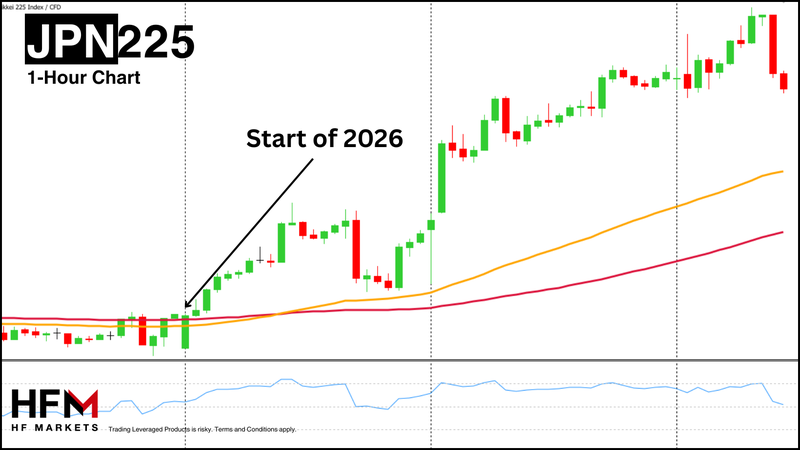 HFM - NIKKEI225 1-Hour Chart Japan Does Not Condemn US Military Action In Venezuela US President Donald Trump has invited Japanese Prime Minister Sanae Takaichi for an official visit to the United States later in 2026, likely in the spring, aimed at strengthening economic and security ties amid rising tensions in East Asia. In addition to this, Japan has chosen not to condemn the US actions in Venezuela, unlike China and Russia. Again this can prompt more favourable relations in the future, such as lower tariffs and more trade. A vital factor for the Japanese economy. Bank of Japan & Stocks In addition to the above, factors from 2025 also continue to support the Nikkei 225. This primarily includes the higher wages which has been agreed with trade unions, and the Bank Of Japan’s dovishness. Market participants in the first few months of 2025 advised they expect the BOJ’s rate to rise to 1.00%. However, rates have only risen to 0.75% and the committee refuses to give concrete guidance for further rate hikes. As a result, the dovishness of the Central Bank continues to support Japanese stocks. However, this is something which could potentially change in the upcoming months. If the BOJ does take a more hawkish tone, then the stock market may come under some pressure unless wages also increase. Are Oil Prices About to Fall and What Would That Mean for Stocks? Oil is expected to be one of the most closely watched assets in 2026. Traders should be mindful that movements in oil have a significant impact on inflation, interest rates, and consumer demand. As a result, fluctuations in oil prices can strongly influence both currency and equity markets. Last Saturday, President Maduro and his wife, Cilia Flores, were arrested and transferred to a pretrial detention facility in Brooklyn. They could face charges related to narcoterrorism and weapons possession as early as today. While this escalation in political tensions briefly affected investor sentiment at the start of the trading session, it has not triggered a wave of new trades yet. This muted market reaction is likely due to the fact that the US blockade on oil exports remains in place, preventing tankers from leaving the country’s ports. Meanwhile, OPEC+ agreed on Sunday to keep output unchanged for February and March despite disagreements between Saudi Arabia and the UAE, while reaffirming its flexibility to reinstate previously lifted production cuts of 1.65 million and 2.2 million barrels per day. If these developments eventually prompt higher supply, the price of crude oil can decline further. If prices and inflation falls, the global stock market potentially can rise, particularly if interest rates also fall. 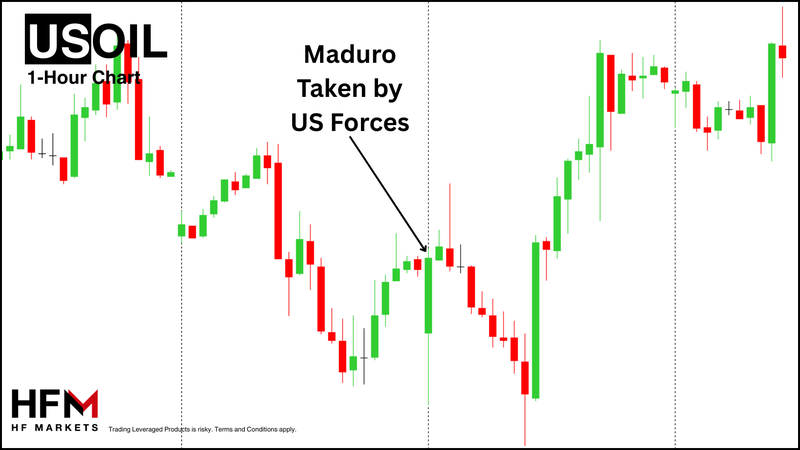 HFM - Crude Oil 1-Hour Chart Key Takeaways: * The Nikkei 225 and Asian stocks have started 2026 strongly, rising over 3.5%. * Closer US-Japan ties and Japan’s neutral stance on Venezuela support positive investor sentiment. * The Bank of Japan’s cautious, dovish policy continues to underpin stock market strength. * Oil price movements remain critical, influencing inflation, interest rates, and global equity performance. * Maduro’s arrest and OPEC+ output decisions have had limited immediate impact on markets. Always trade with strict risk management. Your capital is the single most important aspect of your trading business. Please note that times displayed based on local time zone and are from time of writing this report. Click HERE to access the full HFM Economic calendar. Want to learn to trade and analyse the markets? Join our webinars and get analysis and trading ideas combined with better understanding of how markets work. Click HERE to register for FREE! Click HERE to READ more Market news. Michalis Efthymiou HFMarkets Disclaimer: This material is provided as a general marketing communication for information purposes only and does not constitute an independent investment research. Nothing in this communication contains, or should be considered as containing, an investment advice or an investment recommendation or a solicitation for the purpose of buying or selling of any financial instrument. All information provided is gathered from reputable sources and any information containing an indication of past performance is not a guarantee or reliable indicator of future performance. Users acknowledge that any investment in Leveraged Products is characterized by a certain degree of uncertainty and that any investment of this nature involves a high level of risk for which the users are solely responsible and liable. We assume no liability for any loss arising from any investment made based on the information provided in this communication. This communication must not be reproduced or further distributed without our prior written permission.
|
|
#495
07-01-2026, 15:39
|
||||
|
||||
|
Re: HFMarkets (hfm.com): Market analysis services.
Date: 7th January 2026.
US Stock Futures Steady as Investors Await Key Jobs Data After Record Wall Street Rally. Trading Leveraged products is Risky US stock futures were little changed early Wednesday, as investors paused after Wall Street pushed deeper into record territory and shifted focus towards a crucial week of US labour market data that could influence expectations for Federal Reserve policy. Futures linked to the Dow Jones Industrial Average rose 0.1%, while S&P 500 futures traded flat. Nasdaq 100 futures slipped 0.1%, reflecting cautious positioning following Tuesday’s strong rally. US stocks advanced during regular trading despite lingering geopolitical tensions after US military action in Venezuela over the weekend. The Dow Jones Industrial Average crossed the 49,000 mark for the first time, securing its second consecutive record close. The S&P 500 also finished at an all-time high, continuing its move towards the 7,000 level. Economic Data Takes Centre Stage as Jobs Reports Approach Attention is now firmly on a packed US economic calendar, as data releases begin to normalise following recent disruptions. On Tuesday, figures showed signs of slowing momentum in the services sector, with S&P Global’s final Services PMI for December marking the weakest expansion in eight months. Today, investors are focused on the release of ADP’s monthly report on private-sector employment. The report has shown job losses in three of the past four months, though forecasts point to a modest rebound in hiring. Markets will also assess November’s JOLTS data, which tracks job openings, voluntary quits, and layoffs, key indicators of labour market tightness. These releases set the stage for Friday’s December nonfarm payrolls report, which investors see as a critical gauge of whether the US economy is cooling enough to support potential changes in Federal Reserve policy. 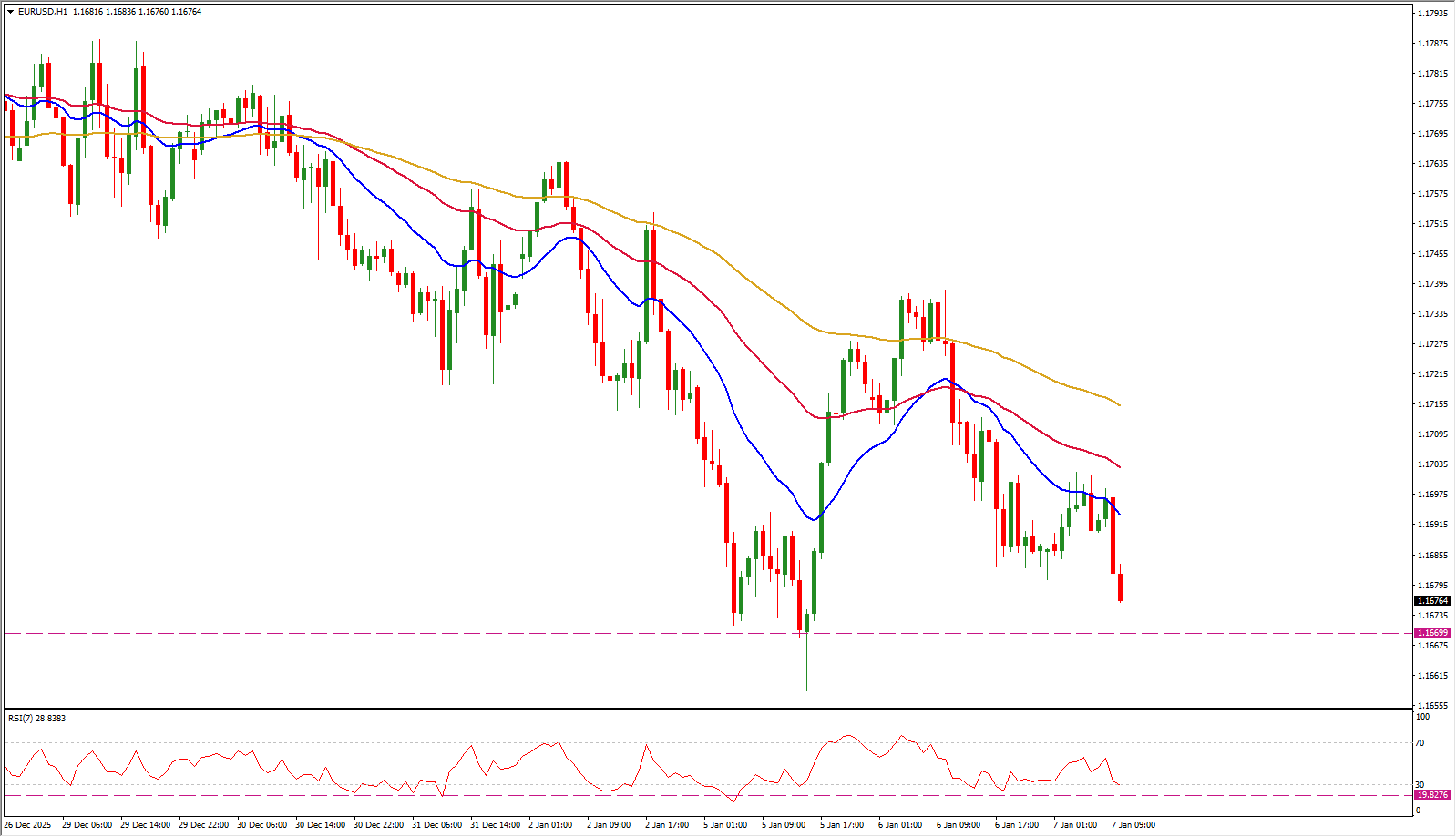 CES 2026 Highlights Debate Over Tech Sector Outlook The CES 2026 technology conference continues to shape market sentiment, as ambitious forecasts from industry leaders contrast with more cautious assessments from Wall Street. Nvidia remains a focal point, with analysts divided over whether the stock is approaching bubble-like valuations or entering another phase of rapid growth fuelled by demand for artificial intelligence. Japanese Stocks Post Best Start to a Year in Decades In Asia, Japanese equities recorded their strongest start to a year in several decades, supported by heavy buying from overseas investors and domestic individuals. The Topix and Nikkei 225 extended gains on Tuesday, lifting their two-day advances to 3.8% and 4.3%, respectively. Bloomberg-compiled data showed this was the strongest performance for the first two trading days of a year since at least 1990. Despite the rally, concerns persist about the sustainability of the AI-driven surge and ongoing geopolitical risks. Analysts said attention surrounding Venezuela is likely to shift towards the responses of China, Russia, and India. Masayuki Doshida, senior market analyst at Rakuten Securities, said that ‘depending on how developments unfold, this could become a geopolitical risk that draws attention’. Valuations and Retail Buying Support Japan’s Equity Rally Buying has been concentrated in large-cap Japanese stocks. Compared with US equities, Japanese stocks continue to trade at lower price-to-earnings ratios, supporting foreign investor demand, according to Hideyuki Ishiguro, chief strategist at Nomura Asset Management. Some analysts also pointed to increased retail participation, as individual investors add funds to tax-free NISA accounts at the start of the new year. Market optimism has also been supported by expectations of improving corporate earnings, stronger corporate governance, and Prime Minister Sanae Takaichi’s pro-stimulus policies, alongside resilience in US markets and hopes for US interest-rate cuts. Much of the earnings recovery has already been priced in, Doshida said, adding that if profits exceed expectations, the Nikkei 225 could rise to 55,000 or higher. The index closed at a record 52,518.08 on Tuesday. Gold Prices Ease as Focus Shifts to US Data Gold prices edged lower as investors looked beyond heightened geopolitical tensions and refocused on upcoming US economic data. Bullion traded near $4,470 an ounce after rising more than 4% over the previous three sessions. President Donald Trump said Venezuela would deliver up to 50 million barrels of oil to the US, while the White House declined to rule out military force to acquire Greenland. China, meanwhile, imposed export controls on goods shipped to Japan with potential military uses. Gold recently recorded its strongest annual performance since 1979, supported by central-bank buying and inflows into bullion-backed exchange-traded funds. Silver posted an even sharper rally last year, rising nearly 150% amid supply constraints and concerns over potential US import tariffs. Silver fell as much as 2.2% on Wednesday but remains up 12% so far this year, supported by strong retail demand, particularly in China. Commodity Index Rebalancing Poses Near-Term Risk Analysts warned that near-term pressure could emerge from commodity index rebalancing, as passive funds adjust holdings to reflect new weightings. Citigroup estimated that rebalancing across the two largest commodity indices could lead to outflows of about $6.8 billion from gold futures and a similar amount from silver. By early afternoon in Singapore, gold was down 0.6% at $4,466.04 an ounce. Silver fell 1.9% to $79.69, platinum dropped 4.2%, and palladium declined 2.9%. Always trade with strict risk management. Your capital is the single most important aspect of your trading business. Please note that times displayed based on local time zone and are from time of writing this report. Click HERE to access the full HFM Economic calendar. Want to learn to trade and analyse the markets? Join our webinars and get analysis and trading ideas combined with better understanding of how markets work. Click HERE to register for FREE! Click HERE to READ more Market news. Andria Pichidi HFMarkets Disclaimer: This material is provided as a general marketing communication for information purposes only and does not constitute an independent investment research. Nothing in this communication contains, or should be considered as containing, an investment advice or an investment recommendation or a solicitation for the purpose of buying or selling of any financial instrument. All information provided is gathered from reputable sources and any information containing an indication of past performance is not a guarantee or reliable indicator of future performance. Users acknowledge that any investment in Leveraged Products is characterized by a certain degree of uncertainty and that any investment of this nature involves a high level of risk for which the users are solely responsible and liable. We assume no liability for any loss arising from any investment made based on the information provided in this communication. This communication must not be reproduced or further distributed without our prior written permission.
|
|
#496
08-01-2026, 10:51
|
||||
|
||||
|
Re: HFMarkets (hfm.com): Market analysis services.
Date: 8th January 2026.
US Stocks Pause as Oil Politics, Gold Volatility, and Macro Risks Intensify. Trading Leveraged products is Risky Wall Street opened Thursday with a softer tone as US stock futures pulled back following a choppy session that ended several days of gains for major indices. The S&P 500 and Dow Jones briefly hit fresh intraday peaks before reversing lower, while the Nasdaq held up better thanks to tech leadership. This pause in equities reflects growing macro risk, geopolitical headlines, and commodity volatility, with markets increasingly pricing in uncertainty across multiple fronts. Rotation and Risk Appetite US stock futures dipped on Thursday morning as traders reset after a volatile session. Technology and growth stocks were mixed, while broader benchmarks like the S&P 500 and Dow Jones showed signs of fatigue after reaching intraday highs earlier in the week. The Nasdaq Composite outperformed peers, supported by strength in megacap tech, including a rally in Alphabet shares that briefly lifted its market value above Apple’s, highlighting how leadership remains narrow and selective. Oil Markets & Geopolitical Risk: Venezuela in Focus Markets are digesting fresh developments out of Venezuela, where the US government’s involvement in energy exports has intensified geopolitical risk for markets and commodities. US Policy Shift on Venezuelan Oil The Trump administration has signalled an intent to control Venezuelan crude exports and manage revenues through US channels moving forward. Energy Secretary Chris Wright stated that the US plans to control future sales of Venezuelan oil indefinitely, a major shift in energy policy that could reshape regional supply dynamics and global risk premia. Reuters also reported that oil sales from Venezuela to the US are expected to continue indefinitely, with sanctions being eased to allow initial shipments of more than 50 million barrels to flow to US markets. 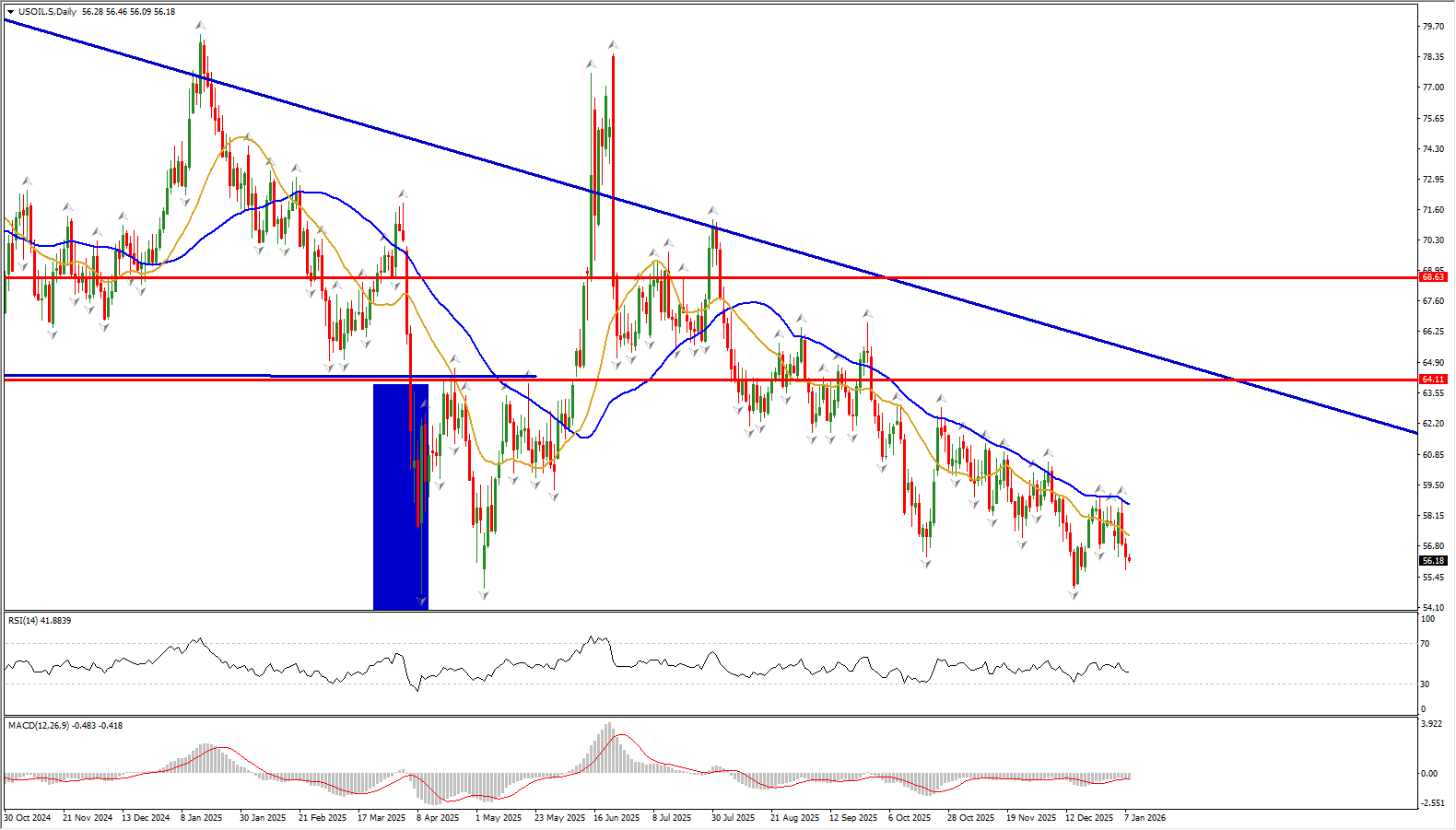 Market Reaction & Sector Implications These developments have moved oil-related equities. US oil stocks rose as investors priced in a potential revival of Venezuelan production and renewed access for major energy firms. Chevron, already the only US company with operational access, saw its position strengthen amid investor speculation. However, analysts caution that execution risks remain high due to Venezuela’s dilapidated infrastructure and political backlash, underscoring how geopolitical headlines can quickly shift from tailwinds to volatility drivers. Key Macro Catalysts This Week 1. Friday Jobs Report The upcoming US labour market report for December will be a major market focal point. With fewer major economic prints on the calendar, traders are assigning outsized importance to payrolls, unemployment figures, and wage growth data, all of which could meaningfully shift expectations around growth and monetary policy heading into Q1. 2. Supreme Court & Tariff Decisions Headline risk remains elevated as markets await potential legal clarity on tariffs imposed under the Trump administration. The Supreme Court’s opinion, expected imminently, could add another layer of market impact, particularly for sectors sensitive to trade policy and input costs. Gold & Silver: Technical Alert in Precious Metals Commodities experienced a marked shift this week, particularly gold and silver, which had been among the most crowded trades heading into 2026. After strong gains in late 2025, both metals are now pulling back: * Gold has retraced close to its key support zone near the 100- and 200-hour moving average, a critical technical juncture for buyers. * Silver is similarly testing its own 200-hour average, with recent price action indicating increased volatility and short-term bearish risk. These moves illustrate how even favoured consensus trades can unwind rapidly when macro headlines and price risk align against them, a valuable reminder that risk management remains paramount for commodities positioning. 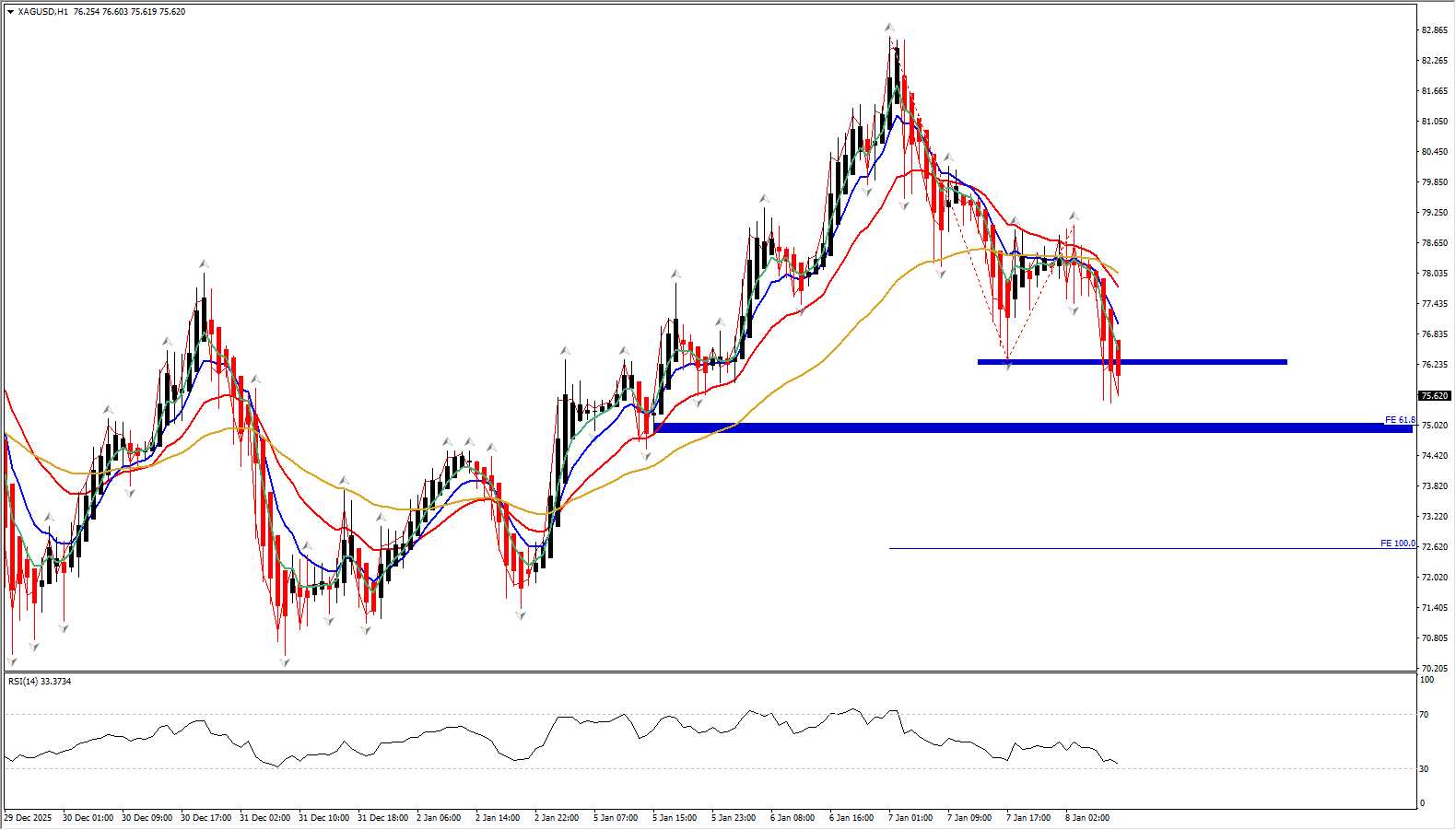 This Week’s Market Summary Bullish Forces * Tech leadership at CES, with AI and silicon innovation driving investor interest. * Continued risk appetite supporting broader equity markets. * Potential long-term energy supply implications from US–Venezuela policy developments. Bearish/Volatility Drivers * Macro uncertainty around labour market data and fiscal policy. * Geopolitical risk in oil markets and trade policy headline risk. * Corrections in crowded consensus positions like gold and silver. Always trade with strict risk management. Your capital is the single most important aspect of your trading business. Please note that times displayed based on local time zone and are from time of writing this report. Click HERE to access the full HFM Economic calendar. Want to learn to trade and analyse the markets? Join our webinars and get analysis and trading ideas combined with better understanding of how markets work. Click HERE to register for FREE! Click HERE to READ more Market news. Andria Pichidi HFMarkets Disclaimer: This material is provided as a general marketing communication for information purposes only and does not constitute an independent investment research. Nothing in this communication contains, or should be considered as containing, an investment advice or an investment recommendation or a solicitation for the purpose of buying or selling of any financial instrument. All information provided is gathered from reputable sources and any information containing an indication of past performance is not a guarantee or reliable indicator of future performance. Users acknowledge that any investment in Leveraged Products is characterized by a certain degree of uncertainty and that any investment of this nature involves a high level of risk for which the users are solely responsible and liable. We assume no liability for any loss arising from any investment made based on the information provided in this communication. This communication must not be reproduced or further distributed without our prior written permission.
|
|
#497
09-01-2026, 09:07
|
||||
|
||||
|
Re: HFMarkets (hfm.com): Market analysis services.
Date: 9th January 2026.
NFP Alert! Markets Search for Direction as Oil & Gold Rise and Defence Stocks Surge. Trading Leveraged products is Risky Asian stock markets edged modestly lower on Friday, while the US dollar remained supported, as investors turned cautious ahead of key US non-farm payrolls data and a highly anticipated US Supreme Court ruling on the legality of President Donald Trump’s global tariff policy, a decision that could reintroduce volatility across financial markets. Market sentiment remained fragile amid elevated geopolitical tensions, which continued to underpin oil prices and support defence stocks. Developments in Venezuela, including a high-profile US military operation in Caracas, remained in focus. However, the dominant drivers for markets were political risk, macro uncertainty, and legal event risk, keeping investors sidelined ahead of major catalysts. Asian Stock Markets Trade Mixed as Event Risk Limits Positioning Across Asia, trading conditions remained subdued. MSCI’s broad Asia-Pacific index excluding Japan slipped 0.07%, hovering just below record highs reached earlier in the week. Japan’s Nikkei outperformed regional peers, rallying 1.53% after Fast Retailing, the operator of the Uniqlo brand, reported strong earnings and issued upbeat guidance, providing a boost to Japanese equities. European equity futures pointed to a mixed open, with EUROSTOXX 50 futures up 0.37%, while FTSE futures edged 0.20% lower. Wall Street Steadies as Defence Stocks Surge on Budget Expectations US stock markets ended the previous session largely unchanged, although defence and aerospace stocks extended gains, pushing the sector to fresh record highs. European defence stocks also continued to attract inflows, reflecting rising geopolitical risks and renewed focus on military spending. Defence stocks surged after President Donald Trump called for a significant increase in US military spending, proposing a defence budget of $1.5 trillion by 2027, up sharply from the current level of around $901 billion. In a post on Truth Social, Trump said the higher budget would help build a ‘Dream Military’ and argued that strong tariff-generated revenues would make the increase affordable. Today, S&P 500 and Nasdaq futures traded lower as investors positioned cautiously ahead of US labour market data. US Non-Farm Payrolls in Focus as Fed Rate Cut Expectations Persist Recent US data has pointed to cooling labour demand, with companies increasingly relying on productivity gains rather than expanding payrolls. Economists expect December’s non-farm payrolls report to show moderate job growth of around 60,000, alongside a slight decline in the unemployment rate to 4.5% from 4.6%. The US economy shed 105,000 jobs in October, the steepest monthly decline in nearly five years, largely due to deferred buyouts among federal employees. Despite signs of softening, markets continue to price in at least two Federal Reserve rate cuts this year, even as policymakers’ December projections suggested a more cautious outlook. The Fed is widely expected to leave interest rates unchanged at its upcoming meeting. Gold Prices Rise Despite Stronger Dollar and Commodity Index Rebalancing Gold prices edged higher today, extending weekly gains, even as a firmer US dollar and commodity index rebalancing pressures weighed on sentiment. Investors continued to position defensively ahead of US jobs data and broader policy uncertainty. Gold rose 0.41% to $4,470.57 an ounce by 05:36 GMT, putting bullion on track for a weekly gain of more than 3%. Gold previously touched a record high of $4,549.71 on December 26. Meanwhile, US gold futures for February delivery gained 0.22% to $4,470.60. The move higher came despite the US dollar trading near a one-month high, a factor that typically weighs on gold prices by increasing costs for non-dollar buyers. Markets were also watching for the Supreme Court ruling on Trump’s use of emergency tariff powers, adding another layer of uncertainty. Watch Our Live NFP Coverage Today Traders and investors looking for real-time insights on today’s US Non-Farm Payrolls (NFP) report can join our live streaming session. My colleague Michalis, HFM analyst, will break down the jobs data as it comes out, discuss impacts on gold, defence stocks, FX, and equities, and provide actionable market commentary. Gold prices could face near-term pressure as the annual rebalancing of the Bloomberg Commodity Index gets underway. The process adjusts commodity weightings based on recent price performance and market conditions, potentially triggering futures selling. This could result in futures contracts being sold in the market to comply with rebalancing requirements. An estimated $6.8 billion in silver futures and a similar amount in gold futures are projected to be sold, following the strong precious metals rally that increased their index weightings. Nevertheless, Valecha noted that the longer-term fundamentals supporting gold and silver remain intact, suggesting any pullback may be technical rather than driven by a shift in underlying demand. Dollar Steady, Yen weakens Oil Prices Extend Weekly Gains In currency markets, the US dollar index edged 0.03% higher to 98.97. The euro slipped 0.04% to $1.1653, while the Japanese yen weakened 0.31% against the dollar. 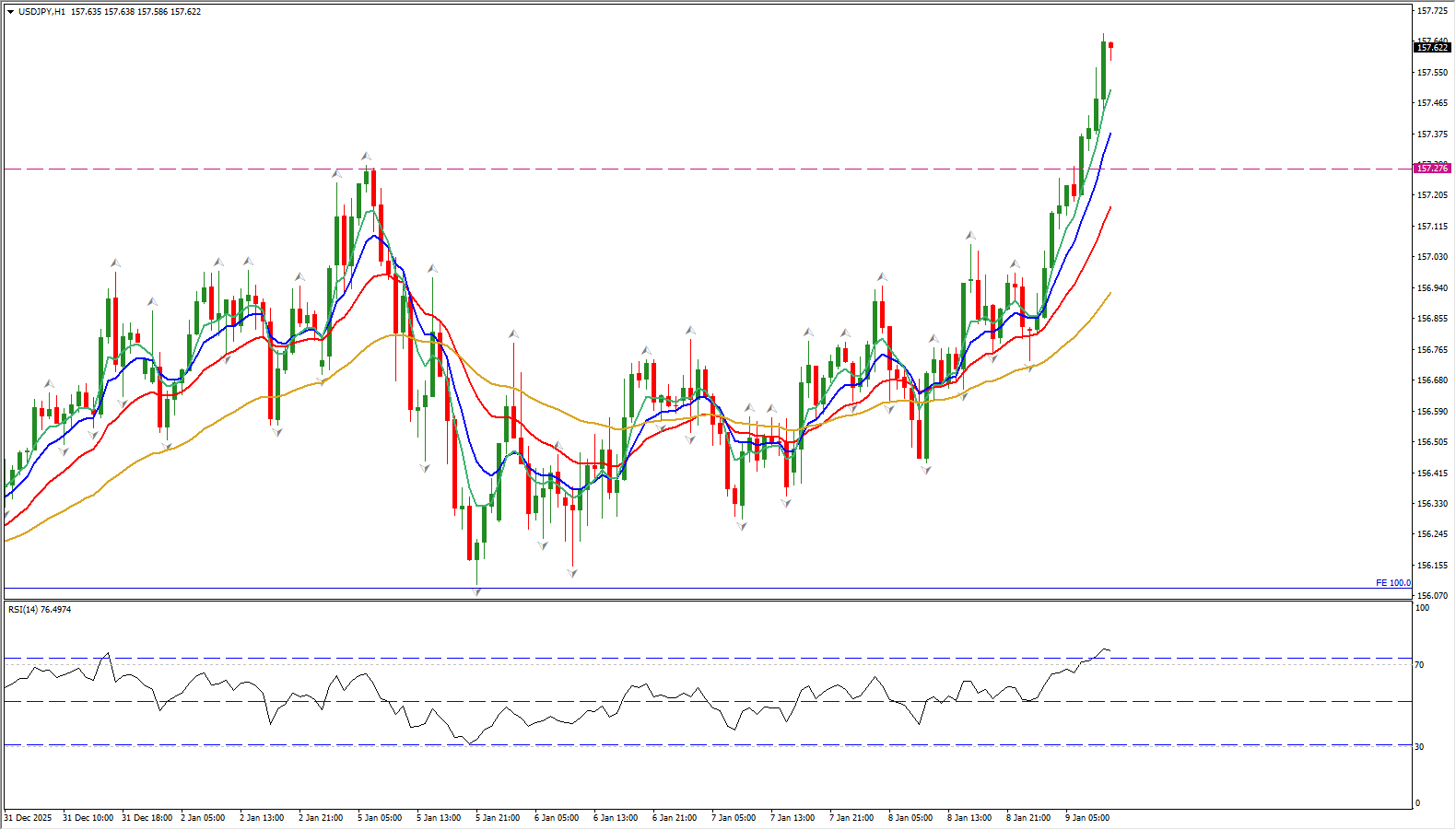 The USD held its ground, particularly against the yen, with USD/JPY climbing past 157.25. This strength came despite robust Japanese data showing household spending jumped 2.9% year-on-year in November—well above expectations—and surged 6.2% month-on-month. While these figures signal short-term resilience in consumer activity, the broader outlook remains fragile as real wages continue to decline, falling 2.8% y/y and weighing on purchasing power. The yen, however, appeared more affected by renewed tensions over China’s restrictions on rare-earth and magnet exports to Japan, a move tied to Taiwan-related remarks. Japanese officials expressed serious concern, indicating the matter would be raised with G7 partners and US counterparts, injecting a geopolitical risk premium into JPY trading. Always trade with strict risk management. Your capital is the single most important aspect of your trading business. Please note that times displayed based on local time zone and are from time of writing this report. Click HERE to access the full HFM Economic calendar. Want to learn to trade and analyse the markets? Join our webinars and get analysis and trading ideas combined with better understanding of how markets work. Click HERE to register for FREE! Click HERE to READ more Market news. Andria Pichidi HFMarkets Disclaimer: This material is provided as a general marketing communication for information purposes only and does not constitute an independent investment research. Nothing in this communication contains, or should be considered as containing, an investment advice or an investment recommendation or a solicitation for the purpose of buying or selling of any financial instrument. All information provided is gathered from reputable sources and any information containing an indication of past performance is not a guarantee or reliable indicator of future performance. Users acknowledge that any investment in Leveraged Products is characterized by a certain degree of uncertainty and that any investment of this nature involves a high level of risk for which the users are solely responsible and liable. We assume no liability for any loss arising from any investment made based on the information provided in this communication. This communication must not be reproduced or further distributed without our prior written permission.
|
|
#498
12-01-2026, 09:31
|
||||
|
||||
|
Re: HFMarkets (hfm.com): Market analysis services.
Date:12th January 2026.
Gold Hits All-Time Highs as the Fed Faces Political Pressure. Trading Leveraged products is Risky Gold rises to new all-time highs as US prosecutors opened a criminal investigation into Jerome Powell over the weekend. In addition, the latest NFP figures continue to support more interest rate cuts in 2026, also supporting Gold prices. Analysts continue to point towards multiple reasons why institutions and investors are increasing Gold’s exposure levels. These include the threat to the Federal Reserve’s independence, employment data, and even US-EU tensions over Greenland. However, at what point is Gold too expensive?  HFM - Gold Daily Chart Why Is the Federal Reserve Prompting Higher Gold Demand? The tensions between the Federal Reserve and the Trump administration have been well documented. The US government believes the Federal Reserve is not cutting interest rates at the pace it should be. The Federal Funds Rate currently stands at 3.75%, which is 1.75% lower than the highs from 2024. That said, interest rates are still considerably higher than those seen over the past decade. According to the Federal Reserve, they have been unable to cut at a faster pace due to tariffs creating uncertainties. More specifically, members of the Federal Open Market Committee had previously projected inflation would rise considerably due to tariffs. These projections have yet to materialise, providing Trump with additional grounds to criticize the Federal Reserve. Tensions have been on the rise over the past few days as US prosecutors started a criminal investigation into the head of the Federal Reserve, Jerome Powell. The investigation is looking at whether Mr Powell misled Congress about the scope and cost of a major $2.5 billion renovation of the Federal Reserve’s Washington office. President Trump and members of the administration have advised the cost is significantly higher than what the Chairman had disclosed. Particularly, Trump accused the Fed of adding ‘luxurious’ features to the renovation. However, Fed officials told journalists that these were later removed. The question is whether Powell gave misleading or false testimony to Congress about the renovation. According to Jerome Powell, the investigation is political pressure to force the Federal Reserve to cut rates. He said it is also meant as personal retaliation for not cutting rates so far. Powell told journalists the move raises concerns about the Fed’s independence. The risk to Federal Reserve independence is largely the development pushing Gold higher. NFP - Mixed Employment Data The NFP data from Friday had both positive and negative factors in the release. The Unemployment Rate fell back to 4.4%, lower than previous projections. However, the NFP Employment Change was only 50,000, lower than expectations. The employment data for December indicates the sector remains resilient, but risks do remain. According to analysts, the figures indicate the need for interest rate cuts but are not weak enough to significantly pressure the Federal Reserve. The chances of a Federal Reserve rate cut still remain low, a 5% possibility. However, investors will monitor if this changes after tomorrow's CPI figures. Gold (XAUUSD) - Technical Analysis As Gold has been increasing for six consecutive months, most indicators, particularly momentum indicators, point towards the bullish trend continuing. The question is whether the price is trading at an overpriced level. Certain timeframes do point towards the price potentially being overbought. For example, on the 4-hour timeframe, the price is trading at an overbought level on the RSI. In addition to this, on the daily timeframe, the price is forming a divergence pattern, which also signals a potential pullback. Momentum and trend-based indicators continue to point upward, and the price stays close to its average, suggesting investors do not overvalue it. In addition, fundamental factors continue to support Gold’s price.  HFM - Gold 5-Minute Chart Certain Wall Street banks are also supporting the bullish trend maintaining momentum this year. Goldman Sachs has given a target price of $4,900. Bank of America and JP Morgan have given a target of $5,000. However, in the short-term, for bullish signals to be valid, the price must remain above $4,542.75, according to the 200-bar MA. Key Takeaways: * Gold hit new all-time highs as US prosecutors launched a criminal investigation into Jerome Powell. * Mixed NFP employment data supports the possibility of more Federal Reserve rate cuts in 2026. * Investors increase Gold exposure due to Fed independence risks, employment trends, and US-EU geopolitical tensions. * Technical indicators show Gold’s bullish momentum continues, though some timeframes signal potential overbought conditions. * Major banks forecast Gold at $4,900-$5,000, with key support at $4,542.75 maintaining short-term bullish signals. Always trade with strict risk management. Your capital is the single most important aspect of your trading business. Please note that times displayed based on local time zone and are from time of writing this report. Click HERE to access the full HFM Economic calendar. Want to learn to trade and analyse the markets? Join our webinars and get analysis and trading ideas combined with better understanding of how markets work. Click HERE to register for FREE! Click HERE to READ more Market news. Michalis Efthymiou HFMarkets Disclaimer: This material is provided as a general marketing communication for information purposes only and does not constitute an independent investment research. Nothing in this communication contains, or should be considered as containing, an investment advice or an investment recommendation or a solicitation for the purpose of buying or selling of any financial instrument. All information provided is gathered from reputable sources and any information containing an indication of past performance is not a guarantee or reliable indicator of future performance. Users acknowledge that any investment in Leveraged Products is characterized by a certain degree of uncertainty and that any investment of this nature involves a high level of risk for which the users are solely responsible and liable. We assume no liability for any loss arising from any investment made based on the information provided in this communication. This communication must not be reproduced or further distributed without our prior written permission.
|
|
#499
13-01-2026, 09:38
|
||||
|
||||
|
Re: HFMarkets (hfm.com): Market analysis services.
Date:13th January 2026.
Yen Slide Accelerates as Japanese Government Signals Concern. Trading Leveraged products is Risky The US Dollar continues to do well in 2026 despite the US government’s attempt to lower interest rates. The main gains are being seen against the Japanese Yen, which is witnessing high levels of volatility. The Japanese government has gone as far as discussing the decline with the US, which is further damaging market sentiment. The USDJPY has risen in value for two consecutive weeks and is now trading at the highest level since July 2024. The US Dollar is increasing against most currencies, but the bullish price movement is primarily being driven by the decline in the Yen. The main factors driving the Japanese Yen lower are rumours that the Japanese Prime Minister is considering snap elections towards the end of February, and ministers’ concern over the weakening of the Japanese Yen. In the past, the Japanese Government has intervened to boost the currency. However, this has not yet taken place. Takaichi Calling Snap Elections? The market is closely watching media reports suggesting that Prime Minister Sanae Takaichi may soon call a snap general election to capitalise on her strong approval ratings. The new Japanese Prime Minister’s ratings over the past few months have considerably risen. However, analysts caution that moving towards an early vote could make it more difficult to secure parliamentary approval for the government’s proposed budget, which features substantial spending measures aimed at supporting households and the broader economy. As a result, the Japanese Yen has come under pressure. The Japanese Yen is currently the worst-performing currency in 2026, declining 1.40% so far. However, many economists believe an intervention within the upcoming days is likely if the Yen does not rebound. However, some analysts are indicating the new Japanese government is likely to wait for a larger decline before intervening. The Financial Times indicates an exchange rate above $160.000 would significantly increase the possibility of a currency intervention. Concerns Over The Japanese Yen’s Decline The Japanese Finance Minister, Mr Katayama, spoke to journalists last night after meeting with his US counterpart. Both the US Treasury, Scott Bessent, and Mr Katayama expressed concerns over the Yen’s decline. According to reports, the main concern for both individuals is not the decline in the currency, but the pace of the decline and its one-sidedness. US Government Attempt to Bring Rates Down The Trump administration continues its attempt to bring interest rates down through multiple routes. The route receiving the most attention is the investigation into the Federal Reserve’s Chairman. However, the US is also considering a cap on credit card rates and has ordered the purchase of mortgage bonds. The US government is not hiding the fact that both moves aim to bring down interest rates in order to boost the US property market. Economists also note that towards the end of the Biden administration the US property market was in its worst state since the previous financial crisis. Certain Wall Street banks are also supporting the bullish trend maintaining momentum this year. Goldman Sachs has given a target price of $4,900. Bank of America and JP Morgan have given a target of $5,000. However, in the short-term, for bullish signals to be valid, the price must remain above $4,542.75, according to the 200-bar MA. The US Dollar Index The US Dollar Index started the week with a bearish price gap and a decline. However, the currency rose in value during the US session and is currently holding onto these gains this morning. Today’s Consumer Price Index (inflation) and tomorrow’s Producer Price Index (producer inflation) will be key. Analysts expect the US inflation rate to remain at 2.7%, which is moderately above the Fed’s target. If the inflation rate falls below this level, more frequent rate cuts will become possible. As a result, the US Dollar may again witness bearish swings. However, if the figure is higher, market participants will price in higher interest rates for the upcoming months. USDJPY - Technical Analysis In terms of technical analysis, the US Dollar remains favourable. The US Dollar Index remains above both Moving Averages and VWAP. The USDJPY is also experiencing ‘buy’ signals from trend-based indicators. 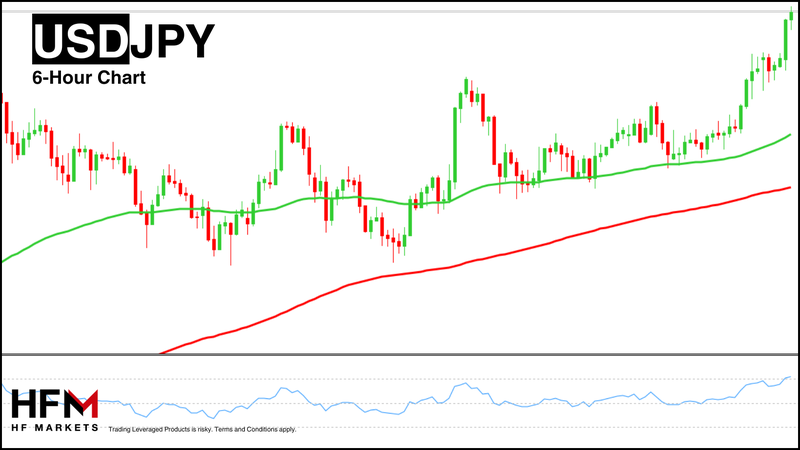 HFM - USDJPY 6-Hour Chart However, all traders are extremely cautious about a possible Japanese intervention and the upcoming inflation data. Nonetheless, the price of the USDJPY is likely to maintain buy signals if the exchange rate remains above 158.365. If the USDJPY drops below this level, signals are potentially likely to change. Key Takeaways: * The US Dollar strengthens in 2026 despite government efforts to push interest rates lower. * USDJPY rises for two straight weeks, driven mainly by sharp Yen weakness. * Snap election speculation and budget risks put additional pressure on the Japanese Yen. * Economists expect possible yen intervention if USDJPY approaches or exceeds the 160 level. * Inflation data and intervention risk dominate near-term USDJPY trading sentiment. Always trade with strict risk management. Your capital is the single most important aspect of your trading business. Please note that times displayed based on local time zone and are from time of writing this report. Click HERE to access the full HFM Economic calendar. Want to learn to trade and analyse the markets? Join our webinars and get analysis and trading ideas combined with better understanding of how markets work. Click HERE to register for FREE! Click HERE to READ more Market news. Michalis Efthymiou HFMarkets Disclaimer: This material is provided as a general marketing communication for information purposes only and does not constitute an independent investment research. Nothing in this communication contains, or should be considered as containing, an investment advice or an investment recommendation or a solicitation for the purpose of buying or selling of any financial instrument. All information provided is gathered from reputable sources and any information containing an indication of past performance is not a guarantee or reliable indicator of future performance. Users acknowledge that any investment in Leveraged Products is characterized by a certain degree of uncertainty and that any investment of this nature involves a high level of risk for which the users are solely responsible and liable. We assume no liability for any loss arising from any investment made based on the information provided in this communication. This communication must not be reproduced or further distributed without our prior written permission.
|
|
#500
14-01-2026, 10:04
|
||||
|
||||
|
Re: HFMarkets (hfm.com): Market analysis services.
Date:14th January 2026.
Slight Drop in Inflation Fails to Boost the Stock Markets. Trading Leveraged products is Risky The US released its inflation rate for December yesterday, confirming no significant rise in inflation. However, investors had previously set forecasts indicating a slight rise. Investors consider lower inflation rates to be positive for the stock market due to their impact on interest rates. Nonetheless, the stock market was not able to maintain its upward price momentum. The S&P500, Nasdaq, and Dow Jones initially saw a positive reaction to the Consumer Price Index (inflation) release. However, all ultimately ended the day lower with the Dow Jones witnessing the strongest decline (-0.76%). Why is the stock market witnessing a decline despite better-than-expected inflation figures? US Consumer Inflation The US inflation rate held at 2.7%, matching analysts’ expectations. Core inflation also remained unchanged at 2.6%, despite analysts expecting it to rise to 2.7%. Because inflation came in slightly better than expected, the stock market initially rose. The S&P 500 gained 0.39%, the Nasdaq rose 0.50%, and the Dow Jones increased 0.40%. The assets later declined as investors concluded that inflation was not low enough to convince the Federal Reserve to cut rates more frequently. According to reports, the chances of the Fed pausing this month rose from 95% to 97% and in March from 57% to 71%. As a result, the US Dollar rose in value while the stock market fell. In addition, investors are also monitoring the rise in Oil prices which have risen to a two-month high. The Federal Reserve, inflation, and interest rates will remain in the spotlight this afternoon. The US will make public its producer inflation rate, which will again impact both future CPI and interest rates. In addition, six members of the Fed’s voting committee will speak this afternoon. The Federal Open Market Committee members are likely to comment on the Fed’s independence, the investigation into the chairman, and interest rates. Those scheduled to give speeches include Mr Paulson, Mr Miran, Mr Kashkari, Mr Bostic, and Mr William. If the Fed maintains its hawkish tone and indicates no rate cuts in the first quarter, the stock market is likely to decline further. Trump’s Push to Lower Interest Rates & Boost the Property Market President Trump unveiled a plan to ban large institutional investors from buying family homes to curb rising housing prices. Critics argue the move is largely symbolic as investor strategies continue to evolve. Supporters believe the policy could help restore balance to the housing market. Possible consequences include legal challenges, increased market volatility, and only a modest effect on overall affordability. In addition, the US administration is also considering capping interest rates on Credit Cards. In response to both developments, certain stocks fell in value. For example, American Express stocks have fallen 7%, Visa 8%, and Mastercard almost 6%. JP Morgan Earnings Report Other stocks witnessing a significant decline are JP Morgan Stocks, which fell 4.00%. JP Morgan delivered a mixed but solid earnings report, supported by strong trading revenue, steady net interest income, and resilient asset and wealth management performance. However, headline results were weighed down by higher credit reserves tied to the Apple Card acquisition and weaker investment banking activity. The CEO was cautiously optimistic about the US economy while acknowledging regulatory and credit risks, leaving investor sentiment balanced between the bank’s underlying strength and near-term headwinds. S&P500 The S&P 500 is one of the indices that is most exposed to assets negatively affected by this move. Out of the most influential stocks for the S&P 500, only 50% rose in value on Tuesday, which is not high enough to obtain a buy signal. In addition, the VIX index is also continuing to rise, pointing towards a lower risk appetite amongst traders. Even with the recent decline, the price of the S&P 500 remains above the 75-Bar Exponential Moving Average. The RSI remains at a neutral level on the 2-hour chart and the price is trading below the VWAP. For this reason, the price is not obtaining an all-round signal pointing in one direction. However, after today’s Federal Reserve speeches and PPI release the index may form a stronger sense of direction. In the short term, if the price remains below $6,961.45, the asset is likely to maintain its current sell signal from Moving Averages. 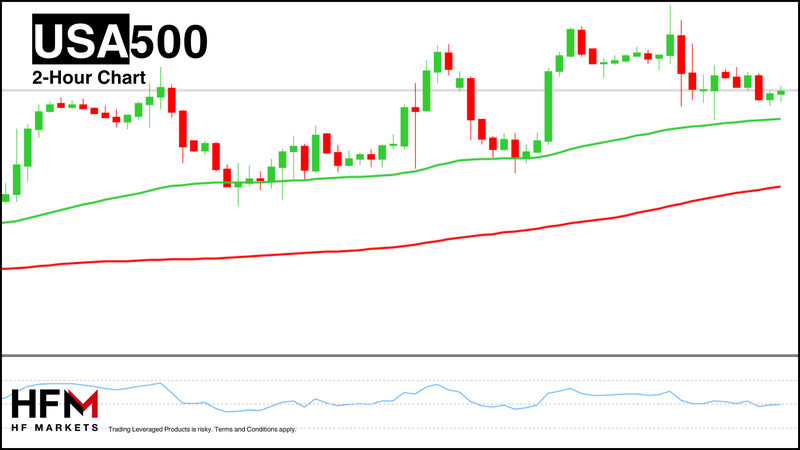 HFM - S&P 500 2-Hour Chart Key Takeaways: * US inflation came in slightly better than expected for stocks, but not low enough to shift Federal Reserve rate-cut expectations. * Stocks initially rose after the CPI release but closed lower as investors priced in a prolonged Fed pause. * Rising oil prices and a stronger US Dollar added further pressure to equity markets. Trump’s proposals targeting housing investors and credit card rates weighed on financial and payment stocks. * Market direction now hinges on upcoming PPI data and Federal Reserve speeches, with volatility increasing. Always trade with strict risk management. Your capital is the single most important aspect of your trading business. Please note that times displayed based on local time zone and are from time of writing this report. Click HERE to access the full HFM Economic calendar. Want to learn to trade and analyse the markets? Join our webinars and get analysis and trading ideas combined with better understanding of how markets work. Click HERE to register for FREE! Click HERE to READ more Market news. Michalis Efthymiou HFMarkets Disclaimer: This material is provided as a general marketing communication for information purposes only and does not constitute an independent investment research. Nothing in this communication contains, or should be considered as containing, an investment advice or an investment recommendation or a solicitation for the purpose of buying or selling of any financial instrument. All information provided is gathered from reputable sources and any information containing an indication of past performance is not a guarantee or reliable indicator of future performance. Users acknowledge that any investment in Leveraged Products is characterized by a certain degree of uncertainty and that any investment of this nature involves a high level of risk for which the users are solely responsible and liable. We assume no liability for any loss arising from any investment made based on the information provided in this communication. This communication must not be reproduced or further distributed without our prior written permission.
|
|
#501
15-01-2026, 10:40
|
||||
|
||||
|
Re: HFMarkets (hfm.com): Market analysis services.
Date:15th January 2026.
From ETFs to Technicals: What’s Fuelling Silver’s 2026 Rally. Trading Leveraged products is Risky The best-performing asset in 2026 so far is Silver. Silver paused during the Asian session this morning after rising for four consecutive days. However, technical analysis is not yet indicating a prolonged downturn. So, why is Silver the best-performing asset of 2026, and what are analysts predicting for 2026? Factors driving Silver’s Bullish Momentum The increase that Silver is experiencing is largely due to demand from institutional investors rather than physical demand. According to the latest reports and projections, demand for physical Silver is likely to slightly decrease over the next 12 months. Institutions are buying Silver for similar reasons to Gold, however, Silver is much more volatile and cheaper to purchase. The slightly lower inflation readings from this week, projections for more frequent interest rate cuts, and questions over Fed independence are increasing demand. Economists are not expecting the Federal Reserve to cut interest rates this month, nor in March 2026. For this reason, the US Dollar has slightly risen while stocks have fallen. However, economists do believe that in the second and third quarters of the year, the Fed will need to make frequent rate cuts. On average, economists believe the Fed will need to cut by 0.75% by the end of the year. This would take the Federal Fund Rate to 3.00%, the lowest since the summer of 2022. For this reason, investors expect the Federal Reserve to delay cuts in the first quarter but eventually cut rates later in the year. At the same time, investors are incorporating political risks into their strategy, which is resulting in a need for Gold and Silver. These include the Federal Reserve’s independence and US global intentions such as within Greenland. In addition, investors are also treading cautiously as the US Midterms will take place later in the year. Investors Buying Silver ETFs Market participants are reviewing the Silver Institute’s early 2025 outlook, which expects global industrial silver demand to fall 2% to 665 million ounces. The decline reflects trade policy uncertainty and reduced use in electronics and photochemical applications. Demand for physical bars and coins is also expected to drop to a seven-year low, down 4% from 2024. However, strong investment inflows into Silver ETFs rose 18%, with net inflows of 187 million ounces. This is likely to offset weaker physical demand and help support prices, particularly as investors seek protection from inflation and currency volatility. On the CME, Silver trading activity spiked on 7 January, with volumes reaching 195,000 contracts, well above the early-month average. XAGUSD - Technical Analysis 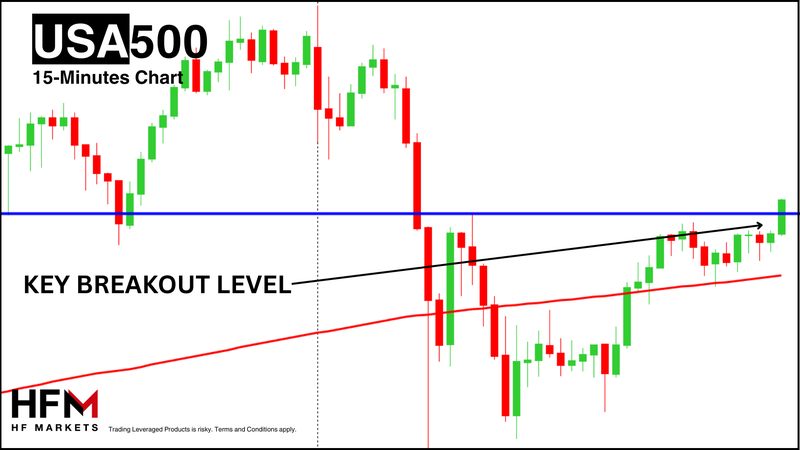 HFM - 15-Minute Chart Due to the bullish price movement, indicators and price action are understandably pointing towards Silver’s trend continuing. Even with the current retracement, the price fell to the previous low and did not necessarily form significant breakouts. When looking at the 2-hour timeframe, the price of the metal remains above the key Moving Average, above the neutral area of the RSI, and the MACD. For this reason, indicators continue to point towards buyers maintaining control. Fundamental analysis also indicates this, with inflation reading slightly lower. The main risk for Silver and Gold is the rise in the US Dollar. If the US Dollar declines, Silver can potentially strengthen further. The only indicators currently pointing towards a downward price movement are the 200-bar Moving Average on the 5-minute timeframe. The price currently remains below this level, giving a bearish bias. However, the price is currently rising and trading close to this level. If the price forms a bullish breakout at $90.185, the bearish bias is likely to fade. Key Takeaways: * Silver leads 2026 performance. It’s the top-performing asset so far, despite a brief pause after four consecutive days of gains. * Institutional demand drives momentum. Growth is fuelled by ETFs and institutional buying rather than physical silver demand. * Fed rate expectations influence buying. Investors anticipate rate cuts later in 2026, boosting silver and gold as hedges. * Physical demand is declining. Industrial use and coins/bars are projected to drop, but ETF inflows (up 18%) support prices. * Technical indicators remain bullish. Silver’s price is holding above key moving averages and RSI/MACD signals, suggesting buyers remain in control Always trade with strict risk management. Your capital is the single most important aspect of your trading business. Please note that times displayed based on local time zone and are from time of writing this report. Click HERE to access the full HFM Economic calendar. Want to learn to trade and analyse the markets? Join our webinars and get analysis and trading ideas combined with better understanding of how markets work. Click HERE to register for FREE! Click HERE to READ more Market news. Michalis Efthymiou HFMarkets Disclaimer: This material is provided as a general marketing communication for information purposes only and does not constitute an independent investment research. Nothing in this communication contains, or should be considered as containing, an investment advice or an investment recommendation or a solicitation for the purpose of buying or selling of any financial instrument. All information provided is gathered from reputable sources and any information containing an indication of past performance is not a guarantee or reliable indicator of future performance. Users acknowledge that any investment in Leveraged Products is characterized by a certain degree of uncertainty and that any investment of this nature involves a high level of risk for which the users are solely responsible and liable. We assume no liability for any loss arising from any investment made based on the information provided in this communication. This communication must not be reproduced or further distributed without our prior written permission.
|
|
#502
16-01-2026, 09:47
|
||||
|
||||
|
Re: HFMarkets (hfm.com): Market analysis services.
Date:16th January 2026.
USDJPY: Intervention On The Table With US Support. Trading Leveraged products is Risky Japan's finance minister tells journalists that the Japanese government is considering currency intervention to support the Japanese Yen. The Japanese Yen Index has already fallen more than 1.00% in the first 2 weeks of 2026. Though, the main concern for the Japanese Federal Government is the decline against the US Dollar, which at one point was almost at a 2% decline. The Japanese Yen is currently the second best performing currency during this morning’s Asian session, after the New Zealand Dollar. Will the Japanese Government Boost the Currency? Analysts cannot advise that a currency intervention is certain without any doubt. However, over the past week, the Japanese government has told journalists that they will support the currency. When asked about direct currency intervention, the finance minister said the option remains on the table. For this reason, many traders do believe the government will boost the currency with an intervention, or if they opt not to intervene directly, they will explore other options. It is important to note that the Bank of Japan is not likely to adjust interest rates without the snap elections ending first: the BOJ is due to announce their decision on Japan’s monetary policy next Friday, however, the snap election will most likely not take place until mid-February. Previously the government's interventions have not been successful other than a short-lived spike. However, according to Japan’s finance minister, on this occasion the move would be supported by the US. Will the Bank of Japan Increase Interest Rates? Some economists argue that with Japan’s new expansionary fiscal policy vision, the BOJ is more easily able to increase rates. Although, with the BOJ it's never that simple and they are traditionally known to move slowly. Market participants are reviewing December’s wholesale inflation data. Monthly inflation slowed from 0.3% to 0.1%, while annual inflation eased from 2.7% to 2.4%, mainly due to lower fuel prices. However, inflation remains above the Bank of Japan’s 2.0% target, which supports the case for maintaining a hawkish policy stance. According to a Reuters survey of leading economists, most expect the Bank of Japan to pause until July before raising interest rates again. Whereas, other economists believe the cut could come as early as April. The Bank of Japan will most likely raise rates by 0.25% and at most rise to 1.25% by the end of the year. If the Bank of Japan does not raise rates, the government will struggle to support the Japanese Yen in 2026. The Fed and Economic Data Support the US Dollar The US Dollar is trading lower this morning, but has been one of the best performing currencies of the week. The US Dollar Index has risen to its highest price since December 9th. Inflation has read more or less as per expectations, but economic data has been significantly higher. The Weekly Unemployment Claims fell to 198,000, the lowest in 6 weeks and lower than expectations. The US Retail Sales, Empire State Manufacturing Index and Philly Index have also all risen above expectations. Due to this, the market is expecting the Federal Reserve to pause in January and March unless data deteriorates. According to the Chicago Exchange, there is a 78% chance of no rate cuts in the first quarter of 2026. By the end of the year there is a 32% chance of 2 rate cuts, a 27% chance of 1 rate cut and a 21% chance of 3 rate cuts this year. However, the Federal Reserve’s hawkishness for the first quarter is supporting the US Dollar. USDJPY - Technical Analysis 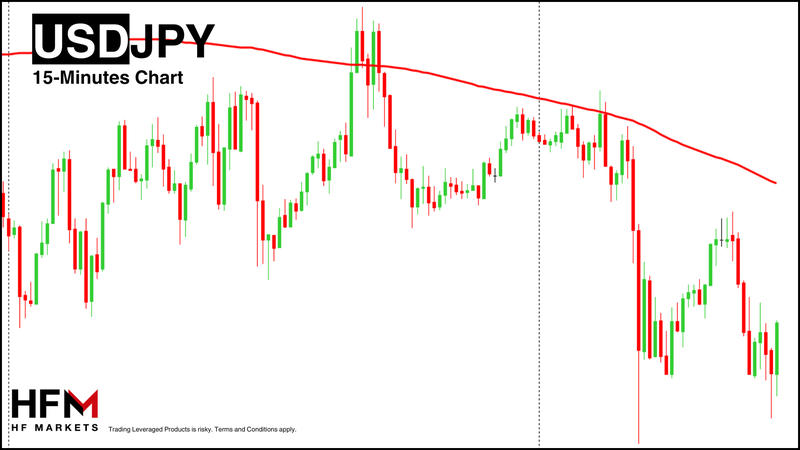 HFM - USDJPY 15-Minute Chart When it comes to government interventions, spreads tend to widen during the sudden spike in volatility and the price movement happens relatively quickly. Therefore, traders may consider an earlier entry with a medium-term view. On a 2-hour chart, the USDJPY has retraced back to the 75-bar Exponential Moving Average which can act as a support level. However, if this level is broken, sell signals may materialise on this timeframe. The MACD and RSI on the 2-hour chart are indicating downward price movement. On the 5-Minute timeframe the 200-bar Simple Moving Average and VWAP are indicating a bearish bias. According to the 200-bar EMA, sell signals are likely to remain as long as the price remains below 158.400. The main support level can be seen at 157.760. Key Takeaways: * Japan’s finance minister says currency intervention remains an option as the Yen weakens against the US Dollar. * Traders expect government support, but the Bank of Japan is unlikely to change interest rates until after the snap election. * Economists see limited rate hikes in 2026, with policy rates likely peaking near 1.25%. * Strong US economic data and a hawkish Federal Reserve continue to support the US Dollar. Technical indicators suggest downside risk for USDJPY unless prices move back above key resistance levels. Always trade with strict risk management. Your capital is the single most important aspect of your trading business. Please note that times displayed based on local time zone and are from time of writing this report. Click HERE to access the full HFM Economic calendar. Want to learn to trade and analyse the markets? Join our webinars and get analysis and trading ideas combined with better understanding of how markets work. Click HERE to register for FREE! Click HERE to READ more Market news. Michalis Efthymiou HFMarkets Disclaimer: This material is provided as a general marketing communication for information purposes only and does not constitute an independent investment research. Nothing in this communication contains, or should be considered as containing, an investment advice or an investment recommendation or a solicitation for the purpose of buying or selling of any financial instrument. All information provided is gathered from reputable sources and any information containing an indication of past performance is not a guarantee or reliable indicator of future performance. Users acknowledge that any investment in Leveraged Products is characterized by a certain degree of uncertainty and that any investment of this nature involves a high level of risk for which the users are solely responsible and liable. We assume no liability for any loss arising from any investment made based on the information provided in this communication. This communication must not be reproduced or further distributed without our prior written permission.
|
|
#503
19-01-2026, 09:33
|
||||
|
||||
|
Re: HFMarkets (hfm.com): Market analysis services.
Date:19th January 2026.
Trump’s Greenland Tariffs Shake Global Markets: Europe & NATO Pushes Back. Trading Leveraged products is Risky President Trump sinks the global stock market amid fears over a new trade war over the status of Greenland. Global indices, including those in the US, Europe and Asia, trade lower on Monday, with European stocks experiencing the largest falls. In addition to global indices experiencing a bearish decline, the US Dollar also falls at the market open. The downward price movement comes as a result of President Trump increasing the pressure on Denmark and the EU to agree to the purchase of Greenland. According to the US administration, the purchase is required for ‘global and national security’. In the President’s weekend speech, journalists were told that the US will impose tariffs on the UK and EU starting on 1 February. According to the President, this will happen unless they support his Greenland purchase proposals. US Tariffs on the UK and Europe The trade tariffs that have so far been announced are 10% on all trade starting from 1 February, rising to 25% on 1 June. The EU, UK, and other NATO countries are pushing back hard on the US demands and are looking for a compromise. According to political experts, the EU is attempting to agree to a joint presence within Greenland. This includes both military, trade, and institutional presence. However, according to the US President and administration, the US will only agree to a total purchase of the island. The latest member of the administration to speak on the matter is the Treasury Secretary, Scott Bessent. According to the Treasury, the European’s proposal on Greenland is ‘outsourcing our security to other countries’. Mr Bessent was quick to reject this while speaking on NBC news. Mr Bessent also made it clear that there is a race to the Arctic and the US is looking to build a protective ‘dome’ around the US hemisphere. The US’s main concerns in the region are Russia and China. The DAX & The EU Response The DAX is witnessing a decline of 1.30% due to the US-EU tensions over the weekend. The bearish price gap on Monday measures 1.45%, and the index is trading at a two-week low. The pressure from sellers is solely due to political tensions and the tariffs that have been thrown on the table. 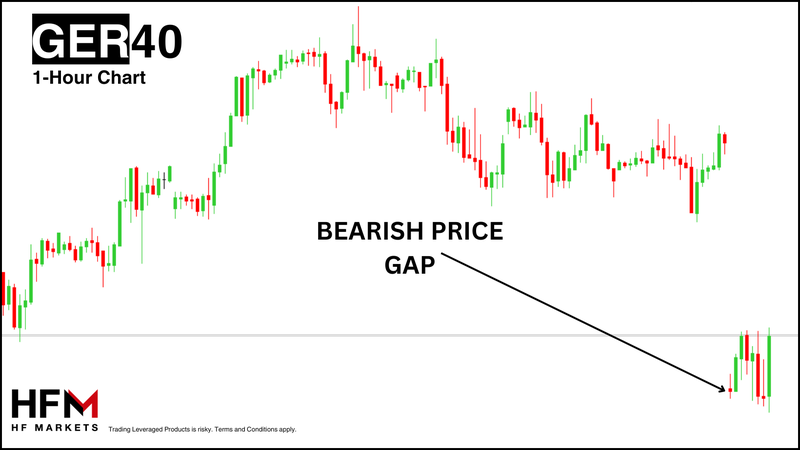 HFM - DAX 1-Hour Chart European leaders have been quick to condemn the tariff as dangerous, warning that they undermine transatlantic relations, and are unacceptable. US leaders have been quick to make statements emphasising sovereignty, unity, and international law. Currently, all EU countries as well as other NATO members have made it clear they will not sell Greenland to the US and will plan countermeasures. Countermeasures, in simple terms, are likely to increase military presence on the island and counter tariffs. Some members of the EU have already met on Sunday evening, but more meetings are due throughout the week. French President Emmanuel Macron has reportedly urged the European Union to use its ‘anti-coercion instrument,’ often called the ‘trade bazooka.’ This tool would allow the EU to limit US access to European markets or introduce export restrictions as part of a wider set of possible responses. It is being rumoured the German Chancellor also agrees. Other heads of state have mentioned imposing tariffs on the US worth $108 billion. Greenland and Denmark both held demonstrations over the weekend in their capital cities. As we can see, the US, NATO, and the EU are gearing up for what looks to be high tensions for the whole of 2026. Unless an agreement is reached, the stock market will struggle to maintain the bullish momentum from the past two-plus years. Technical analysts advise the price will be very reactive to comments made on the situation, meaning fundamental analysis will also be key. The DAX’s decline has taken the index from a Buy signal on the two-hour chart to a ‘neutral’ signal. NASDAQ Hits 17-Day Low The Nasdaq is witnessing the largest decline within the US after the US-EU tensions over the weekend. The bearish price gap on Monday measures 0.95%, and the index is trading at a 17-day low. Even though global indices are trading lower, the Nasdaq is experiencing slightly stronger bearish signals. 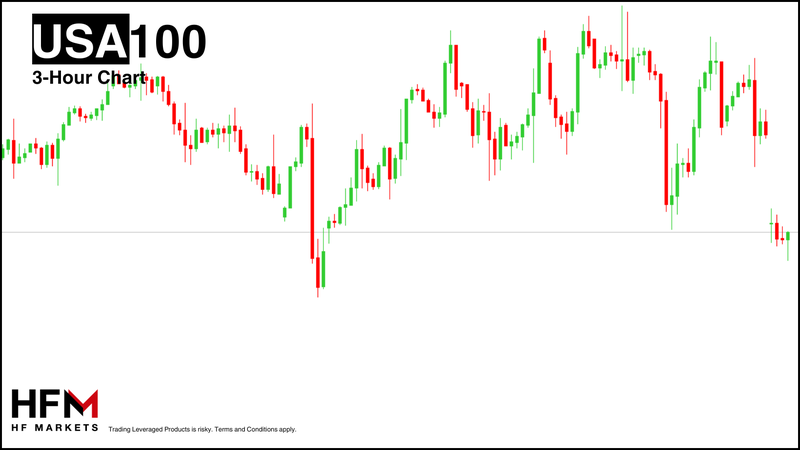 HFM - NASDAQ 3-Hour Chart The VIX is currently trading more than 9% higher, one of the strongest increases in recent months. The higher VIX indicates a lower risk appetite within the market and fear amongst investors. The price of the Nasdaq is currently trading below the day’s VWAP and below Moving Averages. For this reason, the Nasdaq is maintaining its bearish bias and, according to analysts, this potentially remains until further clarity. The main price driver will remain any comments from politicians on Greenland and tariffs. However, Netflix will also release its quarter earnings report tomorrow after market close. Netflix is the 14th most influential company for the Nasdaq, and its earnings report is also likely to impact its performance. Key Takeaways: * Stocks fall as fears of a US-EU trade war over Greenland spike, with European stocks hit hardest. The US Dollar is also weakening. * Trump threatens tariffs on the UK and EU from 1 February(10%, rising to 25% by June). Trump advises tariffs will be removed once they agree to a full US purchase of Greenland. * Europe and NATO reject the proposal, emphasising sovereignty, unity, and international law, and preparing countermeasures, including possible tariffs. * Stock indices show bearish signals: the DAX and Nasdaq are at multi-week lows. The VIX rose 9%, signalling increased market fear and lower risk appetite. Always trade with strict risk management. Your capital is the single most important aspect of your trading business. Please note that times displayed based on local time zone and are from time of writing this report. Click HERE to access the full HFM Economic calendar. Want to learn to trade and analyse the markets? Join our webinars and get analysis and trading ideas combined with better understanding of how markets work. Click HERE to register for FREE! Click HERE to READ more Market news. Michalis Efthymiou HFMarkets Disclaimer: This material is provided as a general marketing communication for information purposes only and does not constitute an independent investment research. Nothing in this communication contains, or should be considered as containing, an investment advice or an investment recommendation or a solicitation for the purpose of buying or selling of any financial instrument. All information provided is gathered from reputable sources and any information containing an indication of past performance is not a guarantee or reliable indicator of future performance. Users acknowledge that any investment in Leveraged Products is characterized by a certain degree of uncertainty and that any investment of this nature involves a high level of risk for which the users are solely responsible and liable. We assume no liability for any loss arising from any investment made based on the information provided in this communication. This communication must not be reproduced or further distributed without our prior written permission.
|
|
#504
20-01-2026, 08:59
|
||||
|
||||
|
Re: HFMarkets (hfm.com): Market analysis services.
Date: 20th January 2026.
Global Markets Volatile as US-EU Trade Tensions Rise and Japan’s Bond Yields Surge. Trading Leveraged products is Risky Global financial markets entered the week under renewed pressure as escalating geopolitical tensions between the United States and Europe reignited fears of a fresh trade war. Investor sentiment weakened sharply after US President Donald Trump intensified rhetoric surrounding Greenland, threatening broad tariffs on several European nations just as Wall Street heads into a pivotal earnings season. The convergence of geopolitical risk, legal uncertainty around US trade policy, and rising global bond yields has pushed markets into a defensive posture, weighing on equities while supporting safe-haven assets and volatility-sensitive instruments. US Stock Futures Drop as Trade Risks Re-Enter the Spotlight US equity futures signalled a sharply weaker start to Tuesday’s session following the holiday closure. Dow Jones Industrial Average futures slid more than 1%, implying a drop of over 500 points at the open. S&P 500 futures declined around 1.2%, while Nasdaq 100 futures underperformed with losses exceeding 1.4%. 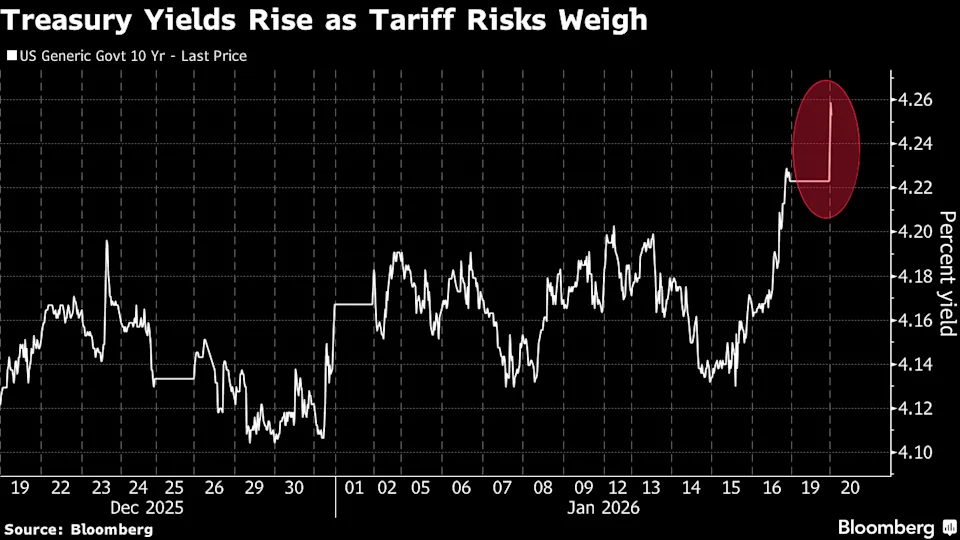 The move reflects mounting concern that renewed trade frictions could undermine corporate earnings expectations, disrupt cross-border supply chains, and slow global economic momentum, particularly at a time when equity valuations remain stretched. US stocks are coming off a negative week, leaving markets more vulnerable to macro and geopolitical shocks. 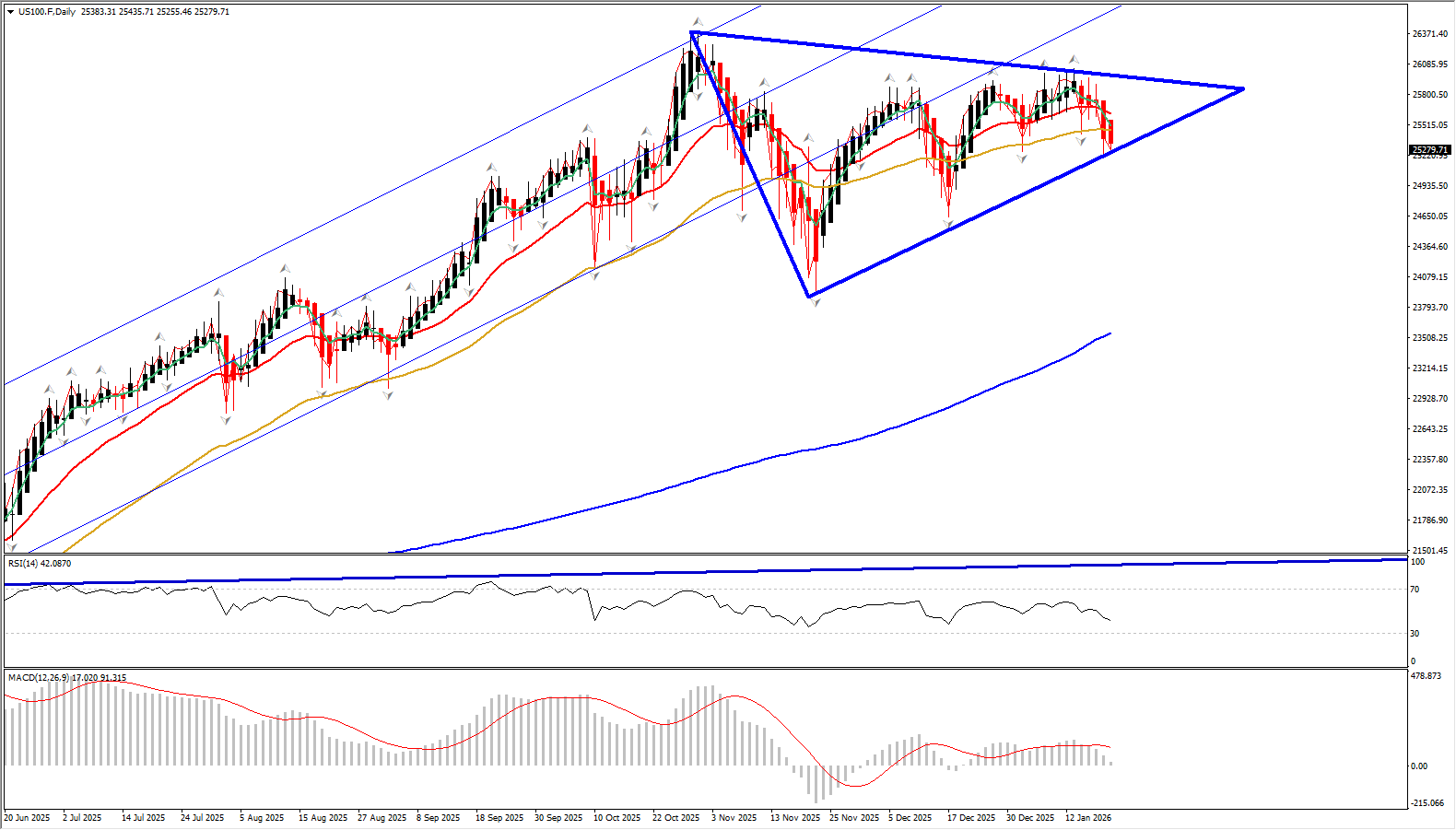 Greenland Tensions Reignite US–EU Trade War Fears Over the weekend, President Trump announced plans to impose tariffs on imports from eight European NATO members unless negotiations begin over the ‘complete and total purchase of Greenland’. Under the proposal, tariffs would start at 10% in early February and rise to as much as 25% by mid-year. European leaders swiftly rejected the threat, warning that such actions risk damaging transatlantic relations and triggering retaliatory measures. Reports suggest the EU is considering counter-tariffs worth up to $108 billion, raising concerns over a broader escalation that could weigh heavily on global trade and investment flows. Trump’s upcoming address at the World Economic Forum in Davos is expected to be closely scrutinised for further policy signals. Legal Uncertainty Adds Another Layer of Risk Markets are also watching a potential US Supreme Court ruling on whether the President’s use of the International Emergency Economic Powers Act to impose tariffs is constitutional. A decision could arrive as soon as this week. While US officials have expressed confidence that the policy will stand, any legal challenge to executive trade authority could significantly alter expectations around future tariffs, adding further volatility across equities, currencies, and commodities. Earnings Season Begins Under a Cloud of Uncertainty Beyond geopolitics, investor focus is shifting to a busy US earnings calendar. Major companies including Netflix, Intel, and Johnson & Johnson are set to report, with forward guidance expected to be more influential than headline results. Consensus forecasts point to S&P 500 earnings growth of roughly 12%-15% this year. However, lingering ‘Sell America’ sentiment, rising geopolitical risks, and tighter financial conditions suggest downside risks remain, particularly for multinational firms with significant overseas exposure. Asian Equity Markets Mixed as Political and Rate Risks Collide Asian equities mostly declined amid rising global risk aversion. Japan: The Nikkei 225 fell more than 1%, pressured by surging bond yields and election uncertainty. China: Mainland and Hong Kong markets edged lower, tracking global weakness. South Korea: The Kospi posted modest gains, bucking the regional trend. Australia: The ASX 200 slipped as external headwinds outweighed domestic factors. For FX and rates traders, Japan remains a key focal point, with bond-market volatility carrying potential implications for capital flows and yen dynamics. Japan’s Bond Rout Deepens, Sending Global Yield Shockwaves A sharp sell-off in Japanese government bonds intensified on Tuesday, pushing long-dated yields to record levels and adding to global market unease. Investors reacted negatively to Prime Minister Sanae Takaichi’s election platform, which includes a proposal to cut taxes on food without clearly identifying a funding source. The yield on Japan’s 40-year government bond surged beyond 4%, marking the highest level since the instrument was introduced in 2007 and the first time in over three decades that any Japanese sovereign maturity has reached such territory. Yields on both 30- and 40-year bonds jumped more than 25 basis points in a single session, the steepest move since the market turmoil following last year’s US tariff shock. A weak auction of 20-year bonds earlier in the day reinforced investor concerns about rising government spending, fiscal sustainability, and inflation risks. Since Takaichi took office in October, yields on Japan’s 20- and 40-year debt have climbed by around 80 basis points. Importantly for global markets, volatility in Tokyo spilled over into US Treasuries during Asian trading hours, with 30-year US yields rising by roughly 7 basis points, highlighting Japan’s growing influence on global rate dynamics. Market participants are increasingly alert to the risk that continued instability in Japanese bonds could reverberate across global fixed-income markets, particularly as Japan’s long-term yields now exceed those of Germany at comparable maturities. While some long-term investors see rising yields as improving value, especially on a currency-hedged basis, the broader concern is that bond markets are signalling discomfort with Japan’s fiscal trajectory. With a snap election scheduled for February 8, volatility in Japanese assets is expected to remain elevated. European Stocks Slide on Trade Concerns European equity markets closed sharply lower, led by export-heavy indices. Germany’s DAX and France’s CAC 40 suffered notable losses, while the UK’s FTSE 100 declined more modestly. European leaders warned that escalating tariffs could spark a damaging cycle of retaliation, further clouding the region’s already fragile growth outlook. Gold Holds Near Record High as Haven Demand Persists Gold prices remained just below record highs, supported by safe-haven demand and a softer US dollar. Silver, after briefly reaching an all-time high, eased slightly as traders locked in profits. Geopolitical uncertainty, rising bond volatility, and concerns over global growth continue to underpin defensive positioning, keeping precious metals in focus. 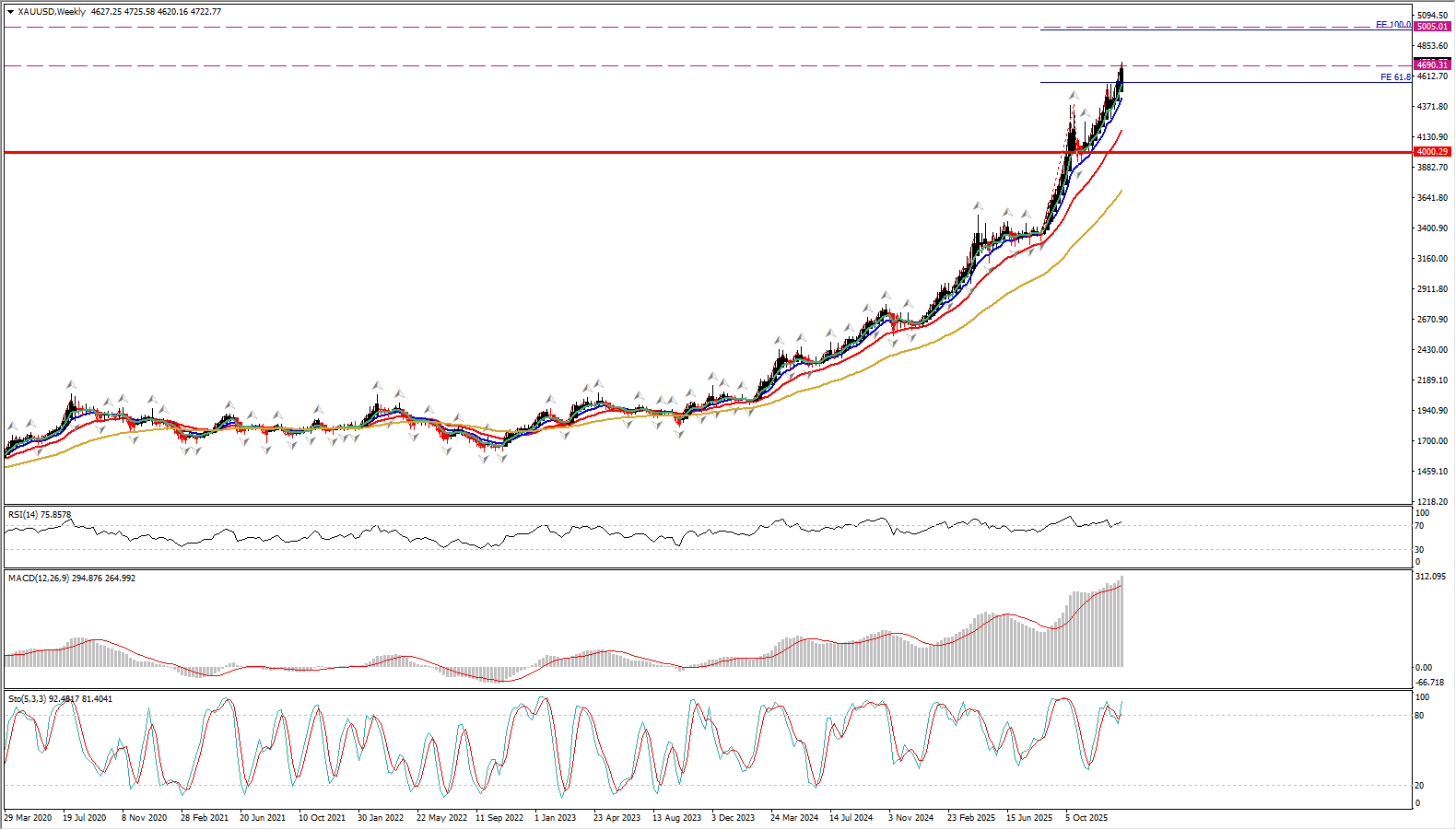 Oil Prices Steady as Supply Concerns Offset Geopolitical Risks Crude oil prices stabilised, balancing geopolitical uncertainty against concerns that supply is outpacing demand. Brent crude hovered in the mid-$60s per barrel, while WTI remained below $60. Despite tensions surrounding US-EU relations, traders remain focused on increasing OPEC+ output and warnings from the International Energy Agency that a surplus could emerge this year. A weaker US dollar has provided some near-term support, but the broader outlook remains cautious. 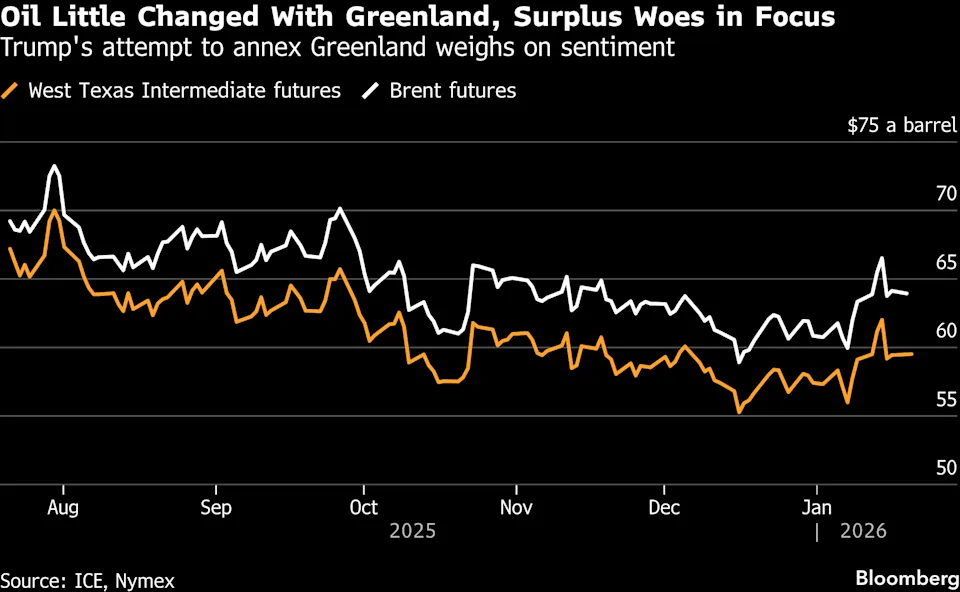 Central Banks and Inflation Data in Focus Looking ahead, markets are bracing for key macro events: Federal Reserve: Rates are widely expected to remain unchanged at the next meeting, as policymakers balance cooling labour markets against inflation still above target. Bank of Japan: This week’s policy meeting will be closely watched following the surge in bond yields. US Inflation Data: Upcoming releases of the Fed’s preferred inflation measure may shape expectations for the policy path ahead. Key Takeaways for Traders In the days ahead, market direction is likely to be driven by: * Developments in US–EU trade negotiations * Earnings guidance and analyst revisions * Japanese bond market volatility and global yield spillovers * Safe-haven flows into gold and FX markets * Central bank communication and inflation trends With geopolitics, earnings, and monetary policy all in play, conditions point to continued volatility, placing a premium on risk management, flexibility, and cross-asset awareness. Key Takeaways: * Stocks fall as fears of a US-EU trade war over Greenland spike, with European stocks hit hardest. The US Dollar is also weakening. * Trump threatens tariffs on the UK and EU from 1 February(10%, rising to 25% by June). Trump advises tariffs will be removed once they agree to a full US purchase of Greenland. * Europe and NATO reject the proposal, emphasising sovereignty, unity, and international law, and preparing countermeasures, including possible tariffs. * Stock indices show bearish signals: the DAX and Nasdaq are at multi-week lows. The VIX rose 9%, signalling increased market fear and lower risk appetite. Always trade with strict risk management. Your capital is the single most important aspect of your trading business. Please note that times displayed based on local time zone and are from time of writing this report. Click HERE to access the full HFM Economic calendar. Want to learn to trade and analyse the markets? Join our webinars and get analysis and trading ideas combined with better understanding of how markets work. Click HERE to register for FREE! Click HERE to READ more Market news. Andria Pichidi HFMarkets Disclaimer: This material is provided as a general marketing communication for information purposes only and does not constitute an independent investment research. Nothing in this communication contains, or should be considered as containing, an investment advice or an investment recommendation or a solicitation for the purpose of buying or selling of any financial instrument. All information provided is gathered from reputable sources and any information containing an indication of past performance is not a guarantee or reliable indicator of future performance. Users acknowledge that any investment in Leveraged Products is characterized by a certain degree of uncertainty and that any investment of this nature involves a high level of risk for which the users are solely responsible and liable. We assume no liability for any loss arising from any investment made based on the information provided in this communication. This communication must not be reproduced or further distributed without our prior written permission. Last edited by HFblogNews; 20-01-2026 at 09:02.
|
|
#505
16-02-2026, 10:36
|
||||
|
||||
|
Re: HFMarkets (hfm.com): Market analysis services.
Date: 16th February 2026.
Gold Pulls Back, Asia Trades Lightly, and AI Volatility Lingers: Markets Recalibrate Ahead of Key US Data. Trading Leveraged products is Risky Global markets opened the week in a restrained mood, with Lunar New Year holidays draining liquidity from Asia, precious metals retreating from recent highs, and investors continuing to digest last week’s AI-driven volatility. While price moves were modest on the surface, underlying themes remain significant: inflation expectations, Federal Reserve policy direction, emerging market resilience, and the structural impact of artificial intelligence. US markets will also be closed on Monday for the Presidents’ Day holiday. Lunar New Year Drains Liquidity Across Asia Trading activity across Asia was heavily influenced by Lunar New Year celebrations, creating thin market conditions and mixed equity performance. Major regional exchanges in mainland China, South Korea, and Taiwan were closed entirely. Hong Kong’s Hang Seng Index operated for only a half-day session, rising 0.5%. Elsewhere: * Australia’s S&P/ASX 200 gained 0.2% * India’s BSE Sensex added 0.3% * Japan’s Nikkei 225 slipped 0.2% Japan’s decline was less about holiday effects and more about disappointing economic data. The country’s GDP expanded at just 0.2% annualized in the final quarter of the year, below expectations. The weaker growth print increases the likelihood that Prime Minister Sanae Takaichi may pursue further fiscal stimulus to revive momentum. The Lunar New Year period once again highlights how regional cultural events can materially affect liquidity, volatility, and short-term price discovery in Asian markets. Gold and Silver Retreat After Extreme Volatility Precious metals moved lower on Monday as traders locked in profits amid thin trading conditions. * Gold fell 0.6% to $5,015 per ounce * Silver dropped 1.9% to $76.50 per ounce The pullback follows a period of dramatic swings. Gold had previously surged to record highs before suffering a sharp 9% one-day drop following news related to Federal Reserve leadership developments. Silver has been even more volatile, sliding more than 25% from recent peaks. Despite the latest decline, the broader trend remains powerful: * Gold is still up approximately 70% over the past 12 months * Silver has surged roughly 140% year-over-year Recent price action reflects consolidation rather than structural weakness. Friday’s US inflation data, which showed moderating price pressures, briefly reignited bullish momentum by strengthening expectations of potential Federal Reserve rate cuts. However, the lack of fresh catalysts combined with reduced Asian liquidity triggered profit-taking. The market appears to be transitioning from aggressive momentum buying to a phase of reassessment and balance between bullish structural drivers and short-term positioning pressures. Wall Street Stabilises After AI-Driven Turbulence Last week’s dominant theme was artificial intelligence disruption. Fears that AI could significantly reshape software, financial services, logistics, and real estate sectors triggered sharp moves beneath the surface of headline indices. By Friday: * The Nasdaq Composite ended the week down 2.1% * The S&P 500 posted a weekly loss of 1.4% * The Dow Jones Industrial Average declined 1.2% on the week Semiconductor heavyweight Nvidia fell 2.2% on Friday, reflecting ongoing sensitivity to AI expectations. Meanwhile, AppLovin rebounded sharply after steep prior losses, illustrating how quickly sentiment can shift in high-beta technology names. Markets found some stability after softer US inflation readings reinforced the possibility of further Federal Reserve easing this year. With US markets closed Monday for Presidents’ Day, attention now shifts to Friday’s Personal Consumption Expenditures (PCE) report — the Fed’s preferred inflation gauge. Emerging Market Currencies Quietly Outperform One of the more underappreciated developments in global markets is the unusual stability of emerging-market currencies. Volatility measures suggest EM currencies have fluctuated less than their G7 counterparts for nearly 200 consecutive trading days; a rare stretch of calm. Several factors are contributing: * A softer US dollar * Expectations of gradual Fed rate cuts * Strong commodity prices * Robust capital inflows The carry trade dynamic remains supportive, as investors borrow in low-yielding currencies and allocate capital to higher-yielding emerging-market assets. So far this year, a basket of developing-market currencies has gained roughly 3%, extending last year’s strong performance. Controlled volatility continues to attract inflows, though such conditions tend to be fragile if global risk sentiment deteriorates. Oil and FX: Stability for Now Oil prices were largely unchanged, reflecting balanced supply-demand conditions. In foreign exchange: * The US dollar strengthened modestly against the Japanese yen * The euro eased slightly versus the dollar Movements were relatively contained, consistent with reduced liquidity and a broader wait-and-see tone ahead of key US data releases. The Bigger Picture: Repricing, Not Panic Markets are not in panic mode; they are in recalibration mode. * Precious metals are consolidating after extreme swings. * Equities are digesting AI disruption narratives. * Emerging markets are benefiting from controlled volatility. * Central bank expectations remain the anchor of sentiment. With Lunar New Year disruptions fading and US inflation data ahead, liquidity will return, and with it, potentially stronger directional moves. For now, the environment is defined by balance: optimism about easing inflation and resilient asset performance, tempered by structural uncertainty around AI, policy credibility, and global growth. The next decisive catalyst is likely to come from inflation data and how it reshapes expectations for the Federal Reserve’s next move. Always trade with strict risk management. Your capital is the single most important aspect of your trading business. Please note that times displayed based on local time zone and are from time of writing this report. Click HERE to access the full HFM Economic calendar. Want to learn to trade and analyse the markets? Join our webinars and get analysis and trading ideas combined with better understanding of how markets work. Click HERE to register for FREE! Click HERE to READ more Market news. Andria Pichidi HFMarkets Disclaimer: This material is provided as a general marketing communication for information purposes only and does not constitute an independent investment research. Nothing in this communication contains, or should be considered as containing, an investment advice or an investment recommendation or a solicitation for the purpose of buying or selling of any financial instrument. All information provided is gathered from reputable sources and any information containing an indication of past performance is not a guarantee or reliable indicator of future performance. Users acknowledge that any investment in Leveraged Products is characterized by a certain degree of uncertainty and that any investment of this nature involves a high level of risk for which the users are solely responsible and liable. We assume no liability for any loss arising from any investment made based on the information provided in this communication. This communication must not be reproduced or further distributed without our prior written permission.
|
|
#506
17-02-2026, 09:58
|
||||
|
||||
|
Re: HFMarkets (hfm.com): Market analysis services.
Date: 17th February 2026.
Market Wrap: Tech Weakness Extends as AI Fears and Geopolitics Weigh on Sentiment. Trading Leveraged products is Risky Global markets reopened Tuesday with a cautious tone as investors returned from the US Presidents’ Day holiday to find risk appetite still fragile. Equity-index futures signalled further downside in US technology stocks, while bond markets attracted renewed demand amid geopolitical uncertainty and shifting expectations around monetary policy. US Futures Point Lower as Tech Slide Deepens Futures linked to the S&P 500 declined roughly 0.4%, while contracts on the Nasdaq 100 dropped nearly 0.8%, indicating that the recent pullback in growth and AI-linked names may not be over. The technology sector, which had driven much of the market’s upside momentum in recent months, continues to face pressure as investors reassess valuations and the longer-term implications of AI disruption. Last week’s inflation data complicated expectations for Federal Reserve rate cuts, and traders now await further signals from upcoming Fed commentary and minutes from January’s policy meeting. Bonds Gain as Safe-Haven Demand Returns US Treasury yields edged lower, with the 10-year yield slipping to around 4.02%, reflecting defensive positioning. The Japanese yen, traditionally viewed as a safe-haven currency, strengthened against the dollar, reinforcing the shift toward caution. In Japan, government bonds rallied across the curve following stronger-than-expected demand at a five-year auction, suggesting that expectations for near-term tightening by the Bank of Japan are softening. 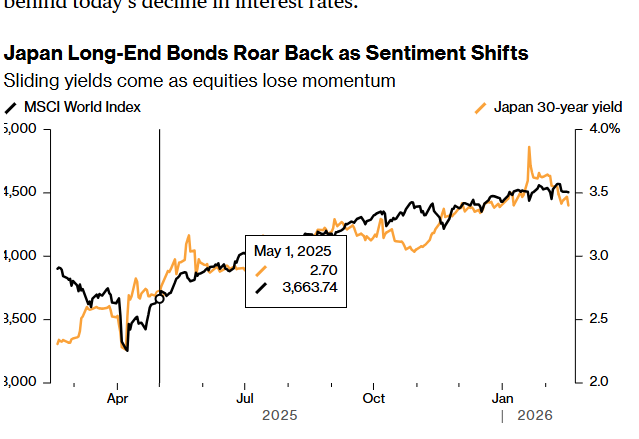 Asia Quiet, Europe Under Pressure Trading volumes in Asia were subdued as markets in China, Hong Kong, and several regional centres remained closed for the Lunar New Year. Elsewhere in the region, equity performance was mixed, with Australia and India posting modest gains. European markets have prepared for a weaker open. In the UK, the pound weakened after unemployment climbed to a near five-year high and wage growth moderated, data that could influence the Bank of England’s rate trajectory in the coming months. Middle East Tensions Back in Focus Geopolitical risks re-emerged as a key driver of market tone. Iran’s recent naval drills near a critical shipping route heightened concerns ahead of renewed nuclear discussions with the United States. Diplomatic efforts are ongoing, but rhetoric has intensified. Former President Donald Trump has warned of potential military action should negotiations fail, adding another layer of uncertainty to an already fragile environment. Oil prices held relatively firm amid these developments, though broader commodity markets reflected risk-off sentiment. Precious Metals and Crypto Pull Back Despite geopolitical tensions, precious metals retreated. Gold slipped toward the $4,900 per ounce level, while silver and platinum recorded sharper losses. The decline suggests profit-taking after recent rallies rather than a full unwind of safe-haven positioning. Cryptocurrencies also softened, with Bitcoin trading near $68,300. The pullback comes amid broader volatility across speculative assets as traders recalibrate exposure to high-beta trades. 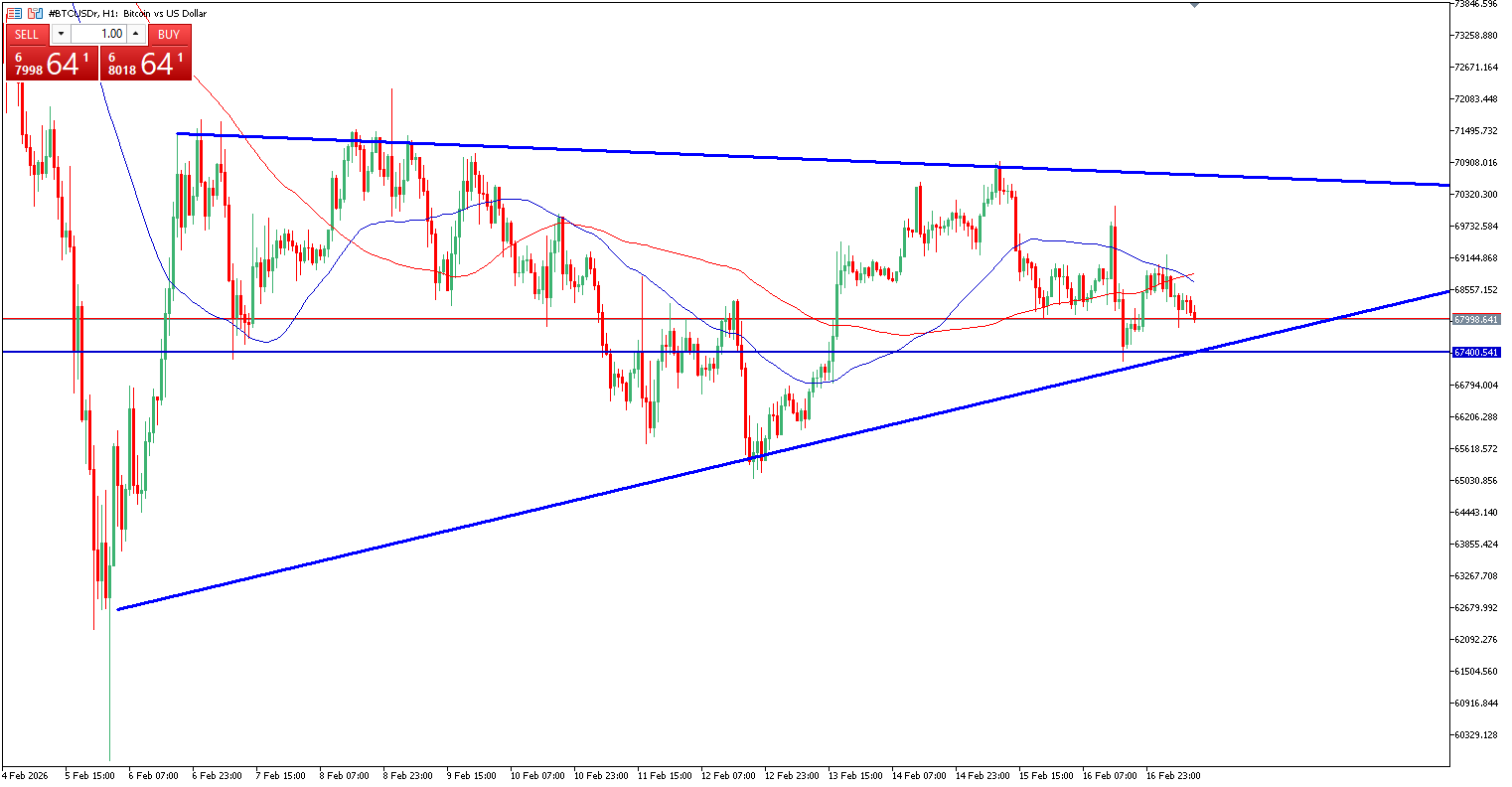 The “AI Cannibalisation” Debate Intensifies Artificial intelligence remains a central theme driving cross-asset volatility. While earnings growth in the US remains resilient, with companies delivering approximately 13% growth this season, concerns are building around what some strategists describe as “AI cannibalisation.” The debate centres on whether AI adoption will enhance productivity or disrupt entire business models, particularly in software, media, and business services. Investment banks are already structuring thematic baskets that go long companies poised to benefit from AI adoption while shorting those potentially vulnerable to workflow displacement. This divergence is adding dispersion within equity markets and amplifying stock-specific volatility. Corporate Movers Several notable corporate developments added to the narrative: * BHP Group shares surged after reporting a more than 20% rise in half-year earnings, supported by strong copper prices. * Apple Inc. announced a March 4 product launch event, fueling anticipation for new device announcements. * Danaher Corporation is reportedly nearing a $10 billion acquisition of Masimo. * Alibaba Group unveiled a major upgrade to its flagship AI model, intensifying competition in China’s fast-moving AI race. * Advanced Micro Devices announced collaboration plans with Tata Consultancy Services to expand AI data-centre capabilities in India. The Bigger Picture Markets are navigating a complex intersection of themes: * Slowing but persistent inflation * Uncertainty over the timing of Fed rate cuts * Renewed geopolitical risks * Earnings resilience versus valuation concerns * Structural disruption from artificial intelligence With liquidity thinner due to global holidays and catalysts limited early in the week, volatility may remain elevated as investors look toward fresh economic data and central bank commentary for direction. For now, the tone is defensive. Whether this develops into a deeper correction or merely a consolidation phase will likely depend on upcoming inflation readings, Fed communication, and the sustainability of corporate earnings growth. Always trade with strict risk management. Your capital is the single most important aspect of your trading business. Please note that times displayed based on local time zone and are from time of writing this report. Click HERE to access the full HFM Economic calendar. Want to learn to trade and analyse the markets? Join our webinars and get analysis and trading ideas combined with better understanding of how markets work. Click HERE to register for FREE! Click HERE to READ more Market news. Andria Pichidi HFMarkets Disclaimer: This material is provided as a general marketing communication for information purposes only and does not constitute an independent investment research. Nothing in this communication contains, or should be considered as containing, an investment advice or an investment recommendation or a solicitation for the purpose of buying or selling of any financial instrument. All information provided is gathered from reputable sources and any information containing an indication of past performance is not a guarantee or reliable indicator of future performance. Users acknowledge that any investment in Leveraged Products is characterized by a certain degree of uncertainty and that any investment of this nature involves a high level of risk for which the users are solely responsible and liable. We assume no liability for any loss arising from any investment made based on the information provided in this communication. This communication must not be reproduced or further distributed without our prior written permission.
|
|
#507
19-02-2026, 09:06
|
||||
|
||||
|
Re: HFMarkets (hfm.com): Market analysis services.
Date: 19th February 2026.
Markets Walk a Tightrope: Strong Data Meets Rising Geopolitical Risk. Trading Leveraged products is Risky As traders approach the weekend, markets are balancing resilience in US data and corporate earnings against mounting geopolitical uncertainty. While equities have extended gains, underlying caution is becoming more visible, particularly in commodities and safe-haven assets. Geopolitical Risk Returns to the Forefront The key macro driver remains escalating tensions between the United States and Iran. Reports suggesting an increased likelihood of military confrontation have lifted oil sharply, with Brent crude holding above $70 and West Texas Intermediate trading above $65. Any disruption from the Middle East, a region responsible for roughly a third of global oil supply, would have immediate inflation implications. That risk alone is enough to keep traders cautious, particularly ahead of a weekend when headline exposure cannot be managed intraday. Gold has edged higher, while Bitcoin has slipped, a subtle signal that risk appetite remains selective rather than euphoric. 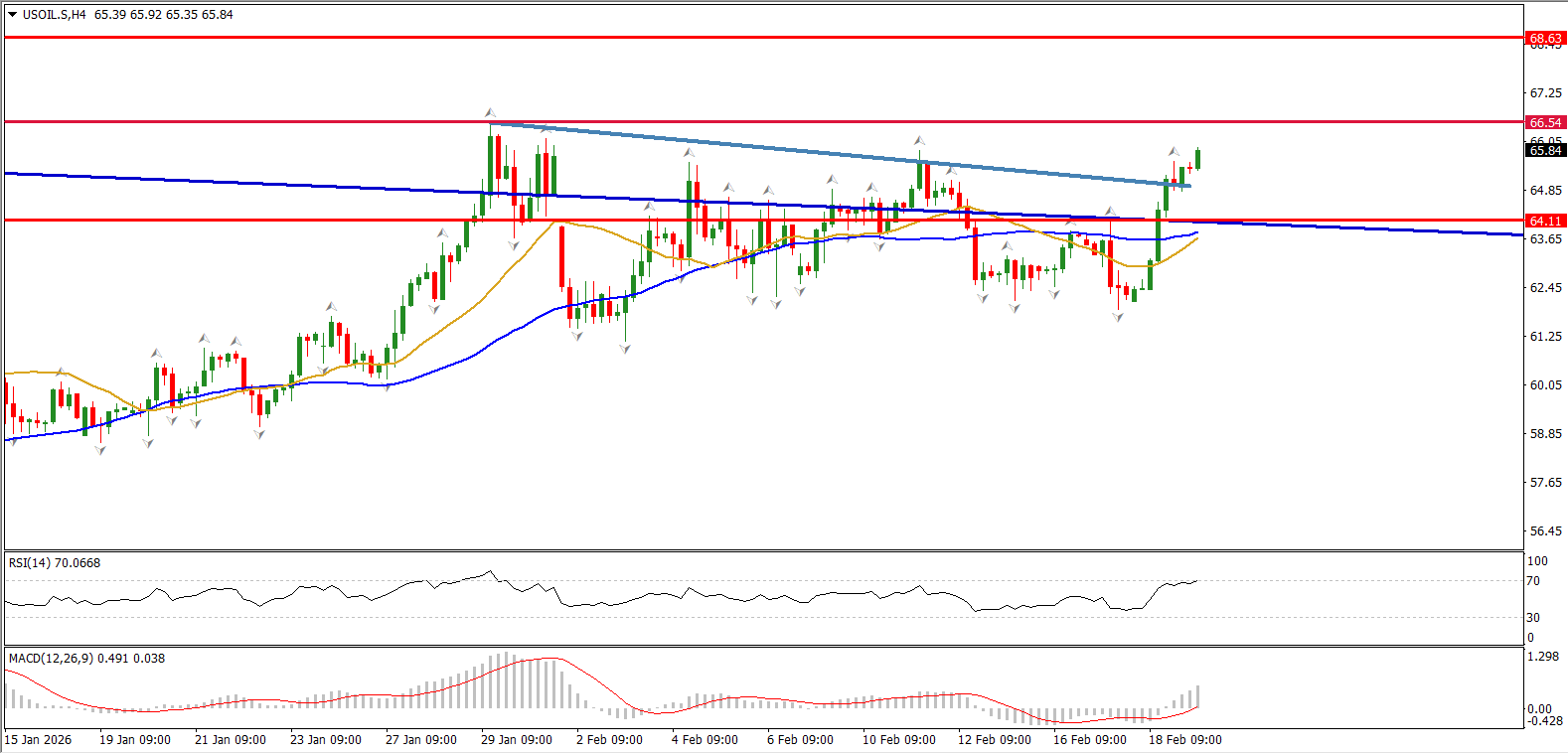 Labour Market Stability Keeps the Fed Patient Thursday’s US jobless claims data is the only meaningful release on the calendar. Initial claims are expected at 225K, with continuing claims near 1.86 million. Recent labour market readings have shown gradual stabilisation rather than deterioration, reinforcing the view that the Federal Reserve does not need to rush into rate cuts. Minutes from the January meeting revealed divisions within the central bank. Some officials remain concerned about persistent inflation, while others are open to easing later in the year. Despite hawkish undertones, market pricing still anticipates two rate cuts by year-end. Unless jobless claims deviate significantly from expectations, the data is unlikely to shift that pricing meaningfully. For now, policy expectations remain steady, but sensitive to surprises. Equities Supported by Tech Leadership US futures are hovering near flat after a solid session in which the S&P 500 and Nasdaq Composite both advanced, led by renewed strength in mega-cap technology. Nvidia once again played a central role in lifting sentiment, particularly following AI-related partnership developments with Meta Platforms. Given Nvidia’s heavy index weighting, its performance continues to exert disproportionate influence on broader benchmarks. However, the AI narrative remains double-edged. While it drives index gains, it also fuels volatility in sectors perceived as vulnerable to disruption. Markets have recently shown a tendency toward sharp rotational moves, underscoring how fragile conviction can be beneath the surface. Global Markets and Diverging Policy Paths In Asia, indices such as the Nikkei 225 and Kospi posted gains following Wall Street’s strength. In Europe, the FTSE 100 advanced after inflation data reinforced expectations that the Bank of England may move towards rate cuts. This divergence highlights an important theme for currency traders: monetary cycles are no longer synchronised globally. Relative policy expectations may drive FX volatility more than absolute levels. The Bigger Picture for Tradersv At the moment, markets are not pricing panic, but they are pricing uncertainty. Strong US data reduces the urgency for rate cuts. Elevated oil prices threaten to reintroduce inflationary pressure. And geopolitical risk adds a layer of unpredictability that can shift sentiment rapidly. This environment typically produces choppy price action, sector rotation, and headline-driven volatility rather than clean, trending moves. As we move towards the weekend, traders may find that disciplined positioning and controlled exposure matter more than directional conviction. Always trade with strict risk management. Your capital is the single most important aspect of your trading business. Please note that times displayed based on local time zone and are from time of writing this report. Click HERE to access the full HFM Economic calendar. Want to learn to trade and analyse the markets? Join our webinars and get analysis and trading ideas combined with better understanding of how markets work. Click HERE to register for FREE! Click HERE to READ more Market news. Andria Pichidi HFMarkets Disclaimer: This material is provided as a general marketing communication for information purposes only and does not constitute an independent investment research. Nothing in this communication contains, or should be considered as containing, an investment advice or an investment recommendation or a solicitation for the purpose of buying or selling of any financial instrument. All information provided is gathered from reputable sources and any information containing an indication of past performance is not a guarantee or reliable indicator of future performance. Users acknowledge that any investment in Leveraged Products is characterized by a certain degree of uncertainty and that any investment of this nature involves a high level of risk for which the users are solely responsible and liable. We assume no liability for any loss arising from any investment made based on the information provided in this communication. This communication must not be reproduced or further distributed without our prior written permission.
|
|
#508
20-02-2026, 09:45
|
||||
|
||||
|
Re: HFMarkets (hfm.com): Market analysis services.
Date: 20th February 2026.
Brent Above $72: Markets React to Iran Tensions, Fed Uncertainty and AI Risks. Trading Leveraged products is Risky Global markets ended the week navigating a complex mix of artificial intelligence disruption fears, intensifying US-Iran tensions, and shifting monetary policy expectations. While US futures attempted a modest rebound, equity benchmarks across Asia delivered a mixed performance as investors reassessed risk exposure. At the centre of the narrative: rising oil prices, renewed geopolitical uncertainty, and growing questions about how AI-driven transformation may reshape entire industries. Oil Climbs as US-Iran Tensions Escalate Crude prices surged to their highest level in six months after President Donald Trump warned Iran it had roughly two weeks to reach a nuclear agreement. Meanwhile, the US expanded its military presence in the Middle East, including aircraft carriers and fighter jets, increasing the risk premium embedded in energy markets. * Brent crude oil rose above $72 per barrel. * West Texas Intermediate crude climbed toward $67 per barrel. * Weekly gains exceeded 6%. A potential military confrontation would threaten oil flows from a region responsible for roughly one-third of global supply. Unsurprisingly, investors rotated toward traditional safe havens, lifting gold and the US dollar. The geopolitical backdrop has halted what had been a tentative recovery in global equities after weeks of volatility tied to AI-related disruption concerns. 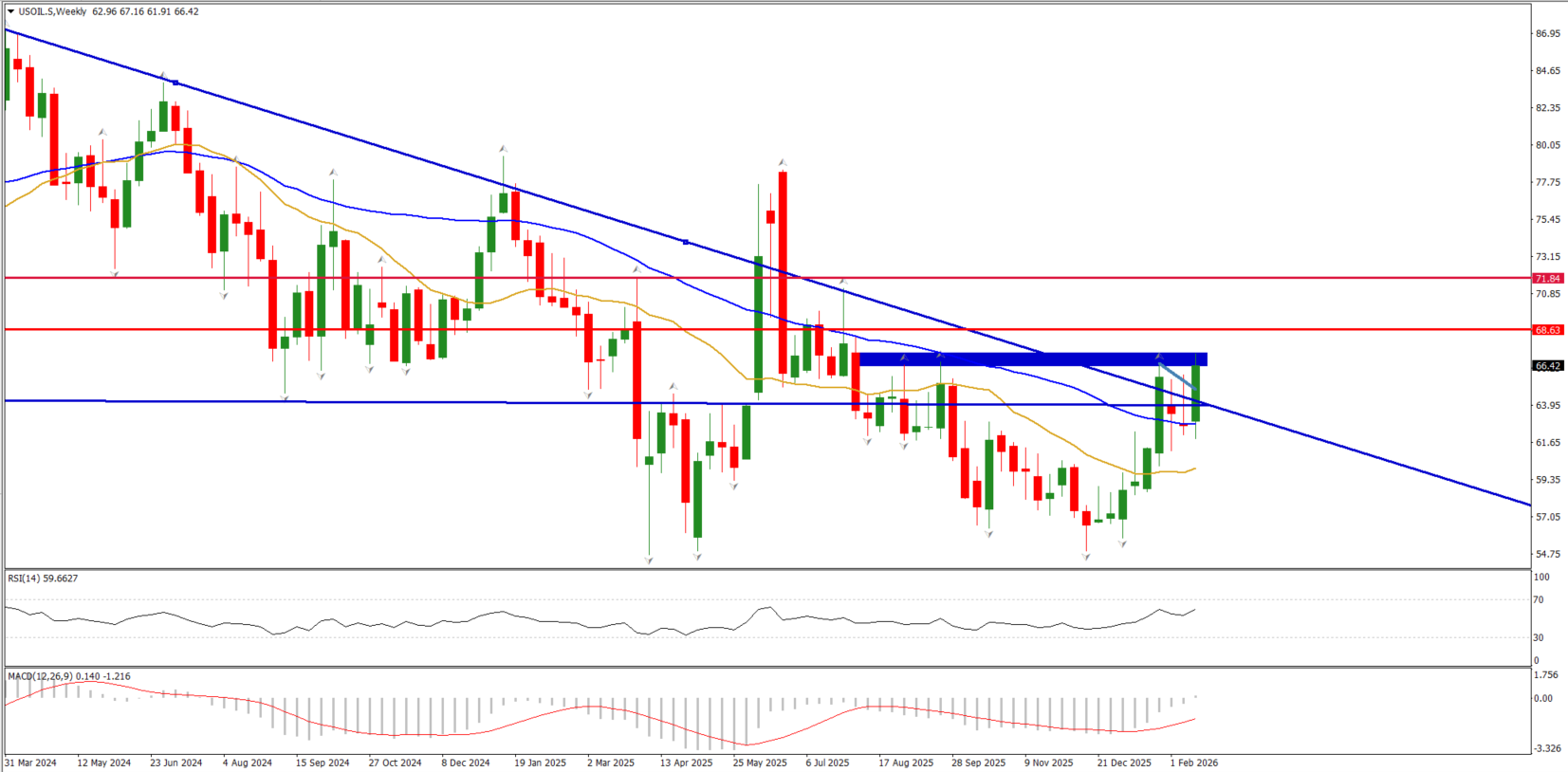 Asia Markets Mixed: Financials and Tech Under Pressure Asian equities reflected the cautious tone. Japan: The Nikkei 225 fell 1.2%, dragged lower by financial institutions exposed to private credit risks. Shares of Mitsubishi UFJ Financial Group dropped after its US partner, Blue Owl Capital, restricted withdrawals from one of its funds, triggering concerns about liquidity stress in private credit markets. Major exporters also weakened: * Toyota Motor Corporation declined nearly 4%. * Sony Group Corporation fell over 3%. Hong Kong & China: The Hang Seng Index slipped as trading resumed after Lunar New Year holidays, while mainland Chinese markets remained closed. South Korea: The Outperformer In contrast, the KOSPI surged over 2%, extending its position as one of the best-performing markets globally this year. Defence stocks led gains. Rising global military spending and continued retail enthusiasm tied to AI-related optimism have underpinned South Korea’s equity strength in 2026. Wall Street Struggles With AI Disruption Fears US markets closed lower Thursday. AI-related disruption remains a dominant theme. Several companies reported solid earnings but still faced sharp sell-offs, reflecting investor anxiety that artificial intelligence could rapidly erode traditional business models. * Booking Holdings fell over 6% despite beating expectations. The stock is down roughly 25% this year amid concerns about AI-powered competition. * Carvana dropped nearly 8% despite stronger profits. * Walmart swung from gains to losses after issuing a cautious outlook. Meanwhile, energy stocks benefited from rising crude prices. Occidental Petroleum surged over 9% following stronger-than-expected earnings. Dollar Strength and Fed Policy in Focus The Bloomberg Dollar Spot Index is on track for its strongest weekly performance in four months, as traders scale back expectations for Federal Reserve rate cuts. Higher oil prices could complicate the Fed’s path. Policymakers have reiterated they want clearer evidence that inflation is cooling before easing further. Rising energy costs risk reigniting price pressures. Economic data delivered mixed signals: * Jobless claims declined, suggesting layoffs may be stabilising. M* anufacturing activity in the mid-Atlantic region accelerated. * The US trade deficit widened more than expected. The US dollar gained against the yen while the euro edged lower, reflecting haven demand and shifting rate expectations. ECB Leadership Speculation Adds European Uncertainty Attention also turned to Europe, where Christine Lagarde addressed speculation about a potential early departure from the European Central Bank. Lagarde reaffirmed that her ‘baseline’ is to complete her term, emphasising her mission of safeguarding price stability and protecting the euro. However, reports suggesting political manoeuvring ahead of French elections have stirred debate about institutional independence. The uncertainty adds another layer of complexity to European market sentiment at a time when global risk appetite is already fragile. UK Consumer Resilience Surprises In contrast to broader caution, UK retail sales posted their strongest growth in 20 months. According to official data: * January sales volumes rose 1.8%, well above expectations. * The budget surplus hit a record high for the month. Improving inflation trends and earlier rate cuts appear to be supporting consumer confidence. For policymakers, the data offers cautious optimism that economic momentum may be stabilising. Emerging Markets Under Pressure Emerging Asian equities and currencies weakened as rising oil prices and Middle East tensions dampened risk appetite. A sustained rise in energy costs could weigh heavily on oil-importing nations while boosting commodity exporters. Currency volatility is likely to remain elevated if geopolitical risks intensify. The Bigger Picture: Fragile Recovery Meets Geopolitical Risk Markets are currently balancing three powerful forces: * AI-driven structural disruption * Geopolitical escalation in the Middle East * Uncertain central bank policy paths Oil’s six-month high underscores how quickly geopolitical developments can reshape risk sentiment. At the same time, concerns about artificial intelligence disrupting traditional sectors continue to pressure specific industries. For now, investors appear cautious rather than panicked, rotating selectively into energy, defence, and safe-haven assets while trimming exposure to sectors perceived as vulnerable to technological disruption. Whether diplomacy prevails in the Middle East and whether inflation remains contained will likely determine the next decisive move across global markets. Always trade with strict risk management. Your capital is the single most important aspect of your trading business. Please note that times displayed based on local time zone and are from time of writing this report. Click HERE to access the full HFM Economic calendar. Want to learn to trade and analyse the markets? Join our webinars and get analysis and trading ideas combined with better understanding of how markets work. Click HERE to register for FREE! Click HERE to READ more Market news. Andria Pichidi HFMarkets Disclaimer: This material is provided as a general marketing communication for information purposes only and does not constitute an independent investment research. Nothing in this communication contains, or should be considered as containing, an investment advice or an investment recommendation or a solicitation for the purpose of buying or selling of any financial instrument. All information provided is gathered from reputable sources and any information containing an indication of past performance is not a guarantee or reliable indicator of future performance. Users acknowledge that any investment in Leveraged Products is characterized by a certain degree of uncertainty and that any investment of this nature involves a high level of risk for which the users are solely responsible and liable. We assume no liability for any loss arising from any investment made based on the information provided in this communication. This communication must not be reproduced or further distributed without our prior written permission.
|
|
#509
02-03-2026, 11:11
|
||||
|
||||
|
Re: HFMarkets (hfm.com): Market analysis services.
Date: 2nd March 2026.
Geopolitical Risk Rocks Markets: Oil Prices Surge, Stocks Slide, Gold Gains Amid Iran Crisis. Trading Leveraged products is Risky Global financial markets entered the week under pressure as escalating tensions between the United States and Iran triggered a broad ‘risk-off’ move across asset classes. The developing crisis, centred around disruptions in the Strait of Hormuz, has intensified concerns about oil supply, inflation expectations, and renewed stock market volatility. For traders and investors, this represents a critical macro inflection point. Oil Prices Surge on Strait of Hormuz Disruption Energy markets reacted immediately to reports that traffic through the Strait of Hormuz, a strategic chokepoint responsible for nearly 20% of global oil flows, has been severely disrupted. Brent Crude Futures initially spiked by as much as 13% before moderating, but prices remain significantly elevated. The Strait of Hormuz is a vital artery for global energy supply. Any prolonged closure or military escalation raises the risk of sustained oil price inflation, which would: * Complicate central bank policy trajectories * Reinforce inflationary pressures globally * Increase input costs across major economies * Intensify volatility across commodity-linked currencies Should supply disruptions persist, analysts warn that oil could test materially higher levels, potentially reintroducing energy-driven inflation as a dominant macro theme. For traders, oil has become the primary real-time indicator of whether the geopolitical shock evolves into a prolonged structural crisis. 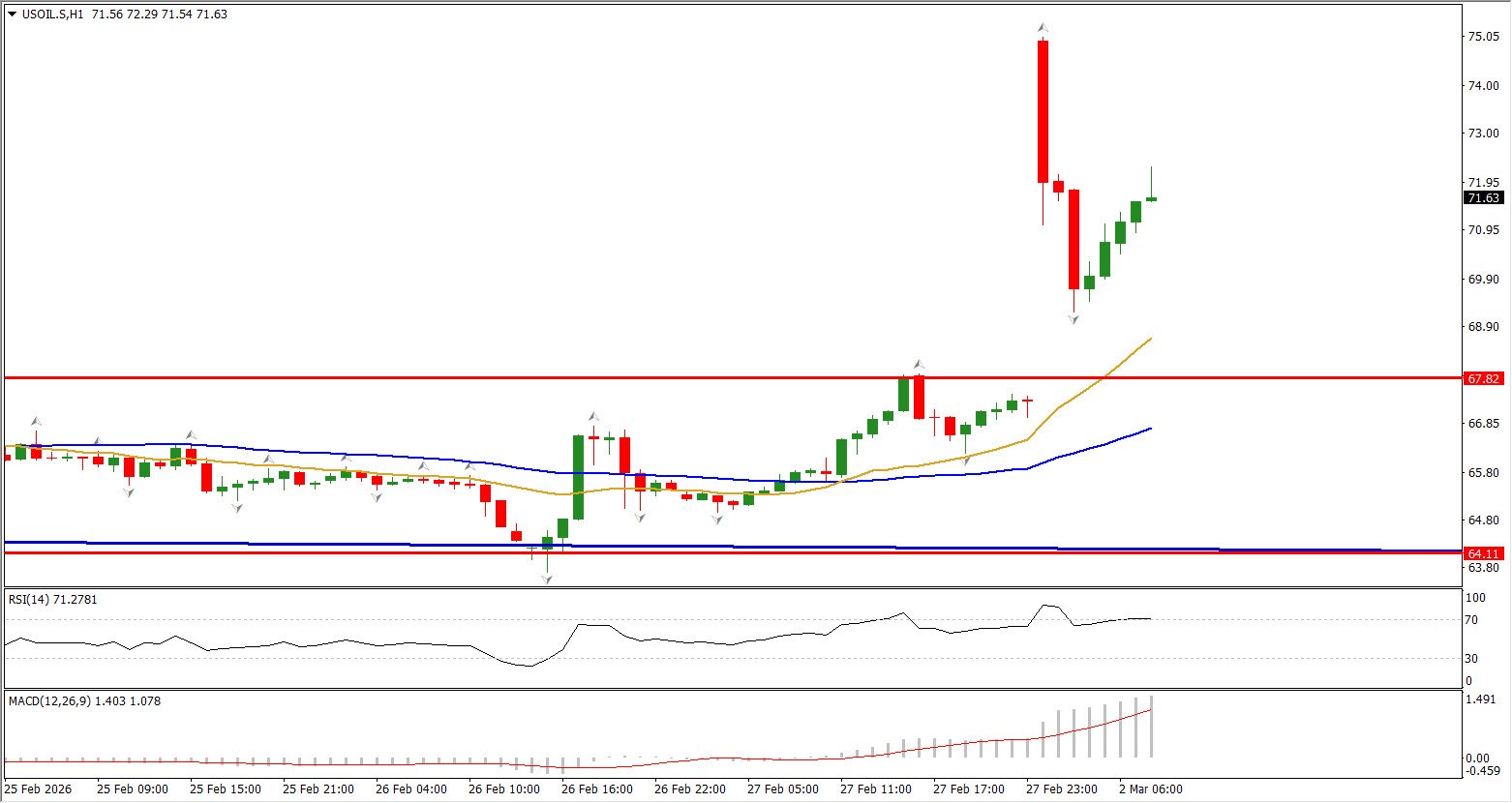 HFM - Gold 1-Hour Chart Stock Markets Retreat as Risk Sentiment Weakens Equity markets across Asia declined sharply, while US equity-index futures pointed to additional downside pressure. European markets are also expected to open lower. The pullback comes at a vulnerable moment for global equities. Prior to the escalation, markets were already contending with: * Elevated valuation metrics * Concerns surrounding AI-driven speculative positioning * Signs of strain in private credit markets * Increased sensitivity to inflation data Strategists at Barclays Plc cautioned against premature dip-buying, noting that geopolitical risk, combined with high valuations, reduces near-term risk-reward attractiveness. If oil prices remain elevated, equity markets may face a dual headwind: slowing growth expectations and renewed inflation pressure. Gold Advances as Safe-Haven Demand Strengthens Safe-haven flows have supported precious metals amid the rise in geopolitical uncertainty. Gold Futures advanced as investors sought protection against both conflict escalation and potential inflation resurgence. Gold’s strength reflects defensive portfolio positioning rather than systemic stress at this stage. However, sustained gains would indicate deepening concern about macro stability and purchasing power erosion. 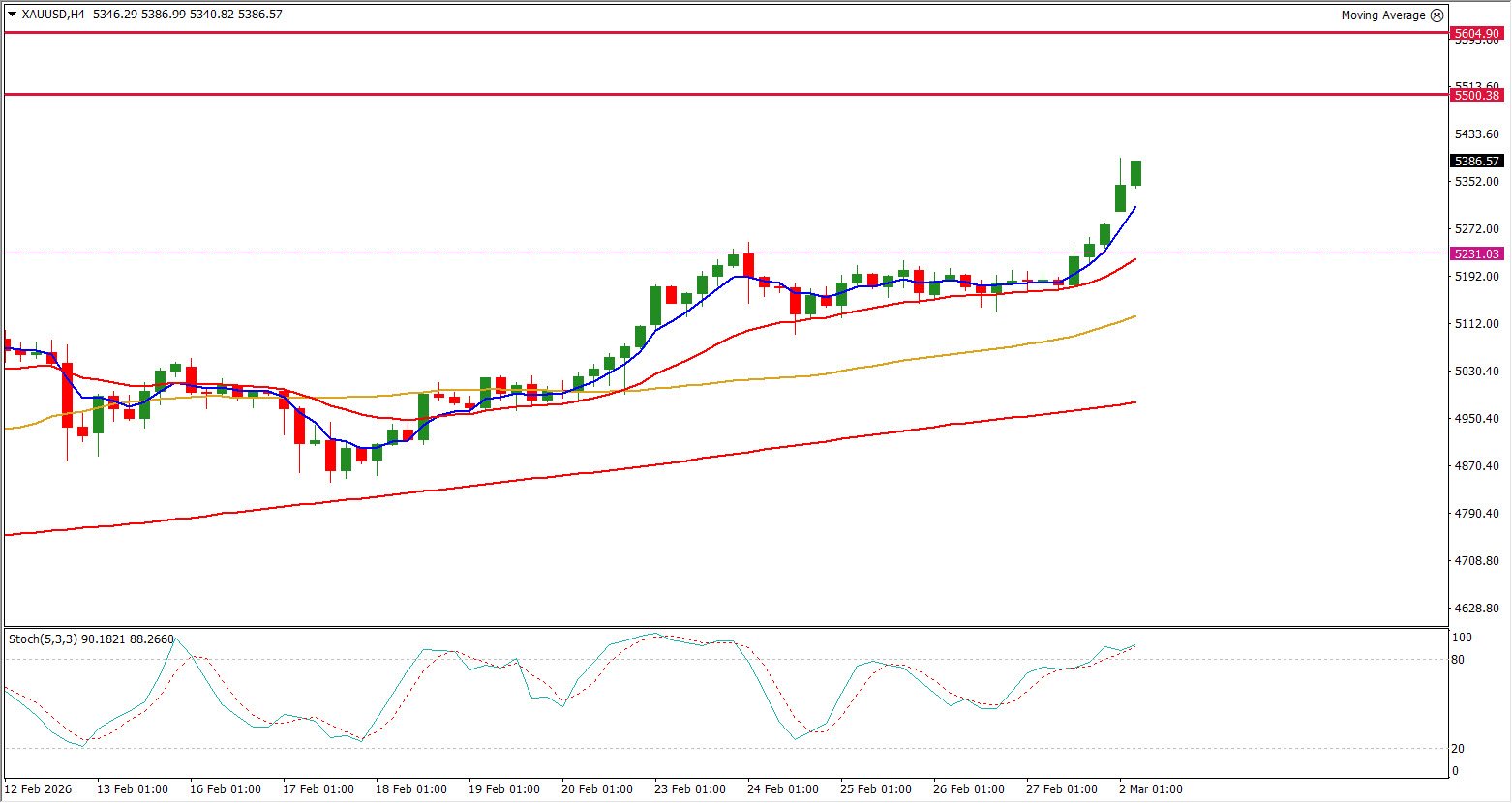 US Dollar and Treasury Markets: A Complex Inflation Dynamic The US dollar has strengthened moderately, consistent with traditional safe-haven demand during geopolitical crises. However, the bond market faces a more nuanced reaction: * Risk aversion typically compresses yields * Rising oil prices increase inflation expectations, placing upward pressure on yields If crude oil continues to climb, expectations for monetary easing could be repriced, particularly if higher energy costs feed into broader consumer price data. This dynamic introduces heightened volatility risk across major currency pairs and rate-sensitive assets. Why This Geopolitical Crisis Carries Structural Risk Financial markets have grown accustomed to short-lived geopolitical flare-ups. However, the current episode presents more durable risks: * Potential long-term disruption to global energy supply chains * Broader instability across the Middle East * Shipping and trade route vulnerability * Inflation reacceleration at a sensitive stage in the economic cycle Unlike prior isolated events, this crisis intersects directly with inflation expectations and central bank credibility, two pillars currently underpinning global asset pricing. Key Market Indicators to Monitor Professional traders should closely track: * Oil price stability relative to recent breakout levels * Developments regarding negotiations between Washington and Tehran * Shipping activity and updates related to the Strait of Hormuz * Inflation expectations and breakeven rates * Equity volatility indices and credit spreads The trajectory of oil prices will likely determine whether markets stabilise or transition into a more sustained correction phase. Market Outlook for Traders The near-term environment is expected to remain headline-driven and highly sensitive to geopolitical developments. In the forex market, traders should monitor: Safe-haven flows into the US dollar Performance of oil-linked currencies Shifts in inflation pricing within rate markets Volatility expansion across risk assets Risk management and position sizing discipline become increasingly important in periods where geopolitical risk intersects with inflation uncertainty. At present, energy markets are leading global price discovery. The persistence or reversal of oil’s surge will shape broader asset performance in the sessions ahead. Always trade with strict risk management. Your capital is the single most important aspect of your trading business. Please note that times displayed based on local time zone and are from time of writing this report. Click HERE to access the full HFM Economic calendar. Want to learn to trade and analyse the markets? Join our webinars and get analysis and trading ideas combined with better understanding of how markets work. Click HERE to register for FREE! Click HERE to READ more Market news. Andria Pichidi HFMarkets Disclaimer: This material is provided as a general marketing communication for information purposes only and does not constitute an independent investment research. Nothing in this communication contains, or should be considered as containing, an investment advice or an investment recommendation or a solicitation for the purpose of buying or selling of any financial instrument. All information provided is gathered from reputable sources and any information containing an indication of past performance is not a guarantee or reliable indicator of future performance. Users acknowledge that any investment in Leveraged Products is characterized by a certain degree of uncertainty and that any investment of this nature involves a high level of risk for which the users are solely responsible and liable. We assume no liability for any loss arising from any investment made based on the information provided in this communication. This communication must not be reproduced or further distributed without our prior written permission.
|
|
#510
03-03-2026, 10:41
|
||||
|
||||
|
Re: HFMarkets (hfm.com): Market analysis services.
Date: 3rd March 2026.
Oil, the Dollar and Geopolitical Shockwaves: What Markets Are Really Pricing. Trading Leveraged products is Risky The escalation in the Middle East following U.S. and Israeli strikes on Iranian targets has reignited volatility across global markets. At first glance, the rebound in the U.S. dollar appears to signal the return of a classic “flight-to-safety” dynamic. However, the underlying drivers tell a more complex story, one rooted less in panic and more in energy economics. Since President Donald Trump returned to office, the dollar has often struggled to reclaim its traditional haven status during periods of geopolitical uncertainty. Policy unpredictability and domestic political friction had dampened foreign appetite for aggressive dollar accumulation. Yet this time, the greenback strengthened broadly after the weekend’s military escalation. The reason appears to be structural rather than emotional. Energy Is the Real Catalyst Oil markets reacted immediately. Brent crude initially surged nearly 10% before stabilising around $77–78 per barrel, still roughly $5 higher than prior levels. While that move is notable, it does not yet constitute a full-scale energy shock. Economists at Barclays estimate that every sustained $10 increase in crude prices trims approximately 0.2 percentage points from global growth. By that measure, the current rise remains manageable. However, forecasts of oil moving toward or above $100 per barrel would significantly alter the macroeconomic outlook. The critical variable is duration. If disruptions to the Strait of Hormuz, through which roughly 30% of global crude and 20% of LNG flows, persist for weeks rather than days, markets will begin pricing a more prolonged inflationary and growth shock. Why the Dollar Strengthened, But Not as a Haven Unlike past geopolitical crises, this dollar rally is less about capital fleeing into safety and more about relative economic positioning. The United States is now a net exporter of petroleum products. In contrast, major economies across Europe and Asia remain heavily dependent on imported energy. When oil prices rise, the relative economic damage falls more heavily on importers. Japan, for example, relies significantly on Middle Eastern crude, with a substantial portion passing through Hormuz. The Nikkei 225 fell more than 2% as investors priced in energy vulnerability. Meanwhile, the yen weakened rather than strengthened, a clear departure from traditional safe-haven behaviour. China also faces exposure to disrupted oil flows, contributing to weakness in the yuan. In Europe, benchmark gas prices surged intraday by nearly 50% before settling about 35% higher, the highest level in more than a year. The euro fell to a one-month low as traders assessed the growth risks tied to energy supply pressures. The takeaway is clear: this is not a conventional “risk-off” event. It is an energy-driven repricing of relative economic exposure. Equity Markets Show Resilience Despite early volatility, U.S. equity markets demonstrated surprising stability. The S&P 500 briefly declined by over 1% before recovering to close nearly flat. Energy and defence sectors outperformed. Shares of Exxon Mobil advanced alongside crude prices, while defence contractor Northrop Grumman rallied strongly. Even growth stocks such as Nvidia contributed positively, highlighting that investors are not yet pricing a systemic risk event. Historically, Middle East conflicts have only produced sustained equity declines when oil prices spike sharply and remain elevated. Strategists suggest that crude would likely need to push well above $100 per barrel to materially threaten the broader U.S. market outlook. Inflation vs Growth: The Policy Question Another dimension shaping currency moves is inflation. With U.S. core inflation still running above 3%, higher oil prices could complicate the Federal Reserve’s policy path. Rather than acting as a recessionary shock, energy strength may reinforce expectations that U.S. interest rates remain elevated for longer. That combination, energy exporter status and higher-for-longer rate expectations, provides structural support for the dollar. However, a feedback loop risk exists. As oil prices rise in dollar terms, the dollar itself tends to appreciate. A stronger dollar then makes energy even more expensive for overseas buyers, intensifying economic strain abroad and reinforcing dollar strength further. This self-reinforcing dynamic is not a scenario policymakers would welcome. US–China Diplomacy Adds a Counterbalance Amid the geopolitical tensions, trade diplomacy remains active. U.S. and Chinese officials are scheduled to meet ahead of a potential summit between President Donald Trump and President Xi Jinping. Constructive discussions around aircraft purchases, agricultural trade, or tariff adjustments could help stabilise risk sentiment. While separate from the Middle East conflict, progress on trade could offset some of the broader uncertainty currently weighing on global markets. Key Scenarios for Traders Scenario 1: Conflict Short & Contained * Oil stabilises near $75–80 * Dollar strength moderates * Equities remain supported Scenario 2: Prolonged Supply Disruption * Oil moves toward $90–100+ * Stronger dollar via energy loop * Pressure on EUR, JPY, Asian currencies * Inflation expectations rise Scenario 3: Diplomatic De-escalation + Trade Progress * Energy premium fades * Gold retraces * Risk appetite returns The Bigger Picture: The Energy-Dollar Feedback Loop One of the most important dynamics to monitor is the potential self-reinforcing loop: * Oil rises * Dollar strengthens * Energy becomes more expensive globally (priced in USD) * Overseas economies weaken * The dollar strengthens further This is not a scenario policymakers would welcome — particularly as part of the Trump administration’s longer-term goal has been reducing dollar overvaluation. What Traders Should Watch Now At this stage, markets are not pricing catastrophe. They are pricing energy risk with contained spillover. The most important variables remain: * The duration of military escalation * The stability of shipping through the Strait of Hormuz * Whether Brent crude approaches $90–100 * Shifts in inflation expectations * Tone and progress in US–China trade discussions If the conflict proves short-lived and energy flows remain largely intact, volatility may gradually subside. If supply disruptions extend for weeks, the dollar’s strength could intensify as energy-importing economies face deeper growth pressures. For now, oil remains the leading indicator. Currencies, equities, and bonds are reacting to it, not the other way around. Always trade with strict risk management. Your capital is the single most important aspect of your trading business. Please note that times displayed based on local time zone and are from time of writing this report. Click HERE to access the full HFM Economic calendar. Want to learn to trade and analyse the markets? Join our webinars and get analysis and trading ideas combined with better understanding of how markets work. Click HERE to register for FREE! Click HERE to READ more Market news. Andria Pichidi HFMarkets Disclaimer: This material is provided as a general marketing communication for information purposes only and does not constitute an independent investment research. Nothing in this communication contains, or should be considered as containing, an investment advice or an investment recommendation or a solicitation for the purpose of buying or selling of any financial instrument. All information provided is gathered from reputable sources and any information containing an indication of past performance is not a guarantee or reliable indicator of future performance. Users acknowledge that any investment in Leveraged Products is characterized by a certain degree of uncertainty and that any investment of this nature involves a high level of risk for which the users are solely responsible and liable. We assume no liability for any loss arising from any investment made based on the information provided in this communication. This communication must not be reproduced or further distributed without our prior written permission.
|
|
#511
04-03-2026, 10:49
|
||||
|
||||
|
Re: HFMarkets (hfm.com): Market analysis services.
Date: 4th March 2026.
Asian Markets Plunge as Iran War Sparks Energy Shock Fears. Trading Leveraged products is Risky Asian equities suffered their worst selloff in nearly a year, with South Korea experiencing its largest crash on record, as escalating war between the US, Israel, and Iran triggered panic across global markets. The MSCI Asia Pacific Index fell as much as 4.5%, while South Korea’s Kospi plunged 12.1% , its sharpest decline in history. The collapse marks a dramatic reversal for what had been one of the world’s strongest-performing markets in 2025. Just weeks ago, the Kospi was celebrated as a global AI-driven outperformer. Heavyweight chipmakers such as Samsung Electronics and SK Hynix had powered gains on optimism around artificial intelligence demand. That narrative unraveled rapidly: * Samsung shares dropped 11.7% * SK Hynix fell 9.6% * The Korea Exchange triggered circuit breakers * The tech-heavy Kosdaq tumbled nearly 14% South Korea’s vulnerability stems from two critical exposures: heavy reliance on global trade and deep dependence on Middle Eastern energy imports. Roughly a fifth of the world’s oil passes through the Strait of Hormuz, a chokepoint now effectively disrupted by escalating hostilities. Region-Wide Shockwaves The selloff spread quickly: * Nikkei 225 fell 3.9% * Hang Seng Index dropped 2.9% * Shanghai Composite Index declined 1.2% * Taiwan’s Taiex slid 4.4% * Bangkok stocks plunged 8% 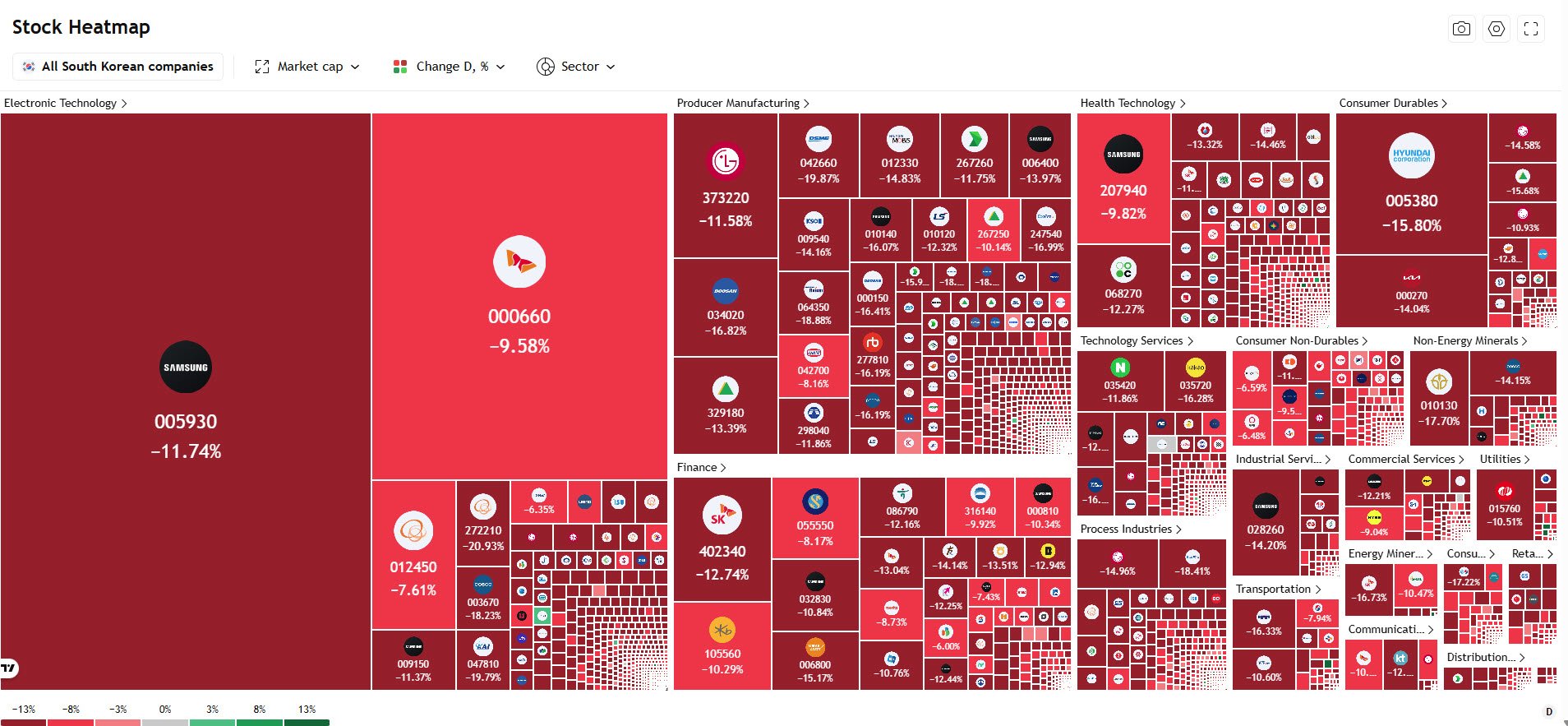 According to strategists, Asia’s acute exposure to Middle Eastern oil flows makes the region especially sensitive to energy price spikes. Rising crude, a stronger US dollar, and geopolitical uncertainty have created what one analyst called a “toxic cocktail” for risk assets. Oil Surge Intensifies Market Anxiety Oil prices extended gains as attacks continued across the region. Brent crude climbed above $82 per barrel after rallying roughly 12% over two days , the largest surge since 2020. West Texas Intermediate hovered near $76. The rapid move reflects fears of supply disruptions after Iraq began shutting major oil fields and Saudi storage facilities filled rapidly. The effective closure of Hormuz has severely disrupted tanker traffic. Insurance costs for shipping have surged, potentially adding $5–$15 per barrel in transport-related expenses. President Donald Trump announced that the US would provide political risk insurance and, if necessary, naval escorts to tankers transiting the strait. However, analysts caution that naval escorts may themselves become targets, limiting the effectiveness of the plan. Brent’s prompt spread widened to $3.38 in backwardation , a strong signal of immediate supply tightness. 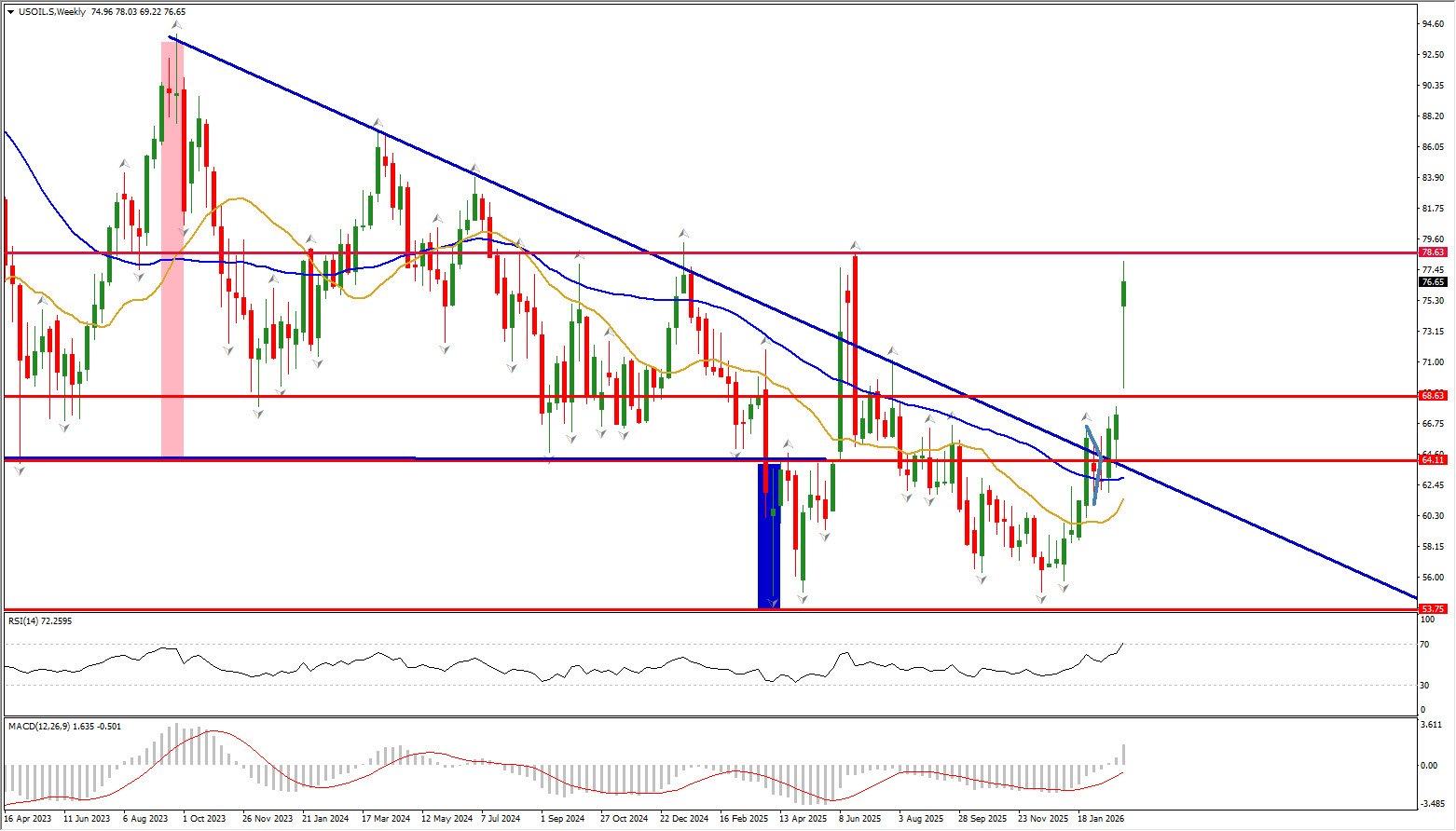 Dollar Strength Adds Pressure The Bloomberg Dollar Spot Index posted its strongest two-day gain in nearly a year before stabilizing. Asian currencies fell to their weakest levels since January, though China intervened to anchor the yuan. A stronger dollar compounds stress for Asian economies by: * Raising import costs * Increasing debt servicing pressure * Tightening financial conditions US Treasury yields climbed as inflation fears resurfaced, with the 10-year yield hovering around 4.07%. Why This Shock Feels Different Markets previously relied on what traders dubbed the “TACO trade” , short for “Trump Always Chickens Out” , a belief that sharp market declines would prompt policy reversals. This conflict, however, is military in nature and carries unpredictable escalation risks beyond traditional policy maneuvering. Investors cannot price a clear endgame, raising fears of a prolonged disruption to global energy flows. Inflation Risk Returns:Higher oil prices threaten to reintroduce inflation pressures globally. In the US, gasoline prices have already risen to $3.11 per gallon on average. A sustained energy shock could complicate plans by the Federal Reserve to cut rates in 2026, potentially keeping borrowing costs elevated and pressuring equities further. 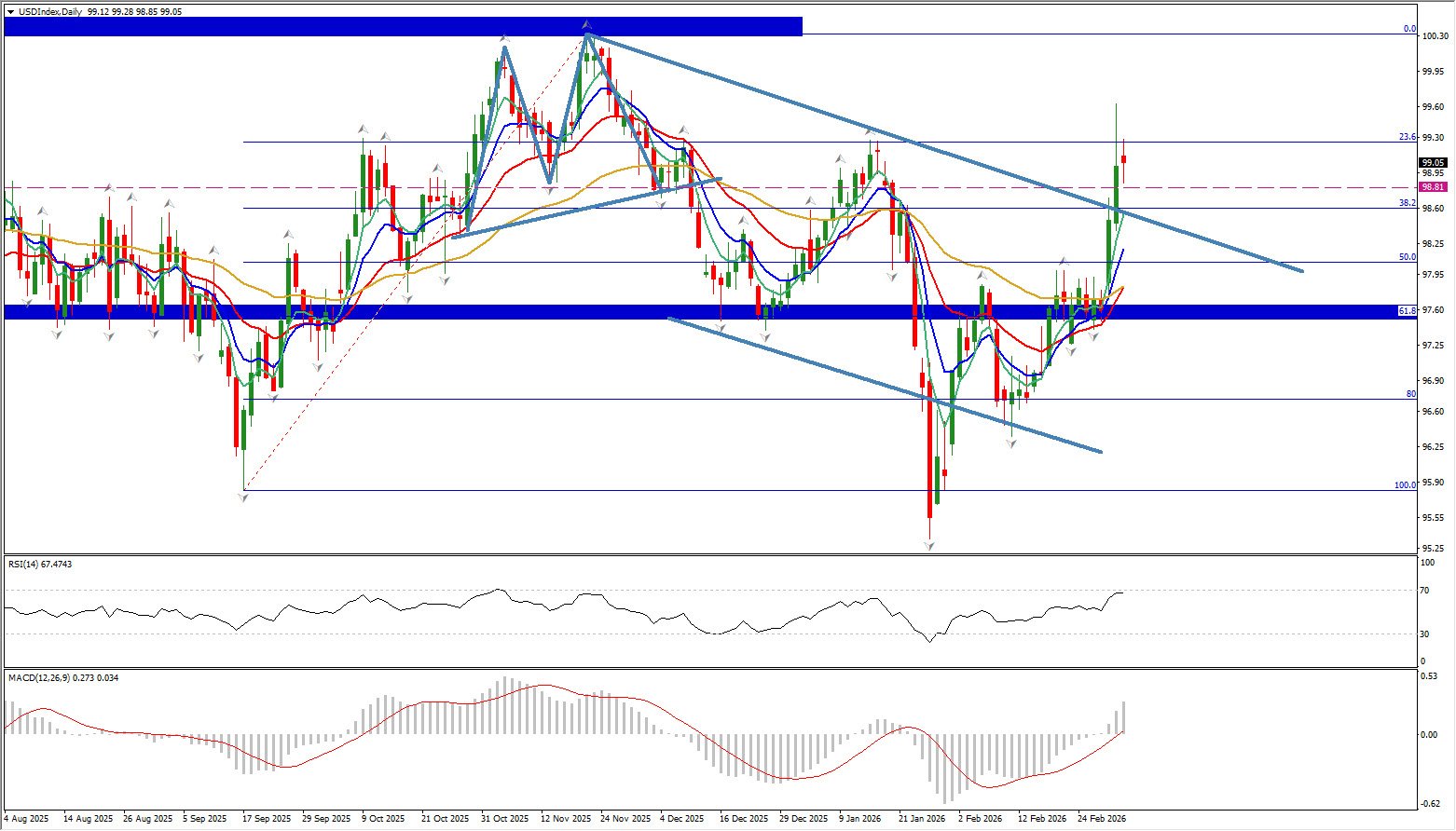 Is This Capitulation or Contained Panic? Despite the sharp selloff, futures point to only modest weakness in the US and potential stabilization in Europe, suggesting for now the shock remains concentrated in Asia. Importantly, Asian stocks remain up approximately 4.7% year-to-date after a 25% surge in 2025, meaning some of the move reflects profit-taking from extended positioning. However, markets remain highly headline-driven. If oil continues to climb or Hormuz disruptions worsen, further downside in Asia appears likely. For now, traders are watching three key indicators: 1. Crude oil stability above $80 2. Confirmation of tanker traffic resuming 3. Dollar strength persistence Until clarity emerges, volatility is likely to remain elevated , particularly in energy-dependent Asian markets. Always trade with strict risk management. Your capital is the single most important aspect of your trading business. Please note that times displayed based on local time zone and are from time of writing this report. Click HERE to access the full HFM Economic calendar. Want to learn to trade and analyse the markets? Join our webinars and get analysis and trading ideas combined with better understanding of how markets work. Click HERE to register for FREE! Click HERE to READ more Market news. Andria Pichidi HFMarkets Disclaimer: This material is provided as a general marketing communication for information purposes only and does not constitute an independent investment research. Nothing in this communication contains, or should be considered as containing, an investment advice or an investment recommendation or a solicitation for the purpose of buying or selling of any financial instrument. All information provided is gathered from reputable sources and any information containing an indication of past performance is not a guarantee or reliable indicator of future performance. Users acknowledge that any investment in Leveraged Products is characterized by a certain degree of uncertainty and that any investment of this nature involves a high level of risk for which the users are solely responsible and liable. We assume no liability for any loss arising from any investment made based on the information provided in this communication. This communication must not be reproduced or further distributed without our prior written permission.
|
|
#512
05-03-2026, 10:56
|
||||
|
||||
|
Re: HFMarkets (hfm.com): Market analysis services.
Date: 5th March 2026.
EURJPY Under Pressure as Yen Gains Safe-Haven Demand. Trading Leveraged products is Risky The global currency market today witnessed significant turmoil in the EURJPY pair. Trading above 182.00, the pair recorded a daily decline of 0.24%. Although the euro has strengthened 14.19% cumulatively over the past 12 months against the yen, short-term momentum is showing signs of exhaustion, with a correction of 1.83% over the past four weeks. This movement reflects the tug-of-war between strong domestic economic data in Europe and the yen's role as a safe-haven amidst escalating conflicts in the Middle East. European Economic Resilience and the Challenge of Disinflation In the Eurozone, recent economic data has provided complex mixed signals for the European Central Bank (ECB). Germany, the region's economic engine, performed solidly, with the HCOB Services PMI surging to 53.5 in February. Collectively, the Eurozone composite index reached a three-month high, signaling a faster-than-expected output acceleration at the start of the year. However, this growth was accompanied by a return of inflationary pressures. Core HICP data surged to 2.4% year-on-year, exceeding market expectations and the previous month's figure. This condition has forced market participants to drastically revise their monetary policy expectations. While last week, interest rate cuts were still the main topic of discussion, the market now estimates a 40% probability of the ECB raising rates before the end of the year. Japanese Yen: Taking Refuge Amid Geopolitical Uncertainty On the other hand, the Japanese Yen has received strong support from its status as a hedge. Military escalation in the Middle East, including reports of direct US involvement in the conflict with Iran, has prompted investors to shift to the Yen. Although Finance Minister Satsuki Katayama stated that he was monitoring the Yen's decline with ‘high urgency’ and left open the possibility of intervention, geopolitical pressures have instead given the Japanese currency a boost, strengthening below 157 per dollar. Bank of Japan (BoJ) Governor Kazuo Ueda, in his statement to parliament, emphasized that while the path to interest rate normalization remains open, external factors such as global conflicts could have a material impact on Japan's domestic economy. Nevertheless, market expectations for a BoJ interest rate hike in April remain stable at 15 basis points, signaling investor confidence that the era of low interest rates in Japan is coming to an end. 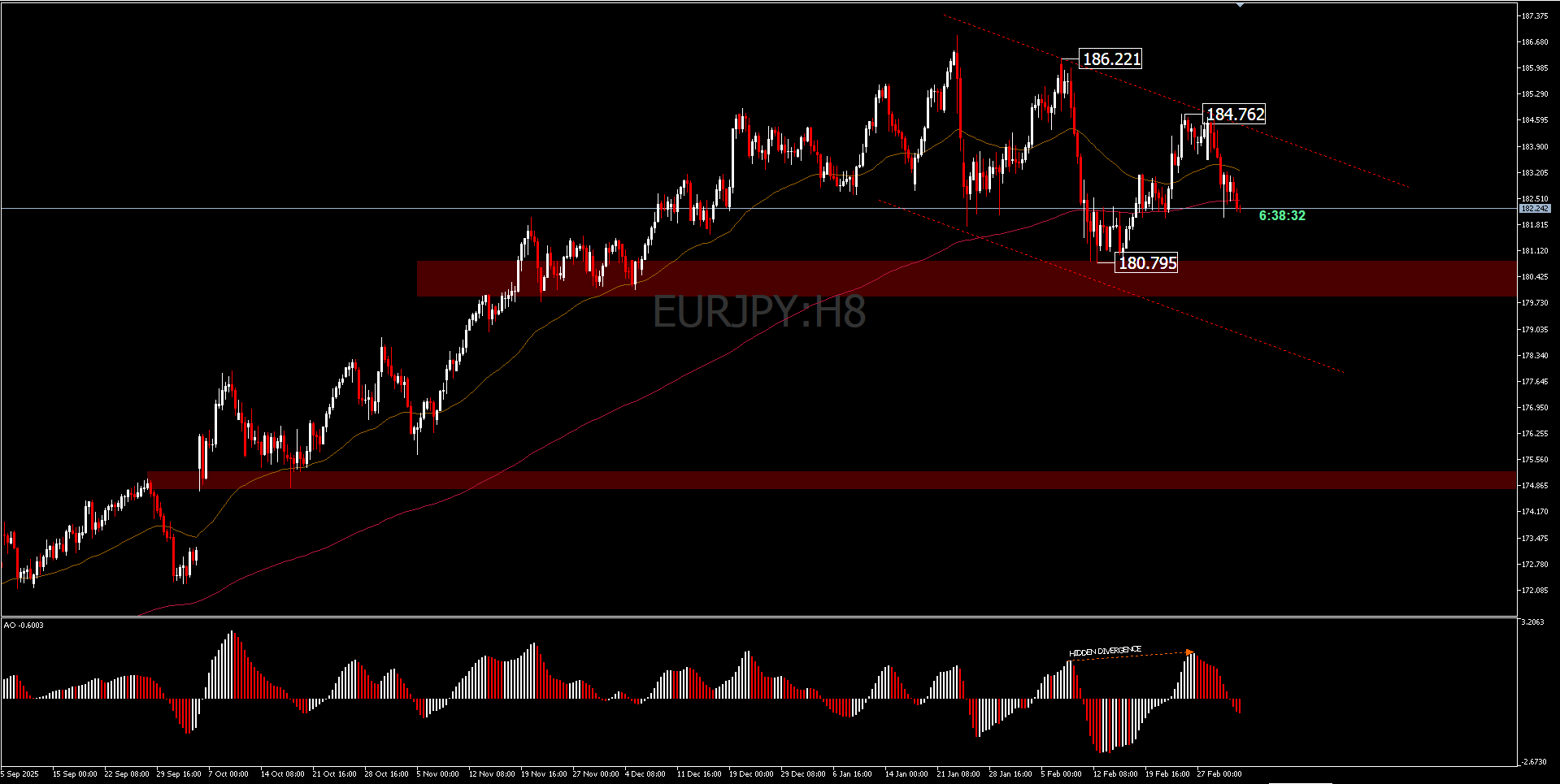 Technical Projection and Market Direction Technically, the intraday bias for EURJPY is currently neutral, with a focus on two key levels. In a bullish scenario, a break above 184.76 would open the way to 186.22, which, if surpassed, would confirm the continuation of the long-term uptrend. Conversely, in a bearish scenario, if the pair breaks through strong support at 180.79, this would signal that the current decline is not merely a short-term fluctuation, but rather a major correction of the long rally that began at 154.77, turning the medium-term outlook negative. Always trade with strict risk management. Your capital is the single most important aspect of your trading business. Please note that times displayed based on local time zone and are from time of writing this report. Click HERE to access the full HFM Economic calendar. Want to learn to trade and analyse the markets? Join our webinars and get analysis and trading ideas combined with better understanding of how markets work. Click HERE to register for FREE! Click HERE to READ more Market news. Ady Phangestu HFMarkets Disclaimer: This material is provided as a general marketing communication for information purposes only and does not constitute an independent investment research. Nothing in this communication contains, or should be considered as containing, an investment advice or an investment recommendation or a solicitation for the purpose of buying or selling of any financial instrument. All information provided is gathered from reputable sources and any information containing an indication of past performance is not a guarantee or reliable indicator of future performance. Users acknowledge that any investment in Leveraged Products is characterized by a certain degree of uncertainty and that any investment of this nature involves a high level of risk for which the users are solely responsible and liable. We assume no liability for any loss arising from any investment made based on the information provided in this communication. This communication must not be reproduced or further distributed without our prior written permission.
|
|
#513
06-03-2026, 11:09
|
||||
|
||||
|
Re: HFMarkets (hfm.com): Market analysis services.
Date: 6th March 2026.
Middle East War Shake Markets as Gold Rises and Stocks Attempt Rebound. Trading Leveraged products is Risky Global financial markets attempted to stabilize on Friday after a week of intense volatility triggered by the escalating conflict between Israel and Iran. While stocks rebounded modestly and precious metals advanced, energy markets remained the central focus for traders as disruptions in the Strait of Hormuz raised concerns about global oil supply. The week has been defined by sharp cross-asset swings, as geopolitical tensions collided with economic uncertainty and rising inflation risks. Stocks Rebound but Volatility Remains Equity markets showed signs of recovery on the final trading day of the week. European equity futures climbed nearly 1%, while US stock futures also moved higher after a weak session on Wall Street. In Asia, markets recovered from earlier losses, with regional shares edging about 0.2% higher as Chinese technology stocks provided support. The rebound comes after heavy losses earlier in the week. Asia’s benchmark stock index is still on track for its worst weekly performance since March 2020, having fallen more than 6% since the Iran conflict began. Markets have experienced dramatic swings during the week. South Korea’s Kospi index, for example, plunged 12% on Wednesday before rebounding nearly 10% the following day. Meanwhile, Japan’s Nikkei 225 rose 0.6%, Hong Kong’s Hang Seng gained 1.6%, and China’s Shanghai Composite advanced 0.4%. Despite Friday’s rebound, investor sentiment remains fragile as funds withdraw capital from Asian markets at the fastest pace in four years. Oil Markets Driven by Strait of Hormuz Disruptions Energy markets remain at the center of global market volatility. Oil prices surged earlier in the week amid concerns about supply disruptions caused by the war. Tanker traffic through the Strait of Hormuz, a critical shipping route that carries roughly one-fifth of the world’s seaborne oil, has nearly halted according to vessel tracking data. Although crude prices eased slightly on Friday, the market remains highly sensitive to developments in the region.Brent crude traded around $84-$85 per barrel after reaching its highest level since mid-2024 earlier this week, while US benchmark crude slipped toward $80 per barrel. Analysts warn that sustained disruptions to oil flows could push prices significantly higher. Some energy strategists believe Brent crude could climb toward the $100 level if interruptions in the Strait of Hormuz persist for several weeks. To ease supply pressures, the United States has granted a temporary waiver allowing Indian refiners to continue purchasing Russian oil, giving global markets additional supply flexibility as the Middle East conflict intensifies. Geopolitical Risks Escalate The military confrontation between Israel and Iran entered its seventh day, with missile and drone attacks reported across multiple countries in the Middle East. Iranian strikes targeted at least five regional nations, while Israel launched another wave of airstrikes on Tehran. Several governments across the region have urged citizens to seek shelter amid the escalating conflict. Diplomatic tensions remain high. Iran’s foreign minister stated that the country has not requested a ceasefire and has no plans to begin negotiations. At the same time, political rhetoric from Washington has intensified. President Donald Trump indicated he believes the United States should play a role in determining Iran’s future leadership, adding further uncertainty to the geopolitical outlook. For markets, the key question now is how long the conflict will last. Many investors still view a relatively short conflict as the base-case scenario, but the lack of diplomatic progress continues to keep traders cautious. Safe-Haven Assets Gain Ground As geopolitical tensions rise, safe-haven assets have benefited. Gold advanced about 0.7%, trading near $5,115 per ounce, while silver surged more than 2%, reflecting strong demand for defensive assets. The US dollar has also regained its safe-haven appeal, putting it on track for its strongest weekly performance since November 2024. Meanwhile, US Treasury yields were little changed ahead of a key economic release that could shape expectations for Federal Reserve policy. Focus Turns to US Jobs Data and Inflation Risks Traders are now turning their attention to the upcoming US Non-Farm Payrolls report, which could provide important clues about the future path of interest rates. Economists expect hiring to have moderated in February after strong job growth earlier in the year, while the unemployment rate is projected to remain steady. However, the inflation outlook is becoming increasingly complicated. Rising oil prices linked to the Middle East conflict could push inflation higher, particularly if energy costs remain elevated. Analysts warn that sustained increases in oil could also drive higher food prices due to rising fertilizer costs and disruptions in global trade. This combination raises the risk of stagflation, slower economic growth combined with rising inflation, a scenario that could create further turbulence for financial markets. Market Outlook: Conflict Duration Key for Traders For investors, the trajectory of the Israel-Iran conflict will likely remain the dominant driver of market sentiment in the near term. If oil supply disruptions persist or escalate, energy prices could surge further, adding pressure on global inflation and central bank policy. At the same time, equity valuations remain elevated following last year’s rally fueled by artificial intelligence optimism, leaving markets vulnerable to geopolitical shocks. As a result, traders are entering the final trading session of the week with a cautious tone, balancing hopes for a short-lived conflict against the growing risk of a prolonged geopolitical crisis. Always trade with strict risk management. Your capital is the single most important aspect of your trading business. Please note that times displayed based on local time zone and are from time of writing this report. Click HERE to access the full HFM Economic calendar. Want to learn to trade and analyse the markets? Join our webinars and get analysis and trading ideas combined with better understanding of how markets work. Click HERE to register for FREE! Click HERE to READ more Market news. Andria Pichidi HFMarkets Disclaimer: This material is provided as a general marketing communication for information purposes only and does not constitute an independent investment research. Nothing in this communication contains, or should be considered as containing, an investment advice or an investment recommendation or a solicitation for the purpose of buying or selling of any financial instrument. All information provided is gathered from reputable sources and any information containing an indication of past performance is not a guarantee or reliable indicator of future performance. Users acknowledge that any investment in Leveraged Products is characterized by a certain degree of uncertainty and that any investment of this nature involves a high level of risk for which the users are solely responsible and liable. We assume no liability for any loss arising from any investment made based on the information provided in this communication. This communication must not be reproduced or further distributed without our prior written permission.
|
|
#514
09-03-2026, 12:10
|
||||
|
||||
|
Re: HFMarkets (hfm.com): Market analysis services.
Date: 09th March 2026.
Attacks on Iran’s Oil Facilities Spark Panic Across Global Markets. Trading Leveraged products is Risky The latest strike on Iran’s oil facilities and energy infrastructure sent oil prices close to $120 per barrel. After the recent spike early this morning, oil rose to the highest level in almost four years. The higher oil prices as well as Friday’s poor employment data are triggering a clear domino effect in the market. Since Friday’s employment data was released and oil prices became volatile this morning, the stock market has taken the biggest hit. Demand for the US Dollar has increased. Investors are opting to invest in safe-haven assets and are pricing in higher interest rates for 2026. Middle East Conflict The conflict between Iran and the US-Israel coalition is intensifying as the war enters its second week. As the conflict enters its second week and the coalition does not seem to be able to achieve its goals without putting troops on the ground, investor confidence is deteriorating. Missile and drone attacks have hit oil facilities, desalination plants, and infrastructure across the region. The conflict is spreading across several Middle Eastern countries and threatening global energy supply. The main concern for investors is that the Strait of Hormuz remains closed, reducing oil supply by 20% and particularly impacting Asian countries. 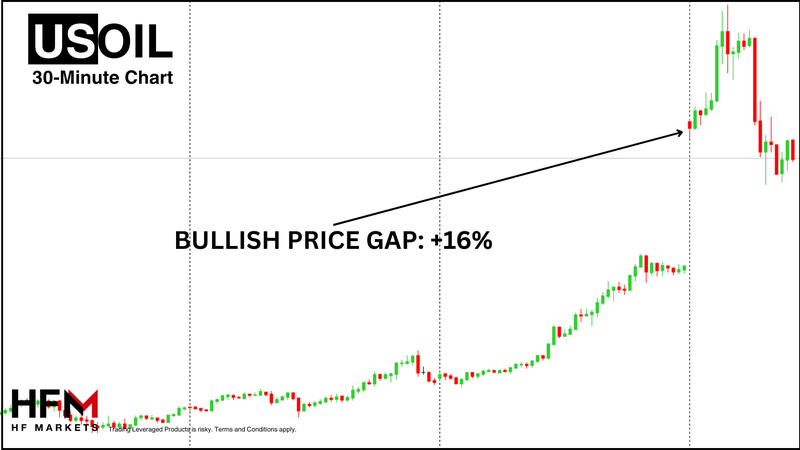 HFM - Crude Oil 30-Minute Chart How will the Seven Leading Economies React? How will the Seven Leading Economies React? Poor US Non-Farm Payroll Jobs fell by 92,000, while economists expected an increase of 58,000. In January, job growth was 126,000, revised down from 130,000. The unemployment rate rose from 4.3% to 4.4%. The healthcare sector, which usually drives hiring, lost 19,000 jobs. This was mainly due to protests by medical workers. They are demanding changes to staffing policies, higher wages, and better working conditions. Around 31,000 healthcare workers temporarily stopped working during the protests. Normally, the lower employment data would positively impact the stock market as investors would expect frequent rate cuts. However, as the Federal Reserve is unlikely to cut interest rates, the market was hoping for strong figures to boost confidence. Currently, the poor figures indicate a weakening stock market and a stronger Dollar. Because of this uncertainty, investors are watching comments from Fed officials closely. Neel Kashkari, president of the Federal Reserve Bank of Minneapolis, said the conflict between the United States and Iran has increased economic uncertainty. Earlier, he expected at least one rate cut this year. Now he prefers a ‘wait-and-see’ approach. John Williams, president of the Federal Reserve Bank of New York, said the Fed could ease policy if inflation keeps falling toward 2%. He also expects the United States economy to grow about 2.5% this year. Growth should be supported by government spending and strong financial conditions. Investment in artificial intelligence (AI) is also expected to support expansion. 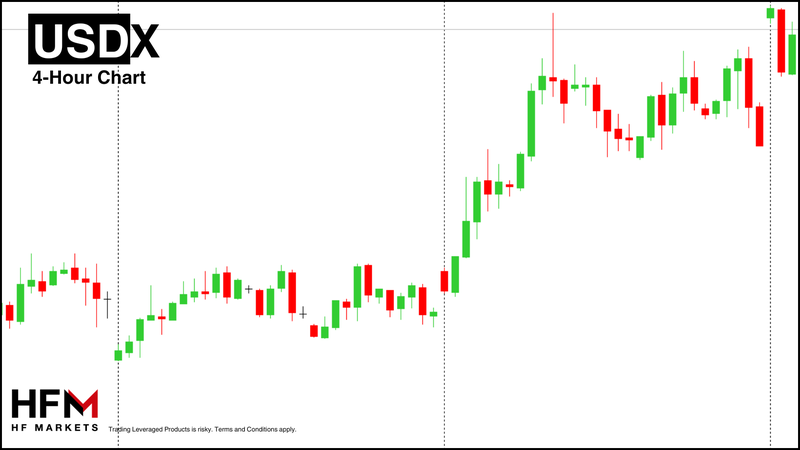 HFM - US Dollar Index 4-Hour Chart The Outcome of a Long-Term Conflict Analysts advise that if the conflict continues in the long term, oil prices and the market’s lower risk appetite will negatively impact stocks. Some analysts advise the NASDAQ may even fall to $20,000 in 2026. While the ‘winners’ of the development will remain both the US Dollar and Gold, although investors advise the performance of the Dollar and Gold will also be tied to rate hikes. Key Takeaways: * Strikes on Iran’s energy infrastructure pushed oil near $120 per barrel, the highest level in almost four years. * Global stocks fell sharply, while investors increased demand for the US Dollar and other safe-haven assets. * The Strait of Hormuz closure is a major concern. About 20% of global oil supply could be disrupted, heavily affecting energy markets. * Weak US employment data added pressure on markets. Jobs fell by 92,000, unemployment rose to 4.4%, and the data suggests weakening economic momentum. * Central banks may keep interest rates higher for longer. The Federal Reserve may abandon rate cuts in 2026, while the European Central Bank could raise rates to control inflation. Always trade with strict risk management. Your capital is the single most important aspect of your trading business. Please note that times displayed based on local time zone and are from time of writing this report. Click HERE to access the full HFM Economic calendar. Want to learn to trade and analyse the markets? Join our webinars and get analysis and trading ideas combined with better understanding of how markets work. Click HERE to register for FREE! Click HERE to READ more Market news. Michalis Efthymiou HFMarkets Disclaimer: This material is provided as a general marketing communication for information purposes only and does not constitute an independent investment research. Nothing in this communication contains, or should be considered as containing, an investment advice or an investment recommendation or a solicitation for the purpose of buying or selling of any financial instrument. All information provided is gathered from reputable sources and any information containing an indication of past performance is not a guarantee or reliable indicator of future performance. Users acknowledge that any investment in Leveraged Products is characterized by a certain degree of uncertainty and that any investment of this nature involves a high level of risk for which the users are solely responsible and liable. We assume no liability for any loss arising from any investment made based on the information provided in this communication. This communication must not be reproduced or further distributed without our prior written permission.
|
|
#515
10-03-2026, 12:09
|
||||
|
||||
|
Re: HFMarkets (hfm.com): Market analysis services.
Date: 10th March 2026.
Gold Climbs: Will Gold Stay Within Its Current Trading Range? Trading Leveraged products is Risky President Trump’s comments regarding a possible end to the Middle East conflict have calmed investors. Crude oil prices fell back to similar prices seen on Friday ($85) and the stock market rose close to last week’s highs. Investors are positively reacting to G7 nations advising that they will release part of their oil reserves to boost supply. Market sentiment also found support from Trump's comments about the Strait of Hormuz becoming operational again. However, investors are concentrating on Trump’s comments regarding the conflict ending ‘very soon’. Analysts advise that the US administration is attempting to find a way out of the conflict. Gold Prices Re-Establish Clear Correlation with the US Dollar The price of Gold rose 1.70% over the past 24 hours due to the value of the US Dollar declining. The need for safe-haven assets remains as investor confidence has not returned to healthy levels. At the same time markets do not trust any guidance given by the US President though it has been enough to create a change in trend amongst most asset categories. The price of the US Dollar is supporting higher Gold prices as are Silver and other metals. The US Dollar Index has fallen 1.23% and Silver was one of the first leading indicators signalling Gold could rebound at the $5,000 psychological price. On Monday, while Gold was declining Silver was maintaining its value and rose thereafter, indicating Gold may rebound. The decline in the US Dollar Index further validated this indicating upward price movement which has indeed materialised. Silver remains key for the analysis of Gold due to its strong correlation. According to the Silver Institute, the global silver market has entered its sixth consecutive year of structural deficit. Analysts project a 67M-ounce shortfall for 2026, while the cumulative deficit from 2021–2025 has already exceeded 800M ounces, roughly one year of global mine production. Investment demand remains the key growth driver. Physical coin and bar demand may rise 20% to 227M ounces, a three-year high. Returning Western investors and steady demand from India are supporting this growth. Meanwhile, industrial demand may fall about 2% to 650M ounces, a four-year low. Higher silver prices, often $25–$30 per ounce, are weighing on demand. Manufacturers are optimising usage and reducing silver content without affecting product performance. The correlation between Gold and the Dollar is indicating a slight risk. Gold is maintaining range-bound trading conditions staying within the $5,000 to $5,199 range. However, the US Dollar has formed a bearish breakout falling below its previous range. Therefore, there is a slight sense of divergence and limitation to Gold’s bullish possibilities in the short term. This may also indicate that the US Dollar is oversold. Like Silver, higher prices are making investors more cautious, but tomorrow’s US Consumer Price Index will be a key price driver nonetheless. For this reason, investors need to stay vigilant as the price rises to $5,200. Though according to the 200-Bar SMA, buy signals will remain as long as the price remains above $5,145. 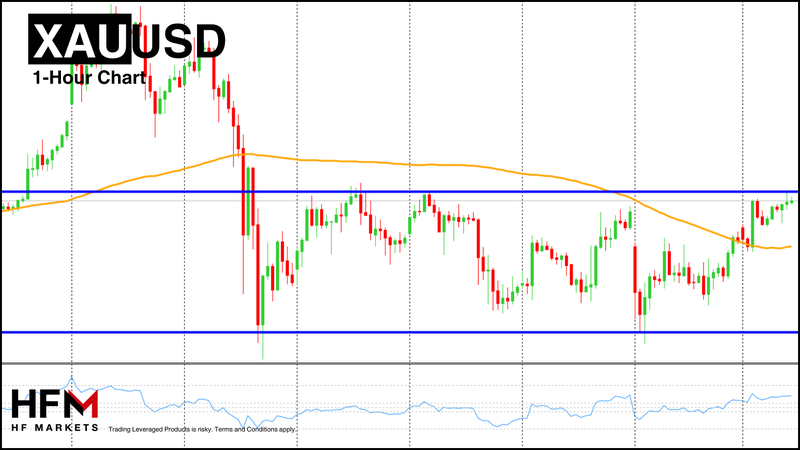 HFM - XAUUSD 1-Hour Chart The US Dollar Index The US Dollar Index is witnessing a strong decline as investors are reacting to Trump’s comments regarding an end to the conflict, but also to the improvement in the market’s risk appetite. The Dollar is the worst performing currency of the day, while the best performing is the Australian Dollar and Euro. The price of the US Dollar is partially tied to the developments in the Middle East, however, this week’s calendar also has multiple price drivers. Tomorrow’s US Consumer Price Index (inflation) can create volatility as can Thursday’s Core PCE Price Index and quarterly GDP. These figures will not include aspects of the current conflict as they reflect February’s data, but they can still create volatility and trends. If these three releases read higher than expectations, the price of the Dollar can find further support. 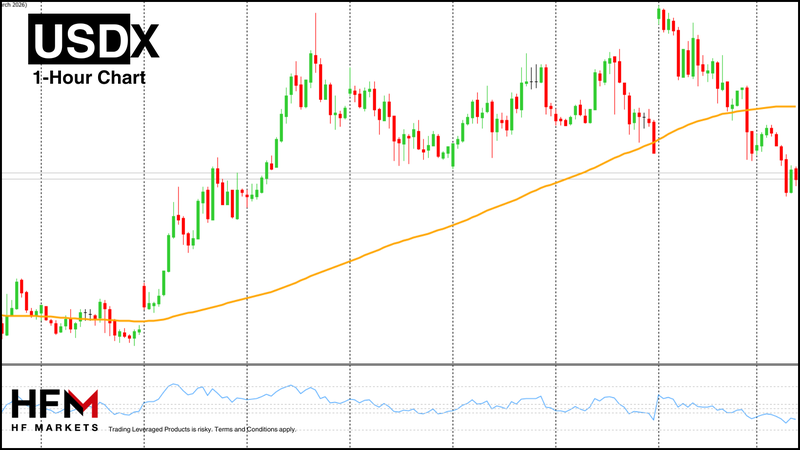 HFM - USDX 1-Hour Chart Key Takeaways: * Markets rise after President Trump signals the Middle East conflict could end soon, improving global investor sentiment. * Oil prices fall toward $85 as G7 nations plan to release reserves and supply concerns ease. * Gold gains 1.7% as the US dollar weakens and investors maintain demand for safe-haven assets. * The Silver market remains in structural deficit, with a projected 67M-ounce shortfall in 2026. * Upcoming US CPI data may drive volatility in the dollar, gold, and broader financial markets. Always trade with strict risk management. Your capital is the single most important aspect of your trading business. Please note that times displayed based on local time zone and are from time of writing this report. Click HERE to access the full HFM Economic calendar. Want to learn to trade and analyse the markets? Join our webinars and get analysis and trading ideas combined with better understanding of how markets work. Click HERE to register for FREE! Click HERE to READ more Market news. Michalis Efthymiou HFMarkets Disclaimer: This material is provided as a general marketing communication for information purposes only and does not constitute an independent investment research. Nothing in this communication contains, or should be considered as containing, an investment advice or an investment recommendation or a solicitation for the purpose of buying or selling of any financial instrument. All information provided is gathered from reputable sources and any information containing an indication of past performance is not a guarantee or reliable indicator of future performance. Users acknowledge that any investment in Leveraged Products is characterized by a certain degree of uncertainty and that any investment of this nature involves a high level of risk for which the users are solely responsible and liable. We assume no liability for any loss arising from any investment made based on the information provided in this communication. This communication must not be reproduced or further distributed without our prior written permission.
|
|
#516
11-03-2026, 12:34
|
||||
|
||||
|
Re: HFMarkets (hfm.com): Market analysis services.
Date: 11th March 2026.
AUD Leads All Currencies as the Dollar Loses Momentum. Trading Leveraged products is Risky As the US-Israel-Iran conflict continues for an 11th day, many assets are stabilising, but currencies continue to witness high volatility. The US Dollar saw significant gains in the first few days of the conflict, but has been unable to maintain momentum. The Australian Dollar remains the best-performing currency as investors are attracted by the country’s hawkish monetary policy, strong economic data, and limited exposure to the Middle East conflict. With gold prices rising, the Australian Dollar is increasingly viewed as a safer option. Australian Dollar The Australian Dollar has risen 7.40% in 2026 so far, significantly ahead of other currencies. The second-best performing is the New Zealand Dollar, which is up 2.85% in 2026. 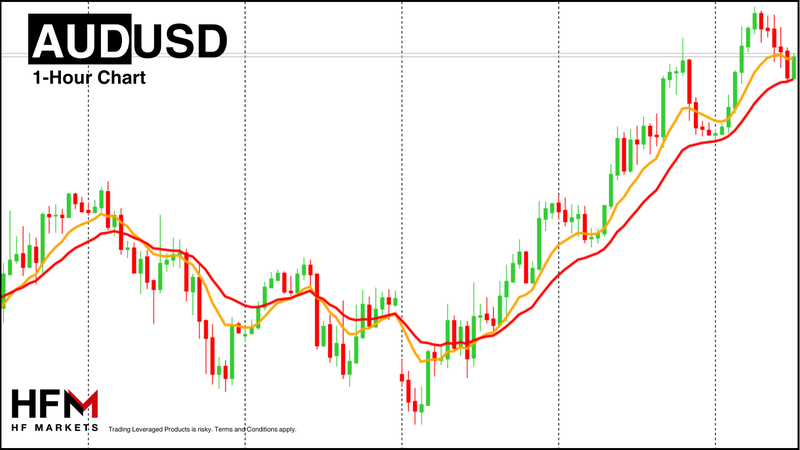 HFM - AUDUSD 1-Hour Chart Consumer sentiment data from the country’s largest bank, Westpac Banking Corp., showed a modest improvement today. The index rose by 1.2% to 91.6 points, following a 2.6% decline in the previous month. Within the report, the household financial conditions sub-index increased by 1.8%, while the timing of major purchases sub-index rose by 4.9%. Meanwhile, the National Australia Bank (NAB) business confidence index, based on a survey of 350 companies and reflecting current business sentiment, came in at 7.0 points. Market attention has also focused on recent comments from RBA Deputy Governor Andrew Hauser, who indicated that the board is expected to discuss the possibility of a further interest rate hike at the upcoming meeting, as uncertainty surrounding the escalation of the Middle East conflict remains elevated. The Australian Dollar was extremely shorted between 2010 and 2020, and investors are now aiming to unwind some of these previous trades. As a result, these moves support the Australian Dollar. Many investors see Australia as being less at risk of trade conflicts, tariffs and geopolitical tensions. Lastly, the Australian Dollar is also finding support from higher Gold prices, which are trading almost 19% up in 2026. Traders who are looking to trade the Australian Dollar against a weaker currency than the US Dollar. The USDJPY is also witnessing similar price movements and less conflict. The Japanese Yen is the worst-performing currency of 2026. The US Dollar The US dollar is trading around 98.7 on the USDX amid rising tensions in the Middle East. The tensions involve the United States and Iran. Investors fear disruptions to oil supplies through the Strait of Hormuz. The route remains blocked by Iran’s Islamic Revolutionary Guard Corps. There are also concerns about attacks on oil facilities in Persian Gulf countries. Such attacks could push inflation higher in the near term. At the same time, traders seem less responsive to statements from US President Donald Trump, who says navigation through the strait is safe. However, satellite data shows that no commercial ships have passed through the route since the start of the week. The halt in oil shipments is already affecting fuel prices in the US, which have risen to $3.34–$3.50 per gallon. This increases household costs and puts pressure on the dollar as a safe-haven asset. Economic data may also affect the US dollar’s price in the coming days. Investors will watch the US Consumer Price Index, Quarterly GDP, and Core PCE Price Index. Analysts expect today’s inflation reading to remain unchanged from last month, as it will not reflect this month’s rise in oil prices. If inflation is higher than expected, the US dollar may strengthen, while the stock market could decline. The US Dollar index has fallen back to the previous resistance level. Traders are considering whether the resistance level will flip to support. This can potentially become more likely if today’s inflation rate reads higher than previous expectations. Key Takeaways: * Currency volatility remains high due to the ongoing US–Israel–Iran conflict, even as some financial assets begin stabilising. * The Australian Dollar is the best-performing currency of 2026 (+7.4%), supported by strong economic data, hawkish monetary policy, and rising gold prices. * Investors see Australia as less exposed to geopolitical tensions, and are unwinding long-standing short positions supporting the currency. The US Dollar initially surged during the conflict, but it is not maintaining momentum as rising fuel costs weigh on sentiment. * Upcoming US inflation and GDP data may determine if the Dollar strengthens, while the Japanese Yen remains the worst-performing currency. Always trade with strict risk management. Your capital is the single most important aspect of your trading business. Please note that times displayed based on local time zone and are from time of writing this report. Click HERE to access the full HFM Economic calendar. Want to learn to trade and analyse the markets? Join our webinars and get analysis and trading ideas combined with better understanding of how markets work. Click HERE to register for FREE! Click HERE to READ more Market news. Michalis Efthymiou HFMarkets Disclaimer: This material is provided as a general marketing communication for information purposes only and does not constitute an independent investment research. Nothing in this communication contains, or should be considered as containing, an investment advice or an investment recommendation or a solicitation for the purpose of buying or selling of any financial instrument. All information provided is gathered from reputable sources and any information containing an indication of past performance is not a guarantee or reliable indicator of future performance. Users acknowledge that any investment in Leveraged Products is characterized by a certain degree of uncertainty and that any investment of this nature involves a high level of risk for which the users are solely responsible and liable. We assume no liability for any loss arising from any investment made based on the information provided in this communication. This communication must not be reproduced or further distributed without our prior written permission.
|
|
#517
12-03-2026, 11:56
|
||||
|
||||
|
Re: HFMarkets (hfm.com): Market analysis services.
Date: 12th March 2026.
Oil Tankers Hit: Iran Increases Its Retaliation Attacks Pushing Oil Higher! Trading Leveraged products is Risky Thursday is set for a risk-off sentiment as two oil tankers were hit close to the Strait of Hormuz. In response to the attack, surrounding nations also took protective measures, further reducing risk appetite. Iraq, which is a member of OPEC and the sixth-largest exporter of oil, shut down most of the country’s oil terminals. Members of the Iraqi government announced that they have suspended most operations temporarily. Oman, also ordered all ships to leave its port as a precautionary measure. The market is currently playing tug-of-war as to whether the conflict will end soon or if Iran increases its retaliatory attacks and prolongs the war. If Iran intensifies its retaliatory attacks, the US may find it difficult to de-escalate the conflict without suffering reputational damage. Currently, investors remain pessimistic, causing oil to trade higher, the stock market to dip and safe-haven assets to rise. Crude Oil - Two Tankers Attacked By Iran Sending Oil Close to $100 Per Barrel! 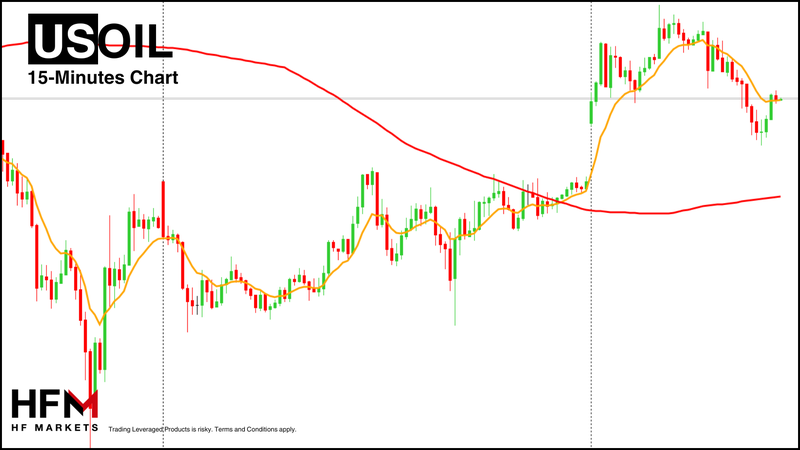 HFM - Crude Oil 15-Minute Chart The US and other major oil producers are attempting to ensure supply shocks remain at a minimum. The IEA has taken the decision to release 400 million barrels of oil in order to support supply to the market. The move does put pressure on prices, but only to a small extent, particularly if the conflict continues in the long term. According to oil analysts, 400 million barrels is a significant figure, but the flow rate to the market is a maximum of 2 million barrels per day. Therefore, it would take a minimum of 200 days for the IEA to ensure the reserves reach the market. For this reason, the move puts pressure on prices but to a smaller extent due to rising tensions. Oil prices opened with a bullish price gap measuring 2.85% and continued to rise to above $96. However, the price is now correcting and falling back to the day’s open price. However, even the open price of $90 per barrel remains elevated. On a two-hour timeframe the price remains above most moving averages indicating the bullish bias remains. However, up and down spikes remain frequent. On smaller timeframes such as the five-minute chart, the price of oil is showing strong bearish momentum, but the price is now at the 200-bar SMA. The 200-bar SMA can act as a support level which technical analysts will be following closely. If the price remains above $89, the short term bullish bias may remain, particularly if Iran continues to attack oil supply chains. Gold - Gold Rises Despite Dollar Pressures The price of Gold fell in the early hours of the Asian session as traders reacted to an expensive Dollar. However, as the need for safe-haven assets became apparent, the price of Gold rose. The US inflation release on Tuesday afternoon was modestly positive, as inflation remained relatively stable and low. However, this data predates the recent surge in oil prices, which have since risen to a four-year high. The US inflation rate remained at 2.4%. Silver and Palladium are also increasing in value indicating the price of Gold may remain high. The main concern for Gold buyers is the US Dollar which also rose this morning. For buy signals to remain valid for Gold, technical analysts will be looking for the US Dollar Index to remain below 99.00. NASDAQ - Stocks Temporarily Rise But Cannot Maintain Momentum Earlier this week, US President Donald Trump told viewers that the main phase of US operations in Iran may be coming to an end. He also said that most objectives have already been achieved. This initially improved market sentiment and increased traders’ appetite for risk assets such as stocks and higher-yield currencies. The NASDAQ rose for two consecutive days, particularly as investors wanted to take advantage of the lower entry levels. However, escalations again rise, the stock market has come under pressure. 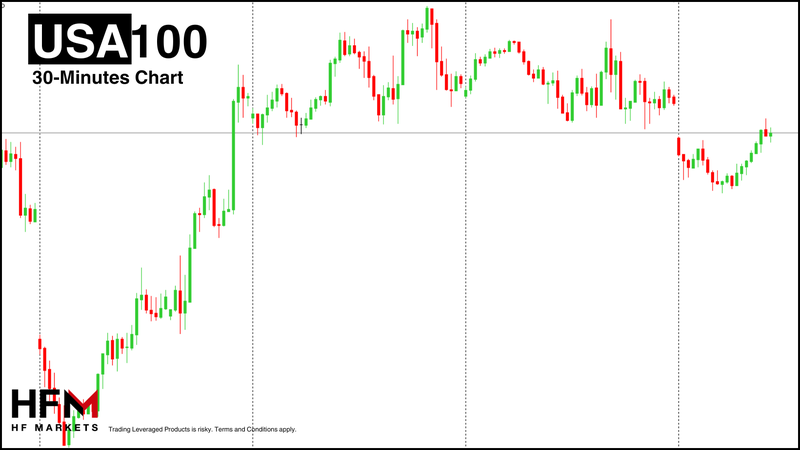 HFM - NASDAQ 30-Minute Chart Generally, the situation remains uncertain. Iranian authorities have reportedly rejected diplomatic talks and continue to maintain the blockade of the Strait of Hormuz, a key global oil shipping route. Due to this, analysts believe a quick resolution is unlikely. Some now warn that the conflict could last for several months. If disruptions to global energy supply continue, oil prices could remain elevated. This could increase inflation risks and potentially force central banks to keep interest rates higher for longer. If global central banks opt to increase interest rates and the conflict continues longer than previously projected, the stock market could fall by 13%, according to analysts. However, this is something traders will continue to monitor. Key Takeaways: * Attacks near the Strait of Hormuz and precautionary measures by Iraq and Oman increased uncertainty and boosted safe-haven demand. * Oil opened with a bullish gap and rose above $96 as markets feared disruptions to global energy supply. * The IEA plans to release 400 million barrels, but limited daily supply means the process could take about 200 days. * Gold initially fell due to a stronger US dollar but later rebounded as investors sought safe-haven assets. * The NASDAQ briefly rose on de-escalation hopes, but renewed tensions and higher oil prices may pressure stocks. Always trade with strict risk management. Your capital is the single most important aspect of your trading business. Please note that times displayed based on local time zone and are from time of writing this report. Click HERE to access the full HFM Economic calendar. Want to learn to trade and analyse the markets? Join our webinars and get analysis and trading ideas combined with better understanding of how markets work. Click HERE to register for FREE! Click HERE to READ more Market news. Michalis Efthymiou HFMarkets Disclaimer: This material is provided as a general marketing communication for information purposes only and does not constitute an independent investment research. Nothing in this communication contains, or should be considered as containing, an investment advice or an investment recommendation or a solicitation for the purpose of buying or selling of any financial instrument. All information provided is gathered from reputable sources and any information containing an indication of past performance is not a guarantee or reliable indicator of future performance. Users acknowledge that any investment in Leveraged Products is characterized by a certain degree of uncertainty and that any investment of this nature involves a high level of risk for which the users are solely responsible and liable. We assume no liability for any loss arising from any investment made based on the information provided in this communication. This communication must not be reproduced or further distributed without our prior written permission.
|
|
#518
13-03-2026, 11:09
|
||||
|
||||
|
Re: HFMarkets (hfm.com): Market analysis services.
Date: 13th March 2026.
Dollar Index Climbs to Five-Month High as Oil Volatility Dominates Markets. Trading Leveraged products is Risky Oil prices are becoming the centre of attention when analysing other assets such as the US Dollar and Gold. The US Dollar saw strong gains on Thursday and also continues to increase in value this morning. Gold, on the other hand, has fallen to a three-day low due to Dollar pressure. Analysts do not expect volatility to fall on Friday as Trump advises that the war may potentially escalate today. In addition to this, the US is due to release its latest Core PCE Price Index and quarterly Gross Domestic Product. What has Triggered the Volatility from the Past 24 Hours? Investors are closely monitoring oil prices which continue to increase in value and trades at almost $100 per barrel. The IEA decided to release a record number of barrels from its reserves. However, prices remain elevated despite the US allowing more Russian oil purchases. Yesterday evening, the US issued a second authorisation allowing buyers to receive Russian oil cargoes already at sea, aiming to ease price pressure as the Middle East war continues. Another factor impacting the price action is the upcoming Federal Reserve meeting which is only five days away. Investors have almost completely removed any possibility of a rate cut this month or in April. A small percentage of analysts even believe the Federal Reserve will increase interest rates by 0.25%. EURUSD - US Dollar Rises As the ECB Indicates No Rate Hikes! Due to market expectations regarding the Fed’s monetary policy, the US Dollar is now trading close to a five-month high. The US Dollar is the day’s best performing currency and is still trading 0.50% below resistance levels. The Euro, on the other hand, is one of this week’s worst performing currencies. In addition to this the Dollar found support from oil prices, inflation and the Fed’s hawkish monetary policy. The European Central Bank is also supporting the US Dollar with its latest comments. Previously, economists were expecting the ECB to increase interest rates on two occasions this year due to higher inflation. However, members of the ECB have told journalists that this is far from reality. Officials have said they are not rushing to change interest rates, even with market volatility and rising oil prices. The head of the French Central Bank advises that inflation remains low enough that even with a moderate increase there may not be a need to respond in the short term. Due to the ECB’s dovishness, the Euro declines, but traders will continue to monitor their forward guidance. The new Iranian leader made his first public statement, offering no signs of de-escalation or willingness to negotiate. He made it clear Iran intends to keep the Strait of Hormuz closed and open additional fronts if the war continues. As a result, the chances of the conflict ending soon remain slim, supporting the US Dollar rather than Gold. Even though the price of Gold is declining, the price of the US Dollar is increasing at a faster pace. Due to this, the correlation is forming an indication of divergence which points towards the bullish trend of the Dollar losing momentum in the short term. 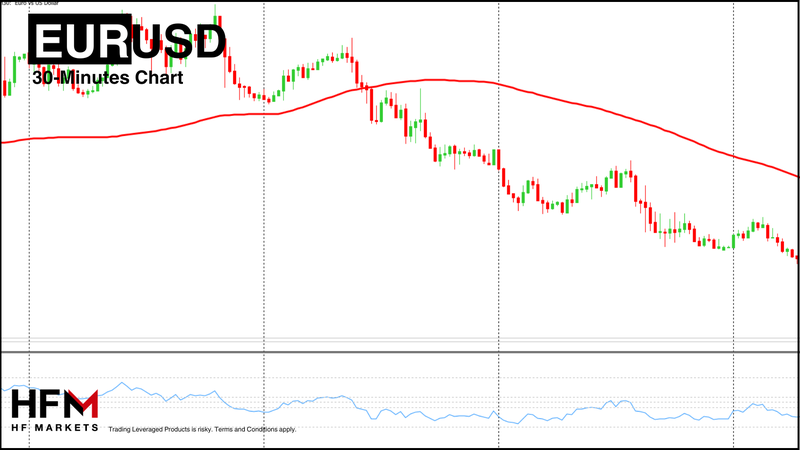 HFM - EURUSD 30-Minutes Even though the US Dollar Index is at a five-month high as mentioned above, against the Euro the Dollar is at an eight-month high. The price is clearly below the VWAP and most moving averages providing a clear bearish indication for the currency pair. Momentum-based indicators are indicating the trend will continue downwards. When monitoring the past week’s price action, the price tends to form a retracement after the price deviates away from the 100-bar SMA by 0.55%. Currently, the price is at a deviation of 0.51% and at 18 on the RSI. Both are indicating the price may be oversold. For this reason, even though momentum indications are pointing towards a further decline, traders may also expect a retracement or slight correction in the short term. Key Takeaways: * Oil prices near $100 per barrel are driving volatility across currencies and commodities. * The US Dollar strengthened, reaching a five-month high, while Gold fell to a three-day low. * Markets expect continued volatility with US Core PCE and GDP data due today. * Fed rate cut expectations have disappeared, with some analysts even expecting a 0.25% hike. * ECB dovish signals and Iran tensions are supporting the US Dollar and pressuring the Euro. Always trade with strict risk management. Your capital is the single most important aspect of your trading business. Please note that times displayed based on local time zone and are from time of writing this report. Click HERE to access the full HFM Economic calendar. Want to learn to trade and analyse the markets? Join our webinars and get analysis and trading ideas combined with better understanding of how markets work. Click HERE to register for FREE! Click HERE to READ more Market news. Michalis Efthymiou HFMarkets Disclaimer: This material is provided as a general marketing communication for information purposes only and does not constitute an independent investment research. Nothing in this communication contains, or should be considered as containing, an investment advice or an investment recommendation or a solicitation for the purpose of buying or selling of any financial instrument. All information provided is gathered from reputable sources and any information containing an indication of past performance is not a guarantee or reliable indicator of future performance. Users acknowledge that any investment in Leveraged Products is characterized by a certain degree of uncertainty and that any investment of this nature involves a high level of risk for which the users are solely responsible and liable. We assume no liability for any loss arising from any investment made based on the information provided in this communication. This communication must not be reproduced or further distributed without our prior written permission.
|
|
#519
16-03-2026, 14:24
|
||||
|
||||
|
Re: HFMarkets (hfm.com): Market analysis services.
Date: 16th March 2026.
Strait of Hormuz Crisis Shakes Markets: Oil Surges, Stocks Stabilize as Traders Watch Supply Risks. Trading Leveraged products is Risky Global financial markets entered the new trading week attempting to stabilize after a period of intense volatility driven by escalating tensions in the Middle East and disruptions to global energy supply routes. While geopolitical risks remain elevated, some assets began to retrace earlier moves as investors reassessed the immediate impact of the conflict and awaited further developments around the Strait of Hormuz, one of the world’s most critical energy corridors. Equity Markets Attempt to Recover Global equities showed signs of stabilization following several sessions of declines. Futures tied to the S&P 500 rose around 0.6%, suggesting the index could end a four-day losing streak. European equities were also expected to open higher, while Asian markets posted modest gains overall. The MSCI All Country World Index, a broad measure of global stocks, remained largely unchanged after three consecutive sessions of losses, highlighting the cautious tone that continues to dominate investor sentiment. Asian markets presented a mixed picture: * Hong Kong’s Hang Seng advanced more than 1% * South Korea’s Kospi gained roughly 0.6% * China’s Shanghai Composite slipped slightly * Japan’s Nikkei edged lower Despite the tentative rebound, equity markets remain sensitive to headlines related to the ongoing conflict and its implications for global growth and inflation. Oil Markets Swing on Supply Disruption Fears Energy markets remain at the center of the current volatility. Brent crude briefly surged above $106 per barrel, its highest level since 2022, following reports of US strikes targeting military sites on Kharg Island, a key Iranian oil export hub. Prices later retreated toward $104 per barrel, while West Texas Intermediate (WTI) traded just below the psychological $100 level. 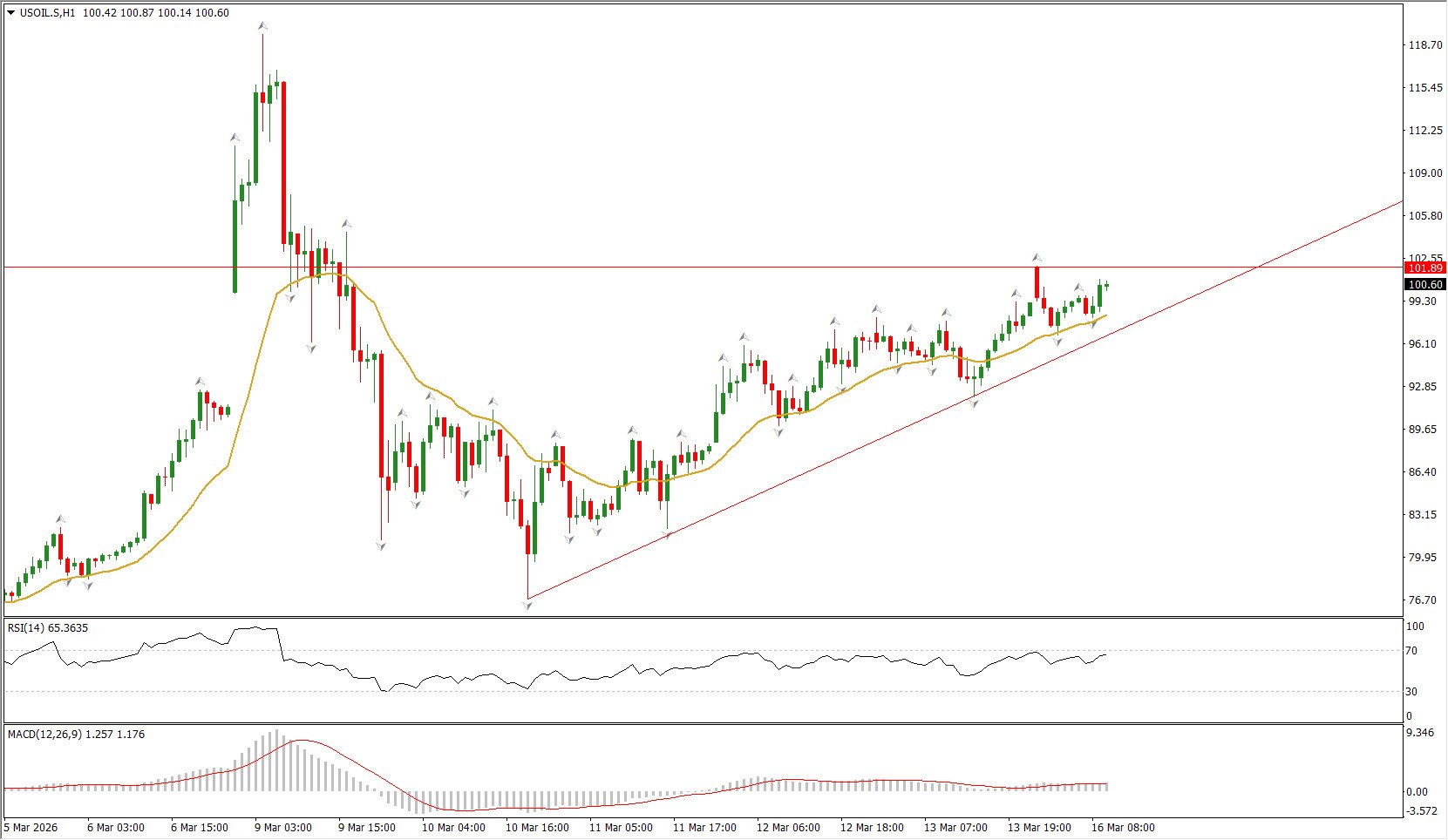 Oil prices have surged dramatically since the conflict began, rising more than 40% as traders priced in the risk of supply disruptions from the Middle East. The primary concern remains the Strait of Hormuz, through which roughly 20% of global oil and liquefied natural gas shipments typically pass. Shipping traffic through the strategic waterway dropped to zero over the weekend, marking the first complete halt since hostilities began on February 28. Under normal conditions: * Around 77 vessels cross the strait daily * The corridor carries a significant share of global energy exports from Gulf producers including Saudi Arabia, the UAE, Kuwait and Iraq. Security risks, vessel attacks and rising insurance costs have prompted many shipping companies to avoid the route entirely, amplifying fears of prolonged supply disruptions. Signs of Partial Relief for Markets Despite the tensions, several developments helped calm markets slightly. Iranian Foreign Minister Abbas Araghchi indicated that the strait had only been closed to vessels belonging to “enemy” nations, raising hopes that energy flows may not be fully disrupted. Additionally, two liquefied petroleum gas tankers successfully passed through the corridor en route to India, offering tentative evidence that shipping activity could resume under certain conditions. Meanwhile, the International Energy Agency (IEA) confirmed that oil from an unprecedented 400-million-barrel emergency stockpile release will be made available immediately to help offset supply disruptions. These measures may help ease short-term shortages, although markets remain highly sensitive to further military developments. US Dollar Weakens After Haven Rally Currency markets also reflected shifting risk sentiment. The US dollar, which had strengthened significantly during the initial escalation of the conflict, pulled back slightly as risk appetite stabilized. Bloomberg’s dollar index declined around 0.2%, with the greenback weakening against most major currencies. The euro held steady near $1.14, while the British pound traded around $1.32. Meanwhile, the Japanese yen remains under pressure despite geopolitical uncertainty, an unusual dynamic given its traditional status as a safe-haven currency. Analysts note that Japan’s heavy dependence on imported energy makes the currency particularly vulnerable to oil price shocks. With crude prices rising sharply, the yen has struggled to attract typical safe-haven flows and is trading near 160 per dollar, levels that previously triggered intervention by Japanese authorities. Bond Markets Reflect Inflation Concerns Government bond markets continue to reflect inflation worries stemming from higher energy prices. The yield on the US 10-year Treasury declined slightly to around 4.26%, snapping a five-day rise as investors sought relative safety after recent market turbulence. However, the surge in oil prices has already pushed yields higher over recent weeks, as traders worry that rising energy costs could fuel broader inflation pressures and delay potential interest rate cuts. As a result, markets now see virtually no chance of a Federal Reserve rate cut at the upcoming policy meeting, with policymakers likely to remain cautious while assessing the inflation impact of the conflict. Gold Hovers Near Historic Highs Precious metals markets have also been heavily influenced by the geopolitical environment. Gold fluctuated around the $5,000 per ounce level, reflecting a tug-of-war between safe-haven demand and rising interest rate expectations. While the metal initially rallied as tensions escalated, its momentum has slowed as investors reassess the possibility that inflation may remain elevated, forcing central banks to maintain higher borrowing costs. Even so, gold remains up roughly 16% year-to-date, supported by ongoing geopolitical risks and concerns about potential stagflation, a combination of slower economic growth and persistent inflation. 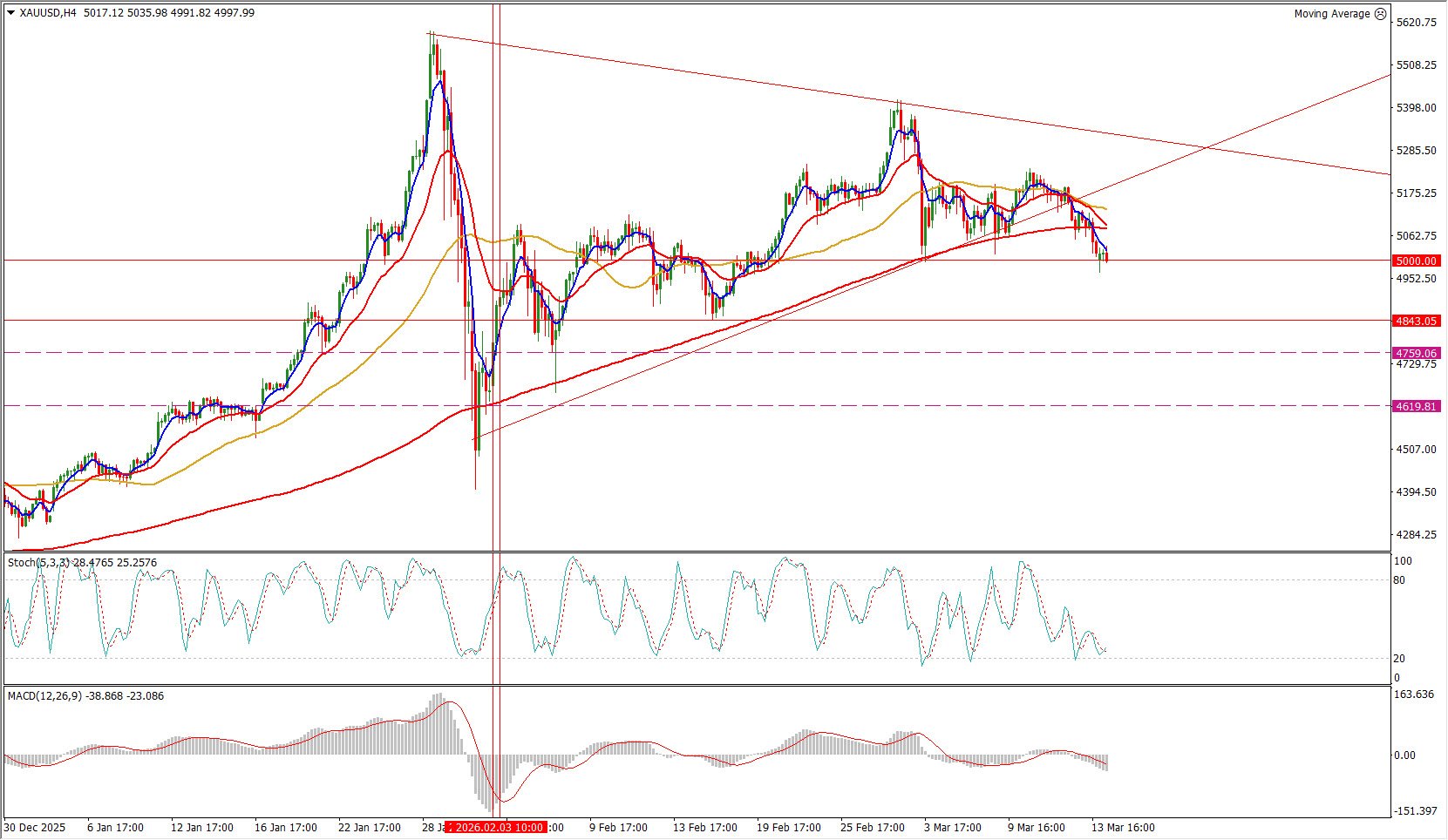 Cryptocurrency Markets Show Risk Recovery Cryptocurrency markets showed modest gains as risk sentiment improved slightly. Bitcoin rose close to 3%, trading near $73,800, while Ether climbed more than 6%, reflecting renewed speculative interest following recent market turbulence. Crypto assets have shown mixed behavior during the conflict, sometimes trading as risk assets alongside equities and at other times benefiting from broader concerns about geopolitical instability. Traders Remain Focused on the Strait of Hormuz Despite signs of stabilization across markets, uncertainty remains extremely high. The United States is reportedly working to form an international coalition to escort commercial vessels through the Strait of Hormuz in an attempt to restore shipping flows and secure the energy corridor. However, military strikes between the US and Iran continue, and officials have warned that the conflict could last four to six weeks, leaving markets vulnerable to sudden swings. For traders, the key risks to monitor in the coming days include: * Whether shipping activity resumes through the Strait of Hormuz * Any escalation targeting energy infrastructure * Further movements in oil prices above the $100 threshold * Shifts in inflation expectations affecting central bank policy With geopolitical headlines continuing to dominate market sentiment, volatility across commodities, currencies and equities is likely to remain elevated in the near term. Always trade with strict risk management. Your capital is the single most important aspect of your trading business. Please note that times displayed based on local time zone and are from time of writing this report. Click HERE to access the full HFM Economic calendar. Want to learn to trade and analyse the markets? Join our webinars and get analysis and trading ideas combined with better understanding of how markets work. Click HERE to register for FREE! Click HERE to READ more Market news. Andria Pichidi HFMarkets Disclaimer: This material is provided as a general marketing communication for information purposes only and does not constitute an independent investment research. Nothing in this communication contains, or should be considered as containing, an investment advice or an investment recommendation or a solicitation for the purpose of buying or selling of any financial instrument. All information provided is gathered from reputable sources and any information containing an indication of past performance is not a guarantee or reliable indicator of future performance. Users acknowledge that any investment in Leveraged Products is characterized by a certain degree of uncertainty and that any investment of this nature involves a high level of risk for which the users are solely responsible and liable. We assume no liability for any loss arising from any investment made based on the information provided in this communication. This communication must not be reproduced or further distributed without our prior written permission.
|
|
#520
17-03-2026, 12:20
|
||||
|
||||
|
Re: HFMarkets (hfm.com): Market analysis services.
Date: 17th March 2026.
Oil Surge and Middle East Tensions Weigh on Global Markets as Central Banks Take Focus. Trading Leveraged products is Risky Global financial markets lost momentum on Tuesday as rising geopolitical tensions in the Middle East pushed oil prices higher, dampening risk appetite and shifting investor focus toward inflation and central bank policy decisions. A brief recovery in global equities, led by technology stocks, appears to be fading, with futures pointing to a weaker open in both Europe and the United States. Market sentiment is increasingly being driven by developments in energy markets and geopolitical uncertainty rather than corporate optimism. Equities Slip as Risk Sentiment Weakens Equity-index futures indicate that both European markets and Wall Street could decline by around 0.5%, reflecting a shift toward caution among investors. Earlier optimism, particularly in the technology sector, had lifted Asian equities, which ended the session up 0.7% after trimming stronger gains. The initial boost in Asian markets was supported by positive sentiment surrounding Nvidia Corp., which helped drive technology shares higher. However, broader market direction remains fragile as macroeconomic and geopolitical risks intensify. Analysts increasingly warn that equities face mounting pressure from rising oil prices, which could simultaneously fuel inflation and push bond yields higher, creating a challenging environment for stock valuations. 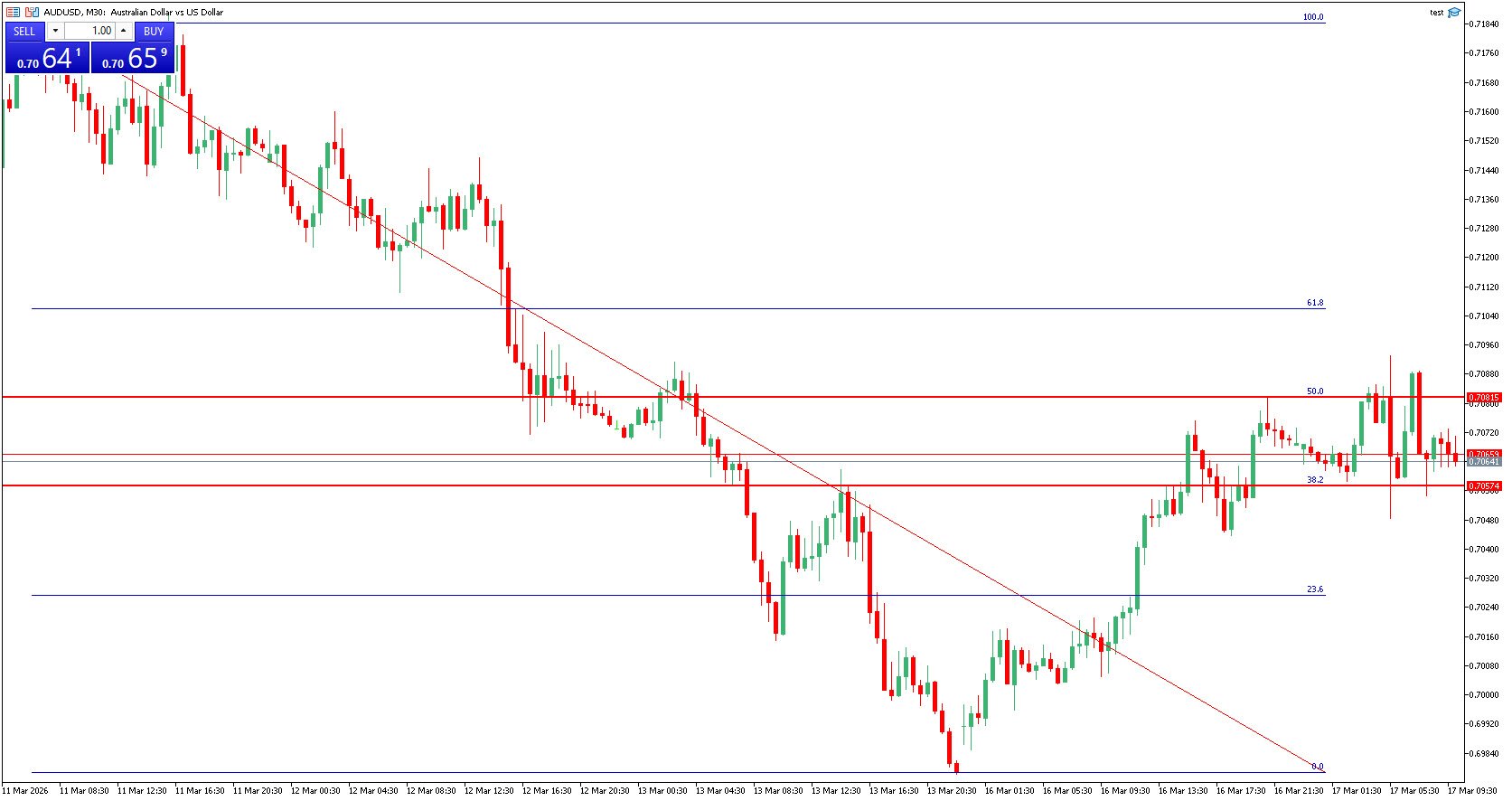 Oil Prices Surge Amid Middle East Escalation Oil markets have become the primary driver of global sentiment. Brent crude climbed nearly 4% to around $103.78 per barrel, reversing a previous decline and extending its gains since the start of the conflict. Prices remain below the peak of $119.50 but are still up nearly 50% compared to pre-conflict levels. The surge comes as Iran intensifies attacks on energy infrastructure across the Gulf region. A drone strike hit the Shah gas field in the United Arab Emirates, one of the largest in the world, while a tanker was struck near the port of Fujairah in the Gulf of Oman. Tensions have also escalated in Iraq, where a drone struck a hotel in Baghdad, prompting the US embassy to advise American citizens to leave the country. A key concern for markets remains the stability of the Strait of Hormuz, a critical route for global oil shipments. Shipping traffic through the strait has slowed significantly, although some vessels continue to transit. Notably, a Pakistan-bound tanker successfully passed through, while Iran-linked shipping activity has surged to wartime highs. Currency and Bond Markets React to Inflation Risks The US Dollar strengthened by 0.2% as investors sought safety amid rising uncertainty. Meanwhile, US Treasuries declined across the curve, with the 10-year yield rising to 4.25%, signalling expectations of persistent inflationary pressures. Gold prices also rebounded, posting their first gain in five sessions as demand for safe-haven assets increased. In foreign exchange markets, the Japanese yen weakened further, approaching the 160 level against the dollar. The currency’s decline reflects Japan’s heavy dependence on imported energy and the impact of rising oil prices on its trade balance. Central Banks Face Growing Policy Challenges The sharp increase in oil prices has complicated the outlook for global monetary policy. Investors are closely watching upcoming decisions from the Federal Reserve, European Central Bank, Bank of England, and Bank of Japan. While these central banks are widely expected to hold interest rates steady, markets are increasingly focused on forward guidance, particularly regarding inflation risks linked to higher energy prices. In contrast, the Reserve Bank of Australia has already taken a more aggressive stance, raising interest rates by 25 basis points to 4.1%, its second consecutive hike. The decision reflects growing concern over inflation driven by higher fuel costs and supply disruptions. The RBA acknowledged that the Middle East conflict has introduced significant uncertainty into the global economic outlook, warning that prolonged tensions could push inflation higher while also weighing on growth. Geopolitical Developments Add to Market Uncertainty Geopolitical risks remain elevated as Donald Trump renewed calls for international support to secure the Strait of Hormuz and suggested that military operations could expand to include further strikes on oil infrastructure. Trump also indicated that a planned summit with China’s leadership may be postponed, citing the need to remain focused on overseeing the conflict. The potential delay has raised concerns that geopolitical tensions could persist longer than anticipated, adding further pressure on global markets. Meanwhile, Iran has denied reports of diplomatic engagement with US officials, signalling limited prospects for de-escalation in the near term. 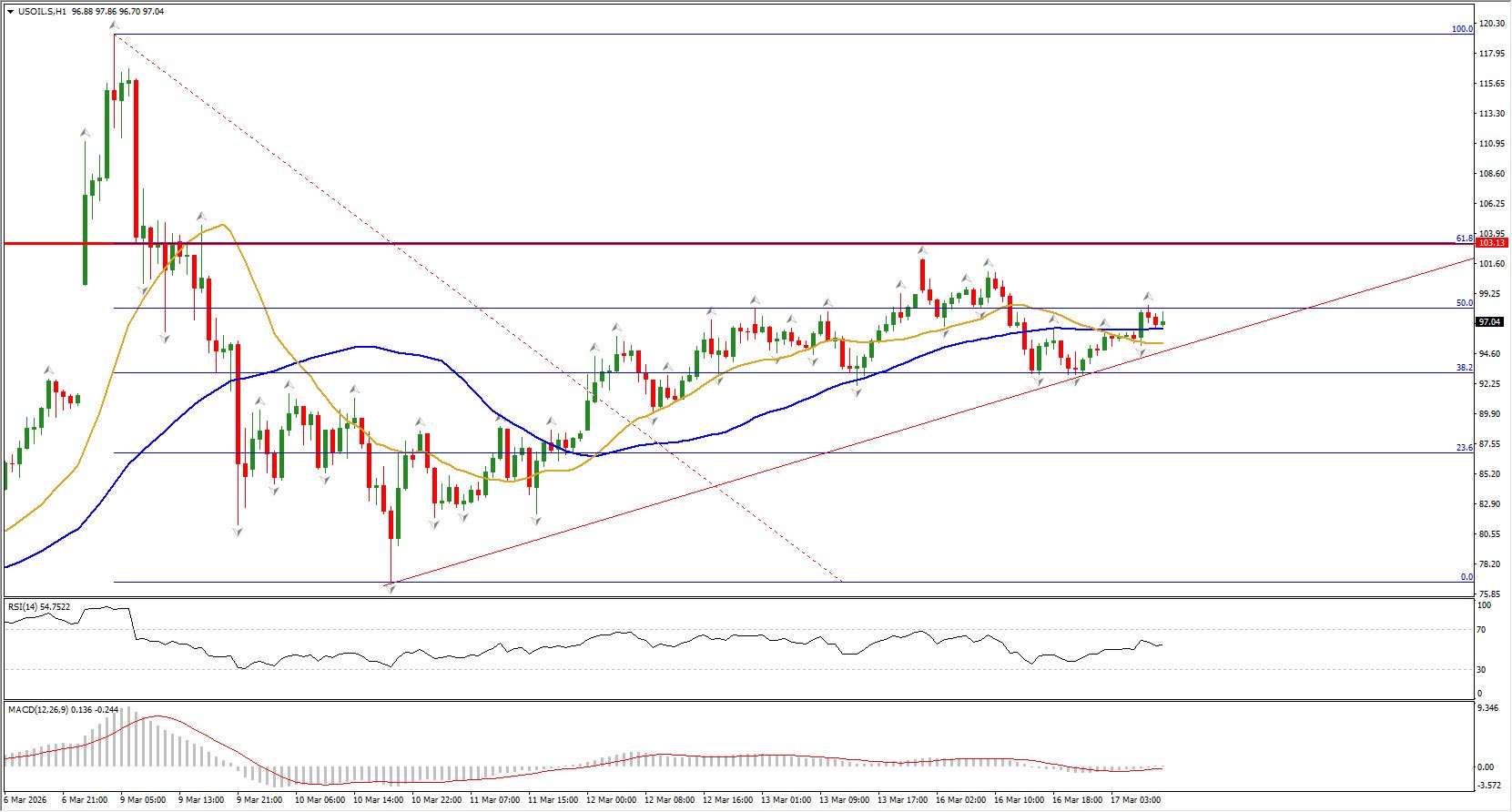 Outlook: Oil and Geopolitics to Drive Market Direction The current market environment is increasingly shaped by the interaction between geopolitical risk, energy prices, and monetary policy expectations. Higher oil prices are reinforcing inflation concerns, which in turn may limit the ability of central banks to adopt a more accommodative stance. At the same time, rising bond yields are creating additional headwinds for equities. Unless tensions in the Middle East ease or oil prices stabilise, markets are likely to remain volatile. Traders will continue to monitor developments in energy infrastructure, shipping routes, and central bank communication for clearer direction in the days ahead. Always trade with strict risk management. Your capital is the single most important aspect of your trading business. Please note that times displayed based on local time zone and are from time of writing this report. Click HERE to access the full HFM Economic calendar. Want to learn to trade and analyse the markets? Join our webinars and get analysis and trading ideas combined with better understanding of how markets work. Click HERE to register for FREE! Click HERE to READ more Market news. Andria Pichidi HFMarkets Disclaimer: This material is provided as a general marketing communication for information purposes only and does not constitute an independent investment research. Nothing in this communication contains, or should be considered as containing, an investment advice or an investment recommendation or a solicitation for the purpose of buying or selling of any financial instrument. All information provided is gathered from reputable sources and any information containing an indication of past performance is not a guarantee or reliable indicator of future performance. Users acknowledge that any investment in Leveraged Products is characterized by a certain degree of uncertainty and that any investment of this nature involves a high level of risk for which the users are solely responsible and liable. We assume no liability for any loss arising from any investment made based on the information provided in this communication. This communication must not be reproduced or further distributed without our prior written permission.
|
|
|
|
 Similar Threads
|
||||
| Thread | Thread Starter | Forum | Replies | Last Post |
| Daily Market Analysis by ForexMart | AppleFXMart | Forex Analysis | 842 | 21-02-2024 18:01 |
| Hotforex.com - Market Analysis and News. | HFblogNews | Forex Analysis | 1313 | 06-05-2022 17:20 |
| ISM Services PMI Miss Adds to Market Turmoil, Recession Risk | Forex News | Latest Industry News | 0 | 03-10-2019 19:50 |
| Use of Technical Analysis in Forex Market | optionsagent | Forex Discussion | 1 | 15-12-2012 10:10 |


